Thursday, February 17. 2011
Interview with Zach Gage
Via Rhizome
-----
By Joshua Noble on Wednesday Feb 16th, 2011
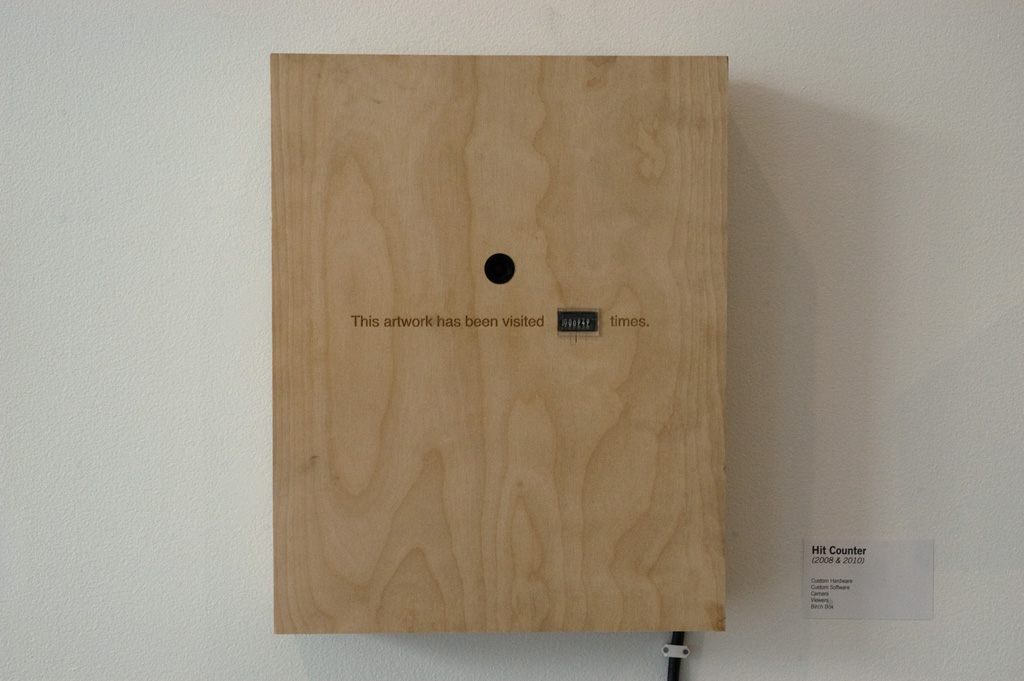
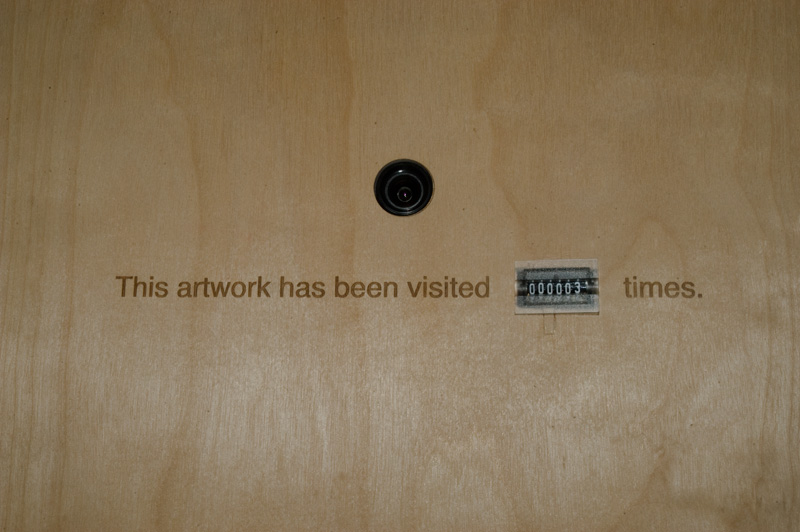
”Between the ubiquity of Internet access and the fact that data has no objective tangible form, internet users have long been plagued with the problem of determining the value of the content they are ingesting.” - Zach Gage
Seen in a certain light, the core of technological mediation has always been presence, absence, and distance. Writing established the possibility of presence during absence, arrows and gunpowder created force at a distance, the telephone created presence at distance, and network computing fundamentally altered the nature of being “absent” or “present” to an almost unrecognizable degree. No small surprise then that contemporary “media art” practice seems to return to these questions as being fundamental investigations. The question of what “presence” could be was explored and expanded throughout the dawn of the internet age: Ken Goldberg’s TeleGarden, Eduardo Kac’s concept of Telepresence, Sven Bauer, Heath Bunting, to grab but a few names. Each possibility of a new field of entry, a new method of retaining, mapping, signifying, and storing, opened a rich possibility. Now fast forward fifteen years and ever-presence is exhausting, a nuisance that forever asks and returns only the vague rewards of a slot-machine and seems to fray our sense of privacy, meaningfulness, boundary, and perhaps even self. So how then to artistically respond to this? Exhibit: Zach Gage.
His works are at once sophisticated and remarkably simple, both in presentation and concept in a way that might be recognizable to Joseph Kosuth or Lawrence Weiner, rather than the Baroque conceptual complexity on display in much media art in the 90’s. Computational art or interactive art has generally taken two tacks in dealing with the complexities of technology itself -- unabashed celebration and dystopian anxiety. At either extreme is the grandiose challenge of prediction: this possible or actual relationship to technology will lead to this consequence or benefit. The reality of living with technology is not only simpler but is often much more banal. The most refreshing element of Gage’s work is how it asks us to do nothing more than consider what is. Working with the instantly familiar data sources, Twitter, Google, chat servers, at their simplest, his work often resembles a refreshingly sharp Occam’s Razor taken to notions of the richness of data and networked experience.
His thesis show, “Data”, is an extremely visually and thematically understated installation comprised of several pieces. Small wooden boxes, wires, and simple placards: none of the forced estrangement, hand-waving interactivity, or spectacle that one associates with computer arts. In particular, one of the pieces in the show, Hit Counter stands out as particularly poignant: a simple measurement of the number of times someone has stood in front of the work. Face recognition software is used to keep track of the actual viewers and the number is displayed on an old-fashioned mechanical counter. Gage states “with no other means to judge it, Hit Counter demands to be assigned a worth based solely on its popularity.” But then, Hit Counter is not merely asking to be judged on popularity. It, like so many things in our media culture, is popularity. It’s nothing else, and it’s not any kind of popularity other than actual physical presence; a sharp reminder of the relationship between presence and popularity. No matter how many people hear about it online, what is written about it, what buzz is generated, it’s a simple box that generates a number based on how many unique people have stood in front of it. I’m not sure whether I’m more struck by the concept itself or that I am so struck by the concept as an ontological exercise: something that simply is actual physical presence. It’s odd that it is odd and, in that oddness, it is a stance closer to Sol Lewitt “Sentences on Conceptual Art” than many other re-interpretations of his legacy and ideas. Reformulating the simplest data object imaginable in the simplest terms has a markedly clarifying effect and in clarification is a rare kind of beauty. I spoke with Zach Gage about Hit Counter, as well as his larger practice.
More about it HERE.
Tuesday, February 01. 2011
Fourth Natures: Mediated Landscapes
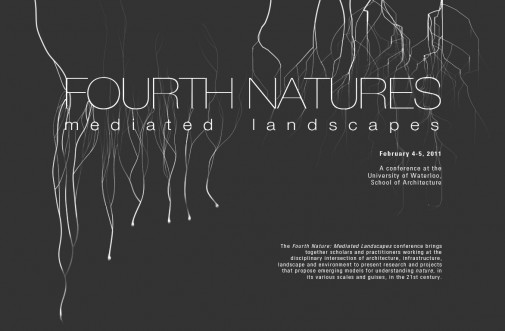
InfraNet Lab is pleased to announce that we will be hosting a conference entitled ‘Fourth Nature: Mediated Landscapes’ at the University of Waterloo, School of Architecture, in Cambridge, ON, this Friday, Feb. 4th and Saturday, Feb. 5th. The conference brings together scholars and practitioners working at the disciplinary intersection of architecture, infrastructure, landscape and environment to present research and projects that propose emerging models for understanding ‘nature’, in its various scales and guises, in the 21st century. From the territorial to the nano-scale, mutant environments which fuse natural and artificial, technologic and infrastructural have been proliferating. Natures are monitored and controlled, ecologies are amplified or manufactured and interior landscapes are conditioned, with the intent of augmenting performance, controlling the flow of resources, monitoring data or redressing environmental imbalances. In the current scenario, the dialectic is no longer nature versus city, or natural versus artificial, but positions within a spectrum of mediation and manipulation of nature, landscape and built environment.
Speakers include:
Keynote
François Roche (R&Sie(n))
Fourth Natures: New Contexts
Cary Wolfe (Rice University, Series Editor of Posthumanities )
Alessandra Ponte (Universite de Montreal)
Christine Macy (Dalhousie University)
Andy Payne (University of Toronto) (Moderator)
Fourth Natures: New Disciplines
Lydia Kallipoliti (Cooper Union, Columbia University, Director of Ecoredux)
John J. May (UCLA and University of Toronto, Millions of Moving Parts)
John McMinn (University of Waterloo) ( Moderator)
Fourth Natures: New Practices
Martin Felsen (Illinois Institute of Technology, Archeworks, Director of UrbanLab)
Janette Kim ( Columbia University, Director of Urban Landscape Lab)
Sean Lally (University of Illinois at Chicago, Director of WEATHERS)
Liat Margolis (University of Toronto) ( Moderator)
Detailed information about the conference schedule and speakers can be found at: http://www.architecture.uwaterloo.ca/fourthnatures/
Friday, October 22. 2010
Ludlow 38 presents Maryanne Amacher's City-Links
Thursday, August 26. 2010
Skinput: Appropriating the Body as an Input Surface
Tuesday, May 18. 2010
Rethinking Location Anytime Anywhere Everything [Berlin]
 Rethinking Location Anytime Anywhere Everything :: until June 19, 2010 :: Sprüth Magers, Oranienburger Straße 18, D-10178 Berlin.
With works by Rosa Barba - Cyprien Gaillard - Andreas Hofer - Koo Jeong-A - David Maljkovic - Trevor Paglen - Christodoulos Panayiotou - Sterling Ruby - Paul Sietsema - Taryn Simon - Armando Andrade Tudela - Andro Wekua. Curated by Johannes Fricke Waldthausen.
Evolving from the work of twelve conceptual artists, filmmakers and photographers presenting alternate interpretations of fictional geographies, imaginary sites and ‘mash-up’ destinations, the exhibition Rethinking Location reconsiders the notion of location. In an era characterized by a rapidly changing perception of time and space due to ever increasing mobility, migration and globalisation, our understanding of what a location is has significantly transformed. Taking these changes for granted, the exhibition investigates how artists consider location and geography as source material for their work.
The work of Rosa Barba and Taryn Simon often derives from an interest in unusual places or improbable situations: Barba’s film The Empirical Effect (2010) explores a geographical ‘Red Zone’: weaving a fiction around the Vesuvio Vulcano, her film was shot during an actual evacuation test and, on another level, points towards the complex relationships between society and politics in Italy. Collaborating with the scientific research laboratory Observatorio Vesuviano in Naples, Barba creates a fictional documentary including surveillance cameras, seismographs and early archival material of Naples by the Lumière Brothers. Empathizing with the role of a contemporary ethnographer, the work of New York based photographer Taryn Simon oscillates between an aesthetisized realism and collective memory. The works shown in Rethinking Location symbolically refer to sites of geopolitical weight, such as the Interior of Fidel Castro’s Palace of the Revolution in Havanna and night shots of a checkpoint between Jerusalem and Ramallah on the West Bank.
In his work Cyprien Gaillard alters the hierarchy of geographical sites and their representative value by detaching them from their original connotations: it deconstructs and conflates actual landscapes perpetuated by a spirit of anachronism and ruin of both past and present. His Fields of Rest series (2010) evolves around decomposed architecture of Second World War bunkers at the coastlines of the French Normandy. Paul Sietsema’s 16 mm films, drawings and sculptures bridge color, space and movement through subjects spanning a broad geographic and temporal range. Over the last years, Sietsema has gathered archival photographs of artifacts of ‘lost cultures’, often from rare anthropological and ethnographic books. The artifacts he examines and transcribes into his own work often derive from western colonialism, industrialisation and geographic explorations including Oceania, South Asia, and Africa. In his film analyse d´une épouse (2008) he traces a ship-wreck, capturing its ruins on celluloid like timeless sculptures of a lost cultural memory.
Recalling thoughts by Bourriaud of the artist as Semionaut, treating geography as source material for new work, the drifting and the displacement between different cities allows artists to enter multi-dimensional, seminal dialogues within different contexts. Within both a local and global artistic practice charted by increasing displacement, expeditions, sites, destinations, distances and routes are elements that become incrementally significant.
Interested in topographies of detachment and displacement, Peru-born Aramando Andrade Tudela explores the notion of ‘tropical abstraction’. Referring to the potential of 1960s utopian modernist architecture from South America, his 16 mm film Espace Niemayer (2007) takes place in the headquarters of the French communist party in Paris. Shot mostly in close-up mode, Tudela transformed the site built 1967 – 1972 by Brasilian architect Oscar Niemayer into a non-place: a fictional site without geographical foundation.
Koo Jeong-A creates mythologies and imaginary sites within the logic of existing places. Her work often gives prominence to the hidden, the ephemere, and the invisible. For the exhibition Koo Jeong-A produced a new series of works, consisting of geological and social layers where maps, drawings and signs extend to a notional geography. Furthermore, she created a site specific, secret surprise location yet to be discovered.
Andreas Hofer’s work overlaps science fiction, scientific research and popular culture. Often evolving around early film noir, comics and crime literature, his multi-media installation Robert and Matt Maitland (2010) responds to the notion of the artist as an explorer. His work in the exhibition archly superimposes the protagonist from J.G. Ballard’s 1974 science fiction novel Concrete Island and the setting of a geographic exploration from a 1950s comic classic. By blending two originally detached storylines, Hofer proposes a new imaginary landscape.
Today intersections between actual sites, mass media and communication technology transform places into virtual mash-up locations: archipelagos of alternating signs oscillating between the actual and the virtual. Moreover, the internet has significantly increased the presence of maps and navigation systems in our thinking. For example, it has become easier to generate maps, to share and alter them, and to create them collaboratively (e.g. GPS and geo-tagging systems like Google Maps and Google Earth).
The art of Trevor Paglen blurs the border of art, science, and politics. Holding a Ph.D. in geography and operating at USC Berkeley’s geography department, Paglen uses data analysis, advanced research skills and state-of-the-art photo observation techniques to map the terrain of American military secrets. He appropriates scientific imagery and dicourses of astronomy to provide the framing for what he calls an ‘experimental geography’. In his series The Other Night Sky Paglen turns our attention to some 189 secret intelligence satellites operated by the U.S. military to keep most of the world under surveillance.
The juxtaposed positions within Rethinking Location express a vast area of interconnected ideas and systems in a world where places are increasingly re-articulated and interrelated. Fostering an interdisciplinary approach, the exhibition aims to serve as inspiration to reconsider what the notion of location implies today. After the recent emphasis on networks and communities, could the focus now shift to location as a new key dimension?
Tuesday, March 16. 2010
Design Approaches for the 21st Century City
Monday, March 01. 2010
Sonic Acts 2010: On the Poetics of Hybrid Space
 I just visited an interesting panel on the Sonic Acts 2010 Conference called The Poetics of Hybrid Space.
When over here at The Mobile City we talk about Hybrid Space, we usually refer to the work of Adriana de Souza e Silva who in several articles has convincingly argued against the dichotomy between physical or real space on the one hand and virtual or mediated spaces on the other. The very fact that these two can longer be separated is one of the central themes of The Mobile City: media spaces and virtual networks extend, broaden, filter or restrict the experience of physical spaces, and the other way around.
Interestingly, over at Sonic Acts they have adopted a broader concept of hybridization. Moderator Eric Kluitenberg explained that hybrid space is not a technical concept. Rather hybridization is about heterogenic logics that are simultaneously at work in the same space. For instance there is the top down logic of the build environment developed by the architect. But the same space may also be subjected to the logic of an informal street economy that may or may not be compatible with the ideas operationalized by the architect. The mediated experiences of the mediascape make up only one of the logics that operate in a space. Sometimes these different logics clash, sometimes they overlap, sometimes they just negate each other. However, we should understand all these different logics as real. They are all operative at the same time and together make up how a place is lived and experienced.
Having said that, the addition of the new media technologies such as mobile phones has increased the density of different logics operational in (urban) space, and new cultural practices and adaptations of space are emerging as a result. This makes the urban experience more complex and messier than ever. It’s even doubtful whether we can truly get a grasp on these processes. What we can do is try to increase our sensitivity of the complexity of different logics at work. It was this issue that most of the presentations in this session addressed.
Duncan Speakman’s Subtlemob
The work of sound artist Duncan Speakman, who discussed his subtlemob-project, addressed several aspects of the hybridization of space through the advent of digital media technologies.
A Subtlemob is a collective urban audio-experience set in urban space. Participants download an mp-3 file, head to a location in the city, and at a particular time they all press play at the same time, thereby collectively experiencing the same soundtrack. The soundtrack does not only consist of music but also of spoken instructions that the participants have to carry out (And sometimes there is different instructions for different groups of participants). It is like a flash-mob, yet more subtle. That is: flash mobs are often staged experiences that gain most of their audience and impact not at the moment itself, but because the event is taped on video and broadcasted on Youtube. A subtlemob is only to be experienced live, there are no recordings, it is all about the experience you have when you are there. You just have to be there to get it.
Popout
One of the starting points of this project is the work of audio culture researcher Michael Bull (I happend to do a podcast interview with him a few years ago, just in case you’d care). Bull studied the experience of the city of first walkman and later iPod users and came up with a few conclusions.
First of all, a lot of people used music to augment their experience of the city, they purposely add a soundtrack to extend or alter their mood. This is not something most composers take into account, Speakman realized. Usually music is not composed with a particular spatiality in mind. One composes for an abstract listening experience, not for the person that listens to an iPod in the back of the bus. But how can you compose for those specific experiences? Speakman therefore decided to change this around, so when composing he often goes to the location his music is intended for to check out if the match is right.
The second theme that has come up in the work of Michael Bull is the idea of the bubble-experience. Digital media have the affordance to make personal spaces warmer, but at the same time they make public spaces cooler. With an iPod one constructs one’s own intense experience in urban space, but it also privatizes this experience. Similarly many critics have argues that also mobile phones play a similar role. They create a ‘full time intimate community’ in which throughout the day a network of friends keeps continuously in touch with each other, even if friends are not physically present. Again this can be understood as a privatization (or parochialization) of public space.
 Speakman:Digital media make personal space warmer, public space cooler |
The idea of the subtlemob is to ‘hack’ these devices to turn their logic around. Can mp3-players also be used to construct collective experiences that heighten the experience of being in public? That encourages people to observe one another rather than retracting in their mediated bubbles of private space.
Teletrust
The other three presentations, including work of Peter Westenberg and Elizabeth Sikiaridi, addressed related issues.
Karen Lancel en Hermen Maat showed their Teletrust-installation, which consists of a full body veil that on the one hand extends the idea of a personal bubble-space. Yet at the same time it enables the wearer – by touching oneself and activating the sensors in the veil – to get in touch with stories told by other people. Is it possible to use networked media to create intimate spaces within public space?
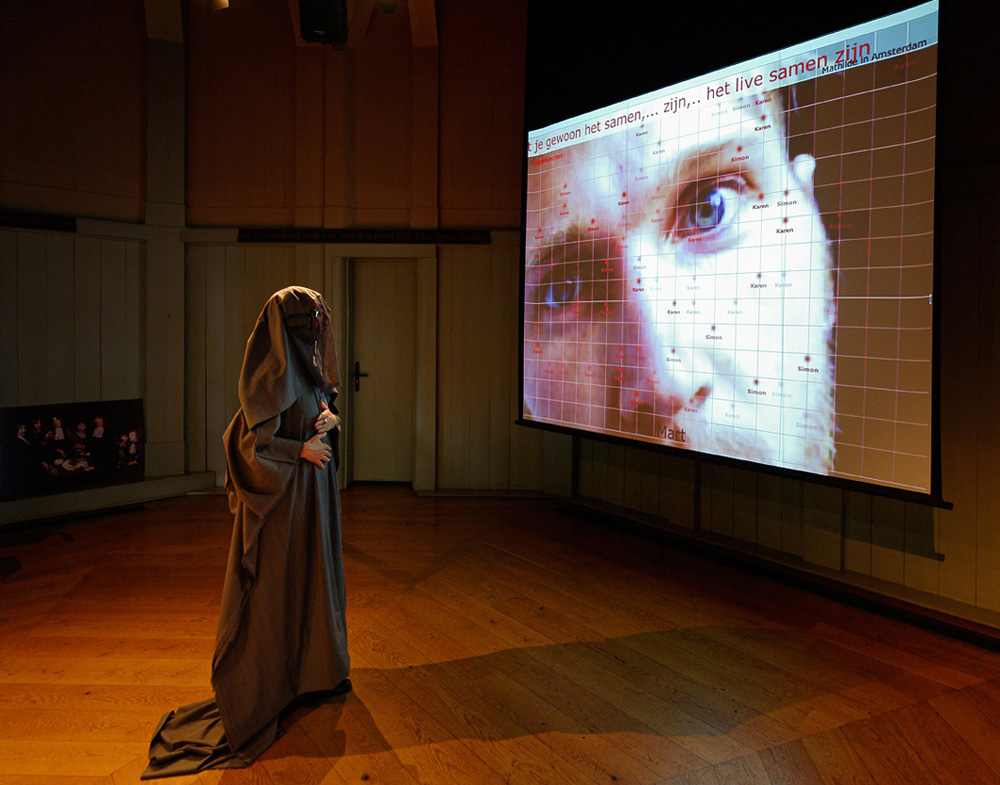 |
In TELE_TRUST [we] explore how in our changing social eco-system we increasingly demand transparency; while at the same time we increasingly cover our vulnerable bodies with personal communication-technology. For TELE_TRUST Lancel and Maat designed a hybrid play zone for a vulnerable process, of balancing between fear AND desire for the other. In a visual, poetic way they explore the emotional and social tension between visibility and invisibility; privacy and trust.
-----
Via The Mobile City
Related Links:
Friday, February 05. 2010
Hairpin bends, no lights, no problem
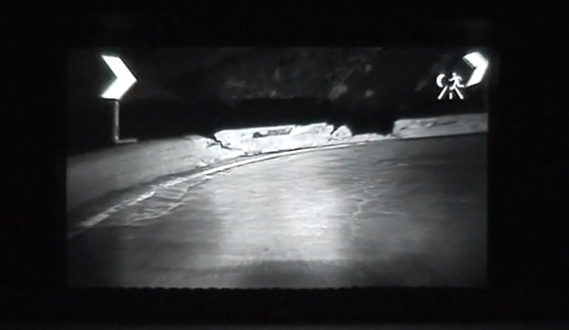
To test the night vision technology in the Mercedes E-Class, Guy Bird took on the hairpins of the Stelvio Pass in the Italian Alps, in the dark. With no lights. He also made a short film of his unusual road trip...
Night vision technology has come a long way since the first heat-sensing systems used in WWII by the US Army to spot enemy targets writes Guy Bird. Today, the latest systems are now so effective and affordable they're being offered as road safety devices on civilian cars.
Car manufacturer research found that many accidents were occurring on poorly-lit country roads due to cars only using dipped beams to avoid blinding on-coming traffic. They then worked out that night vision systems in tandem with dipped beams greatly enhance drivers' ability to see further down the road and spot hazards earlier.
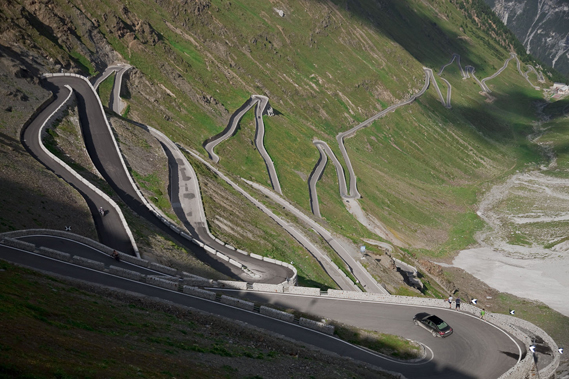
To see how good night vision technology has become three plucky British journalists drove up the infamous 60-hairpin Stelvio Pass in the Italian Alps in a night vision-equipped Mercedes E-Class at midnight, and then taped up the exterior lights to see if the night vision system alone might be enough to navigate by.
The car uses ‘near infrared' technology (also known as ‘active infrared') to allow the driver to ‘see' just beyond the visible light spectrum of the human eye. It works by illuminating the road with invisible, and therefore non-reflective, infrared light from the car's two inner front headlamps. A tiny infrared light-sensitive camera mounted in the windscreen then records what it sees and beams the greyscale images to a small LCD display on the dashboard.
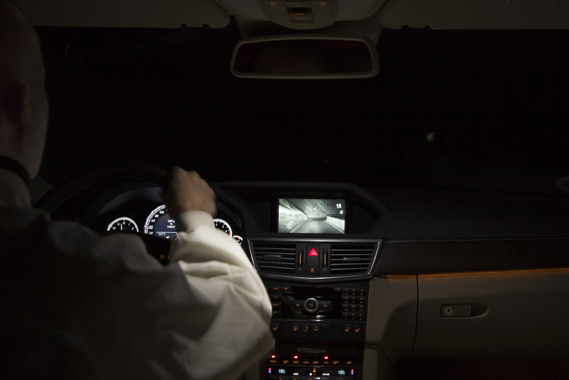
The system in the new E-Class not only detects pedestrians, cyclists or obstacles up to 90 metres ahead, but also highlights them via a graphic on-screen framing device to help avoid them. Luckily, halfway up the Stelvio Pass at midnight pedestrians and cyclists are thin on the ground – but the technology's still useful for displaying the odd car, plus obstacles like stone walls and boulders, behind which lie huge drops down the mountainside.
Mercedes' system is not the first to be plumbed into a passenger car but most of the others major on ‘far' or ‘passive' infrared technology that processes infrared radiation and displays the images on the car's front windscreen.
While they can work up to greater distances than ‘near infrared' the images tend to be much grainier and lower resolution, and Mercedes says such heat-reliant systems don't always work as well if the object to be detected is of a similar temperature to the atmosphere around it, ie rocks or boulders warmed up by hot weather may fail to be picked up by the sensor.
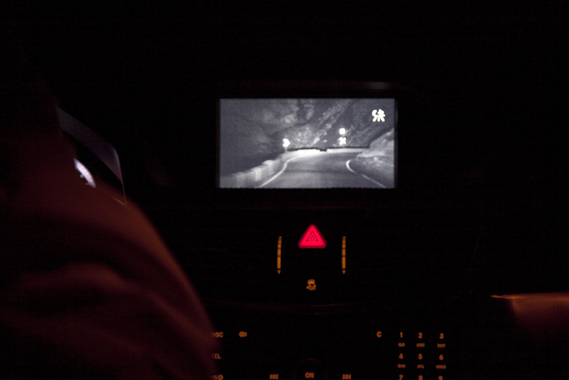
To test the theory that our night vision really could substitute for headlights, the car's main and side headlamps were taped over, leaving only the tiny but crucial infrared light elements exposed. Even so, you'd be hard pressed to read a book by the light left remaining outside, let alone drive anywhere. A safety car drove several hairpins in front (to alert any cars coming the other way) and then it was the turn of our night vision car to set off.
Mercedes' system only kicks in at about 14mph, so once the night vision system has been activated by a small button in the dash it takes a real leap of faith to accelerate into the darkness and just wait for the satnav screen to start beaming back images. But put your foot down properly and the critical speed is quickly reached – a second later the camera is feeding back crystal clear, virtually real-time images to the driver's cabin.
It's a particularly unnerving experience driving a car up a narrow, unlit mountain pass navigating almost completely on the basis of images that resemble a black and white videogame on a screen normally reserved for consulting the satnav.ght vision But after some mental and physical adjustment, traversing the straighter sections gets easier and we go above 25mph.

The hairpins are trickier. The night vision images that feed back as each corner is taken are no more than a fast-moving blur of impending wall. The only way to tackle them is to pick a line hugging the outside wall before you enter the corner and make the turn into the middle of the darkness as smoothly as possible. Without being able to see inside the curve, memories of turns taken in daylight practice runs help, but as soon as the road straightens up again the night vision tech shows the path forward remarkably clearly. After ten minutes more concentration, and dozens more hairpins, the summit is reached.
Of course, ours was a slightly daft test that should ‘not to be tried at home' – or halfway up a mountain – but it nonetheless shows how sharp an image ‘near infrared' night vision can project and how effective a tool it could be for road safety. It's also quite affordable at £1,100 and could well filter down to cheaper and smaller models in time, just like so many other devices from airbags to ABS.
Guy Bird is a freelance journalist, specialising in cars and car design. This article appears in the CR February issue.
-----
Via Creative Review
Personal comment:
Just interested by the strange, unlikely (and a bit nerdly stupid) experience.
Friday, January 22. 2010
Have I cracked the the telepresence conundrum?
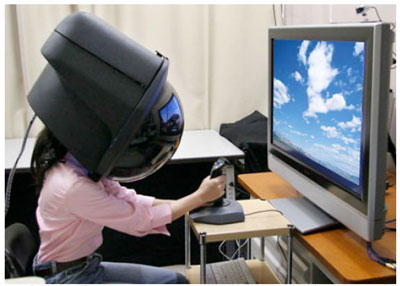
Last evening I particpated remotely from my home in France in a pre-event in Amsterdam of ElectroSmog International Festival for Sustainable Immobility.
I didn't use the fancy gadget in the photo above. My set-up yesterday was a bit, but not a lot, better-organized than the remote recording session (below) I did for a BBC radio programme last summer.
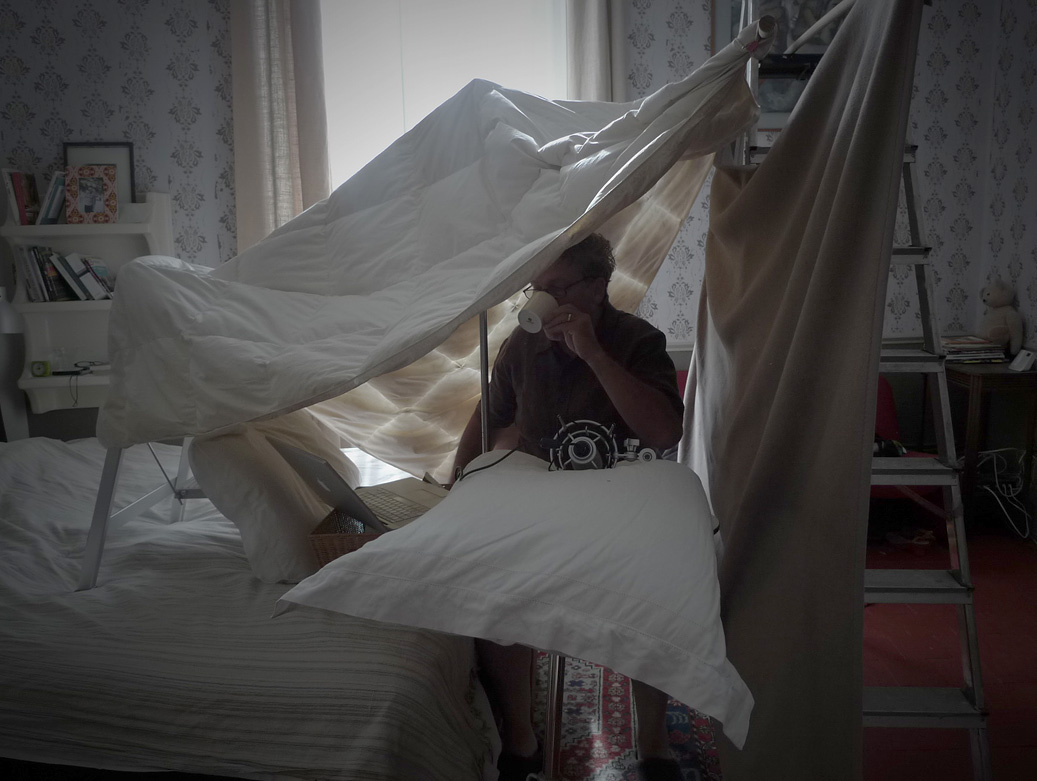
I said my bit to deBalie via skype, and followed the rest of proceedings, which were chaired by Eric Kluitenberg, on deBalie's livestreaming feed.
The deBalie session was not, I know, a major event in the greater context of events concerning sustainability, media, and design. But I'm proud, nonetheless: I have not yet set foot in an aeroplane in 2010, and this event was a meaningful first step: it followed a new year resolution radically to reduce my work-related travel.
In preparing for yesterday's modest exercise, I was amazed to discover that I have been writing about the substitution of telepresence for mobility for seventeen years. Writing, not doing, I know: By no means all my texts and talks are here and here and here and here and here and here and here and here and here and here and here and here and here and here and here and here.
Although deBalie's streaming video feed was clear (thanks to their industrial-quality cameras; three-times normal bandwidth; something called an h264 video codec; and Gerbrand); and Eric was a clear and well-organized compere; but the experience was as unrelaxing, experientially, as always.
I spent half-a-day spent fidding with lights and backdrops at my end. I had to miss lunch in order to test skype. And I had to work hard, during the event itself, to keep track of what was happening in Amsterdam. An abruptly broken connection, internet-side, just as the final Q+A started, was an abrupt but unsurprising conclusion.
Content-wise, the session was a blast from the past - in good ways and bad.
A guy from IBM demo'd a hideous virtual "creative office" populated by avatars. The avatar representing the IBM-er in Belgium failed to speak or move for five minutes; its human owner had apparently left his desk to look for a beer. This was fair enough -a national beer strike in Belgium has only recently ended - but the jerky, implausible look-and-feel of IBM's virtual office was less enticing than the pre-Sims demo given by Will Wright at Doors of Perception back in 1998.
(It wasn't much better, either, than the time I did a video conference with Korea in which twelve corporate persons - not from IBM - sat in a row facing the camera. I was able scan the camera along the line, jerkily, from my end. But because my fellow videoconferencers were dressed in identical blue suits, white shirt and dark tie; and because most of them seemed to be called Mr Kim; I soon gave up).
(But last night's IBM demo was superior to the videoconference between a summer school in Lisbon, and the White House, that I experienced last summer. Then, the link was enabled by Cisco Systems' ultra high-end platform. We were all excited because our interviewee was said to have an office just down the hall from the Oval Office. We all assumed that communicating with the centre of world power on the world's fanciest videoconferencing platform would be fab. But the link, once opened, yielded sound and pictures worse then the ones sent back by the first lunar lander. After ten minutes of torture, someone in Lisbon put their hand up and said" "can't we use skype?" - so we we did).
But there were delights, last evening, too. Costas Bissas from DistanceLab told us, from a location somewhere in the wilds of Scotland, about a cow called Grace who has been fitted with a webcam.
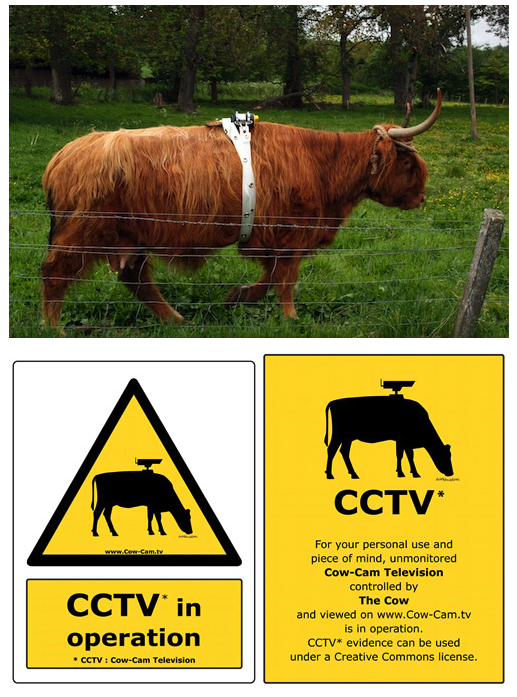
It took me back to the time Bill Gaver and Tony Dunne attached web-enabled microphones to chickens in Peccioli.
I told Costas I would pay good money to see Grace charging a bunch of tourists, but he said that is not their business model.
As last night's discussion continued, I had an epiphany: it is not my job to keep track of all these tele-tools and platforms - still less, to set them up and make them work when I need them.
I thought back to the early years of the telephone: for decades after the telephone was first publicly deployed, one would pick up the receiver - and a room full of operators would make the connection for you.

This is what we need now. We need the equivalent of a roadie for telepresence events.
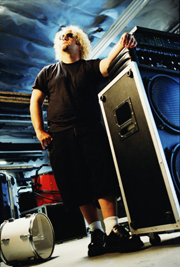
Rock stars don't have to fiddle about setting up amps and lighting and the stage before they perform - so why should I, or any other right thinking citizen who has a life to lead?
e-Roadies are the solution I have been searching for for seventeen years.
I haven't worked out where to find them, nor how to train them - still less, a business model to pay for them. But I am surely on the right track because E-Roadies are a human solution.
Posted by John Thackara at January 22, 2010 10:35 AM
-----
fabric | rblg
This blog is the survey website of fabric | ch - studio for architecture, interaction and research.
We curate and reblog articles, researches, writings, exhibitions and projects that we notice and find interesting during our everyday practice and readings.
Most articles concern the intertwined fields of architecture, territory, art, interaction design, thinking and science. From time to time, we also publish documentation about our own work and research, immersed among these related resources and inspirations.
This website is used by fabric | ch as archive, references and resources. It is shared with all those interested in the same topics as we are, in the hope that they will also find valuable references and content in it.
Quicksearch
Categories
Calendar

|
July '25 | |||||
| Mon | Tue | Wed | Thu | Fri | Sat | Sun |
| 1 | 2 | 3 | 4 | 5 | 6 | |
| 7 | 8 | 9 | 10 | 11 | 12 | 13 |
| 14 | 15 | 16 | 17 | 18 | 19 | 20 |
| 21 | 22 | 23 | 24 | 25 | 26 | 27 |
| 28 | 29 | 30 | 31 | |||
