Monday, April 10. 2017
Note: this "car action" by James Bridle was largely reposted recently. Here comes an additionnal one...
Yet, in the context of this blog, it interests us because it underlines the possibilities of physical (or analog) hacks linked to digital devices that can see, touch, listen or produce sound, etc.
And they are several existing examples of "physical bugs" that come to mind: "Echo" recently tried to order cookies after listening and misunderstanding a american TV ad (it wasn't on Fox news though). A 3d print could be reproduced by listening and duplicating the sound of its printer, and we can now think about self-driving cars that could be tricked as well, mainly by twisting the elements upon which they base their understanding of the environment.
Interesting error potential...
Via Archinect
-----
By Julia Ingalls

James Bridle entraps a self-driving car in a "magic" salt circle. Image: Still from Vimeo, "Autonomous Trap 001."
As if the challenges of politics, engineering, and weather weren't enough, now self-driving cars face another obstacle: purposeful visual sabotage, in the form of specially painted traffic lines that entice the car in before trapping it in an endless loop. As profiled in Vice, the artist behind "Autonomous Trip 001," James Bridle, is demonstrating an unforeseen hazard of automation: those forces which, for whatever reason, want to mess it all up. Which raises the question: how does one effectively design for an impish sense of humor, or a deadly series of misleading markings?
Tuesday, October 04. 2016
Note: j'avais évoqué récemment cette idée du sublime dans le cadre d'un workshop à l'ECAL, avec pour invités Random International. Il s'agissait alors d'intervenir dans le cadre d'un projet de recherche où nous visions à développer des "contre-propositions" à l'expression actuelle de quelques-unes de nos infrastructures contemporaines, "douces" et "dures". Le "cloud computing" et les data-centers en particulier (le projet en question, en cours et dont le processus est documenté sur un blog: Inhabiting & Interfacing the Cloud(s)). Un projet conduit en collaboration avec Nicolas Nova de la HEAD - Genève
Tout cela s'était développé autour du sentiment d'une technologie, qui mettant aujourd'hui de nouveau "à distance" ses utilisateurs, contribuerait au développement de "croyances" (dimension "magique") et dans certains cas, à la résurgence du sentiment de "sublime", cette fois non plus lié aux puissances natutrelles "terrifiantes", mais aux technologies développées par l'homme. Je n'avais pas fait le lien avec cette thématique très actuelle de l'Anthropocène, que nous avions toutefois déjà commentée et pointée sur ce blog.
C'est fait dorénavant avec beaucoup de nuances par Jean-Baptiste Fressoz. Non sans souligner que "(...) cette opération esthétique, au demeurant très réussie, n’est pas sans poser problème car ce qui est rendu sublime ce n’est évidemment pas l’humanité, mais c’est, de fait, le capitalisme".
...
On peut aussi se souvenir qu'en 1990 déjà, Michel Serres écrivait dans son livre Le Contrat Naturel:
"Voici maintenant formée la contemporaine société, qu'on peut appeler deux fois mondiale: occupant toute la terre, solidaire comme un bloc, par ses interrelations croisées, elle ne dispose d'aucun reste, de recul ni de recours, ou planter sa tente et dans quel extérieur. Elle sait, d'autre part, construire et utiliser des moyens techniques aux dimensions spatiales, temporelles, énergétiques des phénomènes du monde. Notre puissance collective atteint donc les limites de notre habitat global. Nous commençons à ressembler à la Terre."
Texte que nous avions par ailleurs cité avec fabric | ch dans l'un de nos premiers projets, Réalité Recombinée, en 1998.
Via Mouvements (via Nicolas Nova)
-----
Par Jean-Baptiste Fressoz
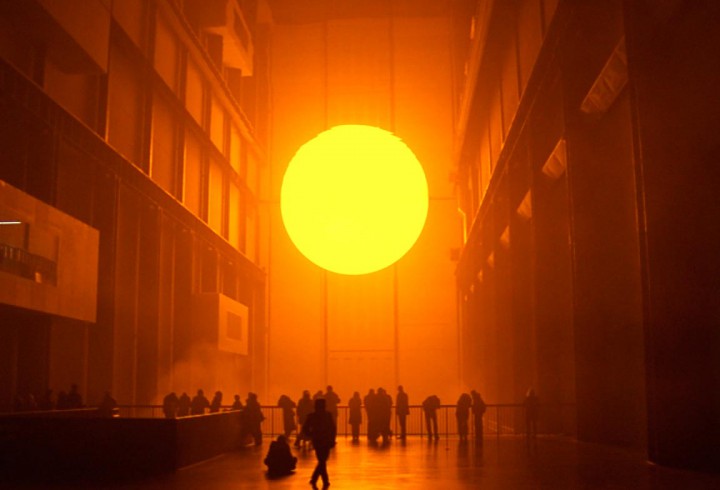
Olafur Eliasson à la Tate Modern.
Pour Jean-Baptiste Fressoz, la force de l’idée d’Anthropocène n’est pas conceptuelle, scientifique ou heuristique : elle est avant tout esthétique. Dans cet article, l’auteur revient, pour en pointer les limites, sur les ressorts réactivés de cette esthétique occidentale et bourgeoise par excellence [note: le sublime], vilipendée par différents courants critiques. Il souligne qu’avant d’embrasser complètement l’Anthropocène, il faut bien se rappeler que le sublime n’est qu’une des catégories de l’esthétique, qui en comprend d’autres (le tragique, le beau…) reposant sur d’autres sentiments (l’harmonie, la douleur, l’amour…), peut-être plus à même de nourrir une esthétique du soin, du petit, du local dont l’agir écologique a tellement besoin.
Aussi sidérant, spectaculaire ou grandiloquent qu’il soit, le concept d’Anthropocène ne désigne pas une découverte scientifique [1]. Il ne représente pas une avancée majeure ou récente des sciences du système-terre. Nom attribué à une nouvelle époque géologique à l’initiative du chimiste Paul Crutzen, l’Anthropocène est une simple proposition stratigraphique encore en débat parmi la communauté des géologues. Faisant suite à l’Holocène (12 000 ans depuis la dernière glaciation), l’Anthropocène est marquée par la prédominance de l’être humain sur le système-terre. Plusieurs dates de départ et marqueurs stratigraphiques afférents sont actuellement débattus : 1610 (point bas du niveau de CO2 dans l’atmosphère causé par la disparition de 90% de la population amérindienne), 1830 (le niveau de CO2 sort de la fourchette de variabilité holocénique), 1945 date de la première explosion de la bombe atomique.
La force de l’idée d’Anthropocène n’est pas conceptuelle, scientifique ou heuristique : elle est avant tout esthétique. Le concept d’Anthropocène est une manière brillante de renommer certains acquis des sciences du système-terre. Il souligne que les processus géochimiques que l’humanité a enclenchés ont une inertie telle que la terre est en train de quitter l’équilibre climatique qui a eu cours durant l’Holocène. L’Anthropocène désigne un point de non retour. Une bifurcation géologique dans l’histoire de la planète Terre. Si nous ne savons pas exactement ce que l’Anthropocène nous réserve (les simulations du système-terre sont incertaines), nous ne pouvons plus douter que quelque chose d’importance à l’échelle des temps géologiques a eu lieu récemment sur Terre.
Le concept d’Anthropocène a cela d’intéressant, mais aussi de très problématique pour l’écologie politique, qu’il réactive les ressorts de l’esthétique du sublime, esthétique occidentale et bourgeoise par excellence, vilipendée par les critiques marxistes, féministes et subalternistes, comme par les postmodernes. Le discours de l’Anthropocène correspond en effet assez fidèlement aux canons du sublime tels que définis par Edmund Burke en 1757. Selon ce philosophe anglais conservateur, surtout connu pour son rejet absolu de 1789, l’expérience du sublime est associée aux sensations de stupéfaction et de terreur ; le sublime repose sur le sentiment de notre propre insignifiance face à une nature lointaine, vaste, manifestant soudainement son omnipuissance. Écoutons maintenant les scientifiques promoteurs de l’Anthropocène :
« L’humanité, notre propre espèce, est devenue si grande et si active qu’elle rivalise avec quelques-unes des grandes forces de la Nature dans son impact sur le fonctionnement du système terre […]. Le genre humain est devenu une force géologique globale [2] ».
La thèse de l’Anthropocène repose en premier lieu sur les quantités phénoménales de matière mobilisées et émises par l’humanité au cours des XIXe et XXe siècles. L’esthétique de la gigatonne de CO2 et de la croissance exponentielle renvoie à ce que Burke avait noté : « la grandeur de dimension est une puissante cause du sublime [3] », et, ajoute-t-il, le sublime demande « le solide et les masses mêmes [4] ». De manière plus précise, l’Anthropocène reporte le sublime de la vaste nature vers « l’espèce humaine ». Tout en jouant du sublime, il en renverse les polarités classiques : la terreur sacrée de la nature est transférée à une humanité colosse géologique.
Or, cette opération esthétique, au demeurant très réussie, n’est pas sans poser problème car ce qui est rendu sublime ce n’est évidemment pas l’humanité, mais c’est, de fait, le capitalisme. L’Anthropocène n’est certainement pas l’affaire d’une « espèce humaine », d’un « anthropos » indifférencié, ce n’est même pas une affaire de démographie : entre 1800 et 2000 la population humaine a été multipliée par sept, la consommation d’énergie par 50 et le capital, si on reprend les chiffres de Thomas Picketty, par 134 [5]. Ce qui a fait basculer la planète dans l’Anthropocène, c’est avant tout une vaste technostructure orientée vers le profit, une « seconde nature », faite de routes, de plantations, de chemins de fer, de mines, de pipelines, de forages, de centrales électriques, de marchés à terme, de porte-containers, de places financières et de banques et bien d’autres choses encore qui structurent les flux de matière et d’énergie à l’échelle du globe selon une logique structurellement inégalitaire. Bref, le changement de régime géologique est bien sûr le fait de « l’âge du capital [6] » bien plus que le fait de « l’âge de l’être humain » dont nous rebattent les récits dominants [7]. Le premier problème du sublime de l’Anthropocène est qu’il renomme, esthétise et surtout naturalise le capitalisme, dont la force se mesure dorénavant à l’aune des manifestations de la première nature – les volcans, la tectonique des plaques ou les variations des orbites planétaires – que deux siècles d’esthétique du sublime nous avaient appris à craindre mais aussi à révérer.
Au sublime de la quantité, l’Anthropocène ajoute le sublime géologique des âges et des éons, duquel il tire ses effets les plus saisissants. La thèse de l’Anthropocène nous dit en substance que les traces de notre âge industriel resteront pour des millions d’années dans les archives géologiques de la planète. Le fait d’ouvrir une nouvelle époque taillée à la mesure de l’être humain signifie que c’est à l’échelle des temps géologiques seulement que l’on peut identifier des événements agissant avec autant de force sur la planète que nous-mêmes : le taux de dioxyde de carbone en 2015 est sans précédent depuis trois millions d’années, le taux actuel d’extinction des espèces, depuis 65 millions d’années, l’acidité des océans, depuis 300 millions d’années, etc. Ce que nous vivons n’est pas une simple « crise environnementale », mais une révolution géologique d’origine humaine. Loin de constituer un cours extérieur, impavide et gigantesque, le temps de la Terre est devenu commensurable au temps de l’agir humain. En deux siècles tout au plus, l’humanité a altéré la dynamique du système-terre pour l’éternité ou presque. « Tout ce qui fait transition n’excite aucune terreur [8] » écrivait Burke. Le discours de l’Anthropocène cultive cette esthétique de la soudaineté, de la bifurcation et de l’événement. Le sublime de l’Anthropocène réside précisément dans cette rencontre extraordinaire : deux siècles d’activité humaine, une durée infime, quasi-nulle au regard de l’histoire terrienne, auront suffi à provoquer une altération comparable au grand bouleversement de la fin du Mésozoïque il y a 65 millions d’années.
La troisième source du sublime anthropocénique est le sublime de la violence souveraine de la nature, celle des tremblements de terre, des tempêtes et des ouragans. Les promoteur·rice·s de l’Anthropocène mobilisent volontiers le sublime romantique des ruines, des civilisations disparues et des effondrements : « Les moteurs de l’Anthropocène pourraient bien menacer la viabilité de la civilisation contemporaine et peut-être même l’existence d’homo sapiens [9] ». Le succès artistique et médiatique du concept repose sur la « jouissance douloureuse », sur le « plaisir négatif » dont parle Burke :
« Nous jouissons à voir des choses que, bien loin de les occasionner, nous voudrions sincèrement empêcher… Je ne pense pas qu’il existe un·e ho·femme assez scélérat·e· pour désirer [que Londres] fût renversée par un tremblement de terre… Mais supposons ce funeste accident arrivé, quelle foule accourrait de toute part pour contempler ses ruines [10] ».
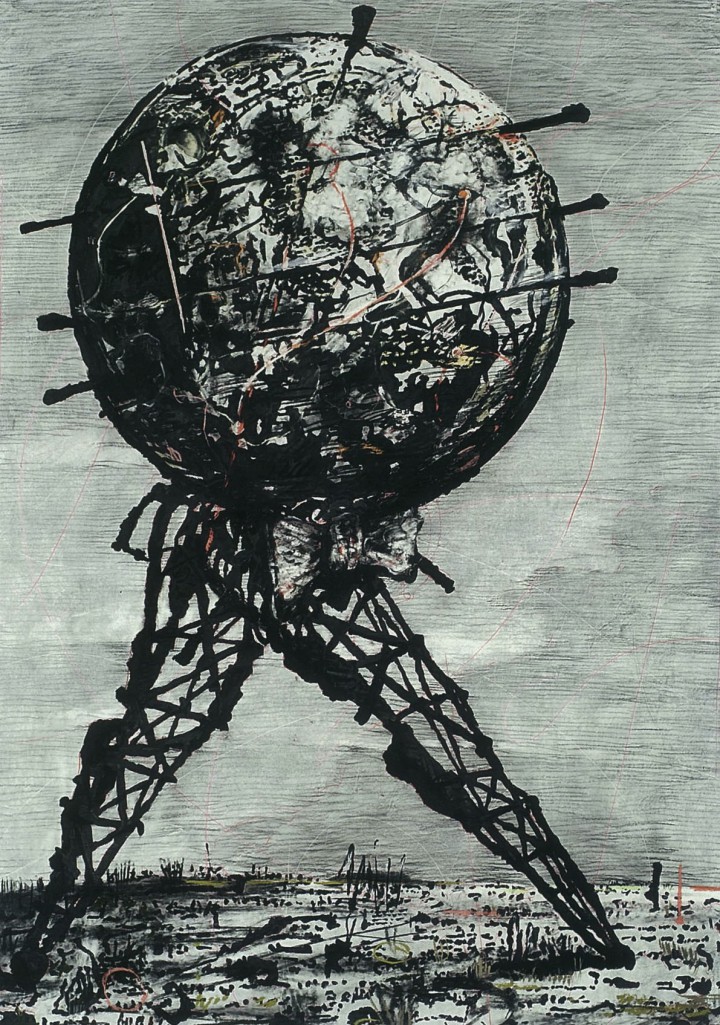
William Kentridge
L’Anthropocène s’appuie sur une culture de l’effondrement propre aux nations occidentales, qui, depuis deux siècles, admirent leur puissance en fantasmant les ruines de leur futur. L’Anthropocène joue des mêmes ressorts psychologiques que le plaisir pervers des décombres déjà décrit par Burke et qui nourrit la vogue actuelle du tourisme des catastrophes de Tchernobyl à ground zero.
La violence de l’Anthropocène est aussi celle de la science hautaine et froide qui nomme les époques et définit notre condition historique. Violence, tout d’abord, de son diagnostic irrévocable : « toi qui entre dans l’Anthropocène abandonne tout espoir » semblent nous dire les savant·e·s. Violence ensuite de la naturalisation, de la « mise en espèce » des sociétés humaines : les statistiques globales de consommation et d’émissions compactent les mille manières d’habiter la terre en quelques courbes, effaçant par la même l’immense variation des responsabilités entre les peuples et les classes sociales. Violence enfin du regard géologique tourné vers nous-mêmes, jaugeant toute l’histoire (empires, guerres, techniques, hégémonies, génocides, luttes, etc.) à l’aune des traces sédimentaires laissées dans la roche. Le géologue de l’Anthropocène est plus effroyable encore que l’ange de l’histoire de Walter Benjamin qui, là même où nous voyions auparavant progrès, ne voyait que catastrophe et désastre : lui n’y voit que fossiles et sédiments.
Que le sublime soit l’esthétique cardinale de l’Anthropocène n’est absolument pas fortuit : sublime et géologie se sont épaulés tout au long de leur histoire. En 1674, Nicolas Boileau traduit en français le traité de Longinus sur le sublime (1er siècle après J.-C.) introduisant ainsi cette notion dans l’Europe lettrée. Mais c’est seulement au milieu du XVIIIe siècle, après que la passion des montagnes et l’intérêt pour la géologie se sont cristallisés dans les classes supérieures, que la « grande nature » devient un objet de sublime [11]. Partis pour leur « grand tour », sur le chemin de l’Italie, les jeunes Anglais·es fortuné·e·s rencontrent en effet la chaîne des Alpes, ses pics vertigineux, ses glaciers terrifiants et ses panoramas immenses. Dans les récits de grands tours, l’expérience de l’effroi face à la nature représente le prix à payer pour goûter la beauté des trésors culturels de l’Italie. Le sublime joue ici un rôle de distinction : être capable de prendre du plaisir en contemplant les glaciers, ou les rochers arides, permettait aux touristes anglais·es de se différencier des guides et des paysan·e·s montagnard·e·s qui n’y voyaient que dangers et terres incultes. Mais c’est évidemment le tremblement de terre de Lisbonne de 1755 qui fournit le véritable coup d’envoi des réflexions sur le sublime : Burke, qui publie son traité l’année suivante, fait référence à la passion esthétique des décombres et des ruines qui saisit alors l’Europe entière. La même année, Emmanuel Kant publie également un court ouvrage sur le tremblement de terre de Lisbonne et, dans son essai ultérieur sur le sublime, il définit ce dernier comme un « plaisir négatif » pouvant procéder de deux manières : le sublime mathématique ressenti devant l’immensité de la nature (l’espace étoilé, l’océan etc.) et le « sublime dynamique » procuré par la violence de la nature (tornade, volcan, tremblement de terre).
Le sublime de l’Anthropocène, et sa mise en scène d’une humanité devenue force tellurique signe la rencontre historique du sublime naturel du XVIIIe siècle et du sublime technologique des XIXe et XXe siècles. Avec l’industrialisation de l’Occident, la puissance de la seconde nature fait l’objet d’une intense célébration esthétique. Le sublime transféré à la technique jouait un rôle central dans la diffusion de la religion du progrès : les gares, les usines et les gratte-ciels en constituaient les harangues permanentes [12]. Dès cette époque, l’idée d’un monde traversé par la technique, d’une fusion entre première et seconde natures fait l’objet de réflexions et de louanges. On s’émerveille des ouvrages d’art matérialisant l’union majestueuse des sublimes naturel et humain : viaducs enjambant les vallées, tunnels traversant les montagnes, canaux reliant les océans, etc. L’idée d’un globe remodelé pour les besoins de l’être humain et fertilisé par la technique constitue une trope classique du positivisme depuis Saint-Simon au moins, qui, dès 1820, écrivait :
« l’objet de l’industrie est l’exploitation du globe, c’est-à-dire l’appropriation de ses produits aux besoins de l’homme, et comme, en accomplissant cette tâche, elle modifie le globe, le transforme, change graduellement les conditions de son existence, il en résulte que par elle, l’homme participe, en dehors de lui-même en quelque sorte, aux manifestations successives de la divinité, et continue ainsi l’œuvre de la création. De ce point de vue, l’Industrie devient le culte [13] ».
De manière plus précise, l’Anthropocène s’inscrit dans une version du sublime technologique reconfigurée par la guerre froide. Il prolonge la vision spatiale de la planète produite par le système militaro-industriel américain, une vision déterrestrée de la Terre saisie depuis l’espace comme un système que l’on pourrait comprendre dans son entièreté, un « spaceship earth » dont on pourrait maîtriser la trajectoire grâce aux nouveaux savoirs sur le système-terre [14]. Le risque est que l’esthétique de l’Anthropocène nourrisse davantage l’hubris d’une géo-ingénierie brutale qu’un travail patient, à la fois modeste et ambitieux d’involution et d’adaptation du social. Pour mémoire, la géo-ingénierie désigne un ensemble de techniques visant à modifier artificiellement le pouvoir réfléchissant de l’atmosphère terrestre pour contrecarrer le réchauffement climatique. Cela peut constituer par exemple à injecter du dioxyde de soufre dans la haute atmosphère afin de réfléchir une partie du rayonnement solaire vers l’espace. L’échec des gouvernements à obtenir un accord international contraignant et ambitieux a contribué à mettre en avant la géo-ingénierie, en tant que « plan B ». Ces techniques potentiellement très risquées pourraient donc soudainement s’imposer en cas « d’urgence climatique ».
Pour ses promoteur·rice·s, l’Anthropocène est une révélation, un éveil, un changement de paradigme désorientant soudainement les représentations vulgaires du monde.
« Par le passé, du fait de la science, l’humanité a dû faire face à de profondes remises en cause de leurs systèmes de croyance. Un des exemples les plus important est la théorie de l’évolution… Le concept d’anthropocène pourrait susciter une réaction hostile similaire à celle que Darwin a produite [15] ».
On retrouve ici le trope romantique du·de la savant·e· payant de sa personne pour lutter contre la foule hostile. En se coupant ainsi du passé et de la décence environnementale commune, en rejetant comme dépassés les savoirs environnementaux qui le précèdent ainsi que les luttes sociales que ces savoirs ont nourries, l’Anthropocène dépolitise l’histoire longue de la destruction de la planète. Avant on ignorait les conséquences globales de l’agir humain, maintenant l’on sait, et, bien entendu, maintenant l’on peut agir. La prétention à la nouveauté des savoirs sur la Terre est aussi une prétention des savants à agir sur celle-ci. Ce n’est pas un hasard si l’inventeur du mot Anthropocène, le prix Nobel de chimie Paul Crutzen, est aussi l’un des avocat·e·s des techniques de géo-ingénierie. À l’Anthropocène inconscient issu de la révolution industrielle succéderait enfin le « bon Anthropocène » éclairé par les savoirs du système-terre. Comme toute forme de scientisme, l’esthétique de l’Anthropocène anesthésie le politique : les « expert·e·s », les autorités vont « faire quelque chose ».
Les expériences du sublime sont toujours à replacer dans un contexte historique et politique particulier. Elles renvoient à des émotions dépendantes des conditions culturelles, naturelles ou technologiques de chaque époque et ce sont ces conditions qui en fournissent les clés de compréhension politique. De la fin du XVIIIe siècle à la fin du siècle suivant, le sublime d’une nature violente et abstraite permettait aux classes bourgeoises urbaines de goûter à la violence de la nature, tout en étant relativement protégées de ses manifestations et de relativiser les dangers bien réels d’un mode de vie technologique et urbain. L’art du sublime nourrissait également le fantasme d’une nature immense et inépuisable au moment précis où l’impérialisme en exploitait les derniers recoins. Dans une culture prenant au sérieux le projet de maîtrise technique de la nature, l’esthétique du sublime fournissait aussi un plaisir légèrement coupable. Enfin, selon le critique marxiste Terry Eagleton, le sublime correspondait aux impératifs esthétiques du capitalisme naissant : contre l’esthétique émolliente du beau, risquant de transformer le sujet bourgeois en sensualiste décadent, le sublime réénergisait le sujet capitaliste comme exploiteur·se ou comme pourvoyeur de travail. Le beau devient à la fin du XVIIIe siècle l’harmonieux, le non-productif, le doux et le féminin ; le sublime : l’effort, le danger, la souffrance, l’élevé, le majestueux et le masculin. Au fond, le sublime, nous dit Eagleton, contenait la menace que la beauté faisait peser sur la productivité [16].
Au début des années 2000, le sublime de l’Anthropocène occupe également une fonction idéologique. Alors que les classes intellectuelles se convertissent au souci écologique, alors qu’elles rejettent les idéaux modernistes de maîtrise de la nature comme has been, alors qu’elles proclament « la fin des grands récits », la fin du progrès, de la lutte des classes, etc., l’Anthropocène procure le frisson coupable d’un nouveau récit sublime. Sur un fond d’agnosticisme quant au futur, l’Anthropocène paraît donner un nouvel horizon grandiose à l’humanité tout entière : prendre en charge collectivement le destin d’une planète. Dans le contexte idéologique terne de l’écologie politique, du développement durable et de la précaution, penser le mouvement d’une humanité devenue force tellurique paraît autrement plus excitant que penser l’involution d’un système économique. Au fond le sublime de l’Anthropocène rejoue assez exactement la scène finale du chef-d’œuvre de Stanley Kubrick, 2001 l’Odyssée de l’espace : l’embryon stellaire contemplant la terre figurant parfaitement l’avènement d’un agent géologique conscient, d’un corps planétaire réflexif. Et c’est bien pour cela que l’Anthropocène fait tressaillir théoricien·ne·s, philosophes et artistes en herbe : il semble désigner un événement métaphysique intéressant.
Pour l’écologie politique contemporaine, l’esthétique sublime de l’Anthropocène pose pourtant problème : en mettant en scène l’hybridation entre première et seconde natures, elle réénergise l’agir technologique des cold warriors (la géo-ingénierie) ; en déconnectant l’échelle individuelle et locale de ce qui importe vraiment (l’humanité force tellurique et les temps géologiques), elle produit sidération et cynisme (no future) ; enfin l’Anthropocène, comme tout autre sublime, est sujet à la loi des rendements décroissants : une fois que l’audience est préparée et conditionnée, son effet s’émousse. En ce sens, désigner une œuvre d’art comme « art de l’Anthropocène » serait absolument fatale à son efficacité esthétique. Le risque est que l’écologie du sublime soit alors appelée à une surenchère permanente, semblable en cela à la course à l’avant-garde dans l’art contemporain. Avant d’embrasser complètement l’Anthropocène, il faut bien se rappeler que le sublime n’est qu’une des catégories de l’esthétique, qui en comprend bien d’autres (le tragique, le beau, le pittoresque…) reposant sur d’autres sentiments (l’harmonie, l’ataraxie, la tristesse, la douleur, l’amour), qui sont peut-être plus à même de nourrir une esthétique du soin, du petit, du local, du contrôle, de l’ancien et de l’involution dont l’agir écologique a tellement besoin.
[1] Cet article reprend sous une forme modifiée un texte déjà paru dans le catalogue de l’exposition Sublime. Les tremblements du monde, Centre Pompidou-Metz, Metz, Centre Pompidou-Metz, 2016.
[2] W. Steffen, J. Grinevald, P. Crutzen, J. McNeill, « The Anthropocene : conceptual and historical perspectives », Philosophical transactions of the Royal Society A, 369, 2011, p. 842–867.
[3] E. Burke, Recherche philosophique sur l’origine de nos idées du sublime et du beau, Paris, Pichon, 1803 (1757), p. 129.
[4] Ibid., p. 225.
[5] T. Piketty, Le capital au XXIe siècle, Paris, Seuil, 2013.
[6] E. Hobsbawm, The Age of Capital : 1848-1975, London, Weindefeld, 1975.
[7] Voir le chapitre « capitalocène » de la nouvelle édition de C. Bonneuil, J.-B. Fressoz, L’événement Anthropocène. La terre, l’histoire et nous, Paris, Seuil, 2016.
[8] E. Burke, op. cit. p. 151.
[9] W. Steffen et al., art. cit.
[10] E. Burke, op. cit., p. 85.
[11] M. Hope Nicholson, Mountain gloom and mountain glory: The development of the aesthetics of the infinite, Ithaca, Cornell University Press, 1959.
[12] D. Nye, American technological sublime, Cambridge (MA), MIT Press, 1994.
[13] Saint-Simon, Doctrine de Saint-Simon, t. 2, Paris, Aux Bureaux de l’Organisateur, 1830, p. 219.
[14] C. Bonneuil, J.-B. Fressoz, op. cit. ; S. Grevsmühl, La Terre vue d’en haut. L’invention de l’environnement global, Paris, Seuil, 2014.
[15] W. Steffen et al., art. cit.
[16] Terry Eagleton, The Ideology of the Aesthetic, Oxford, Basil Blackwell, 1990.
Monday, April 04. 2016
Note: in a time when we'll soon have for the first time a national vote in Switzeralnd about the Revenu de Base Inconditionnel ("Universal Basic Income") --next June, with a low chance of success this time, let's face it--, when people start to speak about the fact that they should get incomes to fuel global corporations with digital data and content of all sorts, when some new technologies could modify the current digital deal, this is a manifesto that is certainly more than interesting to consider. So as its criticism in this paper, as it appears truly complementary.
More generally, thinking the Future in different terms than liberalism is an absolute necessity. Especially in a context where, also as stated, "Automation and unemployment are the future, regardless of any human intervention".
Via Los Angeles Review of Books
-----
By Ian Lowrie
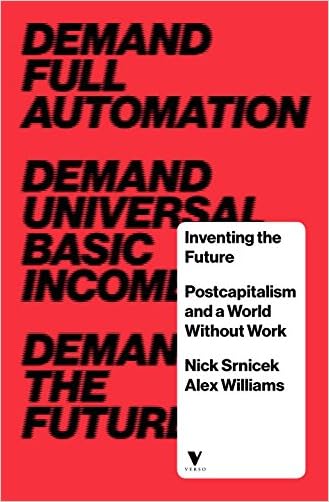
January 8th, 2016
IN THE NEXT FEW DECADES, your job is likely to be automated out of existence. If things keep going at this pace, it will be great news for capitalism. You’ll join the floating global surplus population, used as a threat and cudgel against those “lucky” enough to still be working in one of the few increasingly low-paying roles requiring human input. Existing racial and geographical disparities in standards of living will intensify as high-skill, high-wage, low-control jobs become more rarified and centralized, while the global financial class shrinks and consolidates its power. National borders will continue to be used to control the flow of populations and place migrant workers outside of the law. The environment will continue to be the object of vicious extraction and the dumping ground for the negative externalities of capitalist modes of production.
It doesn’t have to be this way, though. While neoliberal capitalism has been remarkably successful at laying claim to the future, it used to belong to the left — to the party of utopia. Nick Srnicek and Alex Williams’s Inventing the Future argues that the contemporary left must revive its historically central mission of imaginative engagement with futurity. It must refuse the all-too-easy trap of dismissing visions of technological and social progress as neoliberal fantasies. It must seize the contemporary moment of increasing technological sophistication to demand a post-scarcity future where people are no longer obliged to be workers; where production and distribution are democratically delegated to a largely automated infrastructure; where people are free to fish in the afternoon and criticize after dinner. It must combine a utopian imagination with the patient organizational work necessary to wrest the future from the clutches of hegemonic neoliberalism.
Strategies and Tactics
In making such claims, Srnicek and Williams are definitely preaching to the leftist choir, rather than trying to convert the masses. However, this choir is not just the audience for, but also the object of, their most vituperative criticism. Indeed, they spend a great deal of the book arguing that the contemporary left has abandoned strategy, universalism, abstraction, and the hard work of building workable, global alternatives to capitalism. Somewhat condescendingly, they group together the highly variegated field of contemporary leftist tactics and organizational forms under the rubric of “folk politics,” which they argue characterizes a commitment to local, horizontal, and immediate actions. The essentially affective, gestural, and experimental politics of movements such as Occupy, for them, are a retreat from the tradition of serious militant politics, to something like “politics-as-drug-experience.”
Whatever their problems with the psychodynamics of such actions, Srnicek and Williams argue convincingly that localism and small-scale, prefigurative politics are simply inadequate to challenging the ideological dominance of neoliberalism — they are out of step with the actualities of the global capitalist system. While they admire the contemporary left’s commitment to self-interrogation, and its micropolitical dedication to the “complete removal of all forms of oppression,” Srnicek and Williams are ultimately neo-Marxists, committed to the view that “[t]he reality of complex, globalised capitalism is that small interventions consisting of relatively non-scalable actions are highly unlikely to ever be able to reorganise our socioeconomic system.” The antidote to this slow localism, however, is decidedly not fast revolution.
Instead, Inventing the Future insists that the left must learn from the strategies that ushered in the currently ascendant neoliberal hegemony. Inventing the Future doesn’t spend a great deal of time luxuriating in pathos, preferring to learn from their enemies’ successes rather than lament their excesses. Indeed, the most empirically interesting chunk of their book is its careful chronicle of the gradual, stepwise movement of neoliberalism from the “fringe theory” of a small group of radicals to the dominant ideological consensus of contemporary capitalism. They trace the roots of the “neoliberal thought collective” to a diverse range of trends in pre–World War II economic thought, which came together in the establishment of a broad publishing and advocacy network in the 1950s, with the explicit strategic aim of winning the hearts and minds of economists, politicians, and journalists. Ultimately, this strategy paid off in the bloodless neoliberal revolutions during the international crises of Keynesianism that emerged in the 1980s.
What made these putsches successful was not just the neoliberal thought collective’s ability to represent political centrism, rational universalism, and scientific abstraction, but also its commitment to organizational hierarchy, internal secrecy, strategic planning, and the establishment of an infrastructure for ideological diffusion. Indeed, the former is in large part an effect of the latter: by the 1980s, neoliberals had already spent decades engaged in the “long-term redefinition of the possible,” ensuring that the institutional and ideological architecture of neoliberalism was already well in place when the economic crises opened the space for swift, expedient action.
Demands
Srnicek and Williams argue that the left must abandon its naïve-Marxist hopes that, somehow, crisis itself will provide the space for direct action to seize the hegemonic position. Instead, it must learn to play the long game as well. It must concentrate on building institutional frameworks and strategic vision, cultivating its own populist universalism to oppose the elite universalism of neoliberal capital. It must also abandon, in so doing, its fear of organizational closure, hierarchy, and rationality, learning instead to embrace them as critical tactical components of universal politics.
There’s nothing particularly new about Srnicek and Williams’s analysis here, however new the problems they identify with the collapse of the left into particularism and localism may be. For the most part, in their vituperations, they are acting as rather straightforward, if somewhat vernacular, followers of the Italian politician and Marxist theorist Antonio Gramsci. As was Gramsci’s, their political vision is one of slow, organizationally sophisticated, passive revolution against the ideological, political, and economic hegemony of capitalism. The gradual war against neoliberalism they envision involves critique and direct action, but will ultimately be won by the establishment of a post-work counterhegemony.
In putting forward their vision of this organization, they strive to articulate demands that would allow for the integration of a wide range of leftist orientations under one populist framework. Most explicitly, they call for the automation of production and the provision of a basic universal income that would provide each person the opportunity to decide how they want to spend their free time: in short, they are calling for the end of work, and for the ideological architecture that supports it. This demand is both utopian and practical; they more or less convincingly argue that a populist, anti-work, pro-automation platform might allow feminist, antiracist, anticapitalist, environmental, anarchist, and postcolonial struggles to become organized together and reinforce one another. Their demands are universal, but designed to reflect a rational universalism that “integrates difference rather than erasing it.” The universal struggle for the future is a struggle for and around “an empty placeholder that is impossible to fill definitively” or finally: the beginning, not the end, of a conversation.
In demanding full automation of production and a universal basic income, Srnicek and Williams are not being millenarian, not calling for a complete rupture with the present, for a complete dismantling and reconfiguration of contemporary political economy. On the contrary, they argue that “it is imperative […] that [the left’s] vision of a new future be grounded upon actually existing tendencies.” Automation and unemployment are the future, regardless of any human intervention; the momentum may be too great to stop the train, but they argue that we can change tracks, can change the meaning of a future without work. In demanding something like fully automated luxury communism, Srnicek and Williams are ultimately asserting the rights of humanity as a whole to share in the spoils of capitalism.
Criticisms
Inventing the Future emerged to a relatively high level of fanfare from leftist social media. Given the publicity, it is unsurprising that other more “engagé” readers have already advanced trenchant and substantive critiques of the future imagined by Srnicek and Williams. More than a few of these critics have pointed out that, despite their repeated insistence that their post-work future is an ecologically sound one, Srnicek and Williams evince roughly zero self-reflection with respect either to the imbrication of microelectronics with brutally extractive regimes of production, or to their own decidedly antiquated, doctrinaire Marxist understanding of humanity’s relationship towards the nonhuman world. Similarly, the question of what the future might mean in the Anthropocene goes largely unexamined.
More damningly, however, others have pointed out that despite the acknowledged counterintuitiveness of their insistence that we must reclaim European universalism against the proliferation of leftist particularisms, their discussions of postcolonial struggle and critique are incredibly shallow. They are keen to insist that their universalism will embrace rather than flatten difference, that it will be somehow less brutal and oppressive than other forms of European univeralism, but do little of the hard argumentative work necessary to support these claims. While we see the start of an answer in their assertion that the rejection of universal access to discourses of science, progress, and rationality might actually function to cement certain subject-positions’ particularity, this — unfortunately — remains only an assertion. At best, they are being uncharitable to potential allies in refusing to take their arguments seriously; at worst, they are unreflexively replicating the form if not the content of patriarchal, racist, and neocolonial capitalist rationality.
For my part, while I find their aggressive and unapologetic presentation of their universalism somewhat off-putting, their project is somewhat harder to criticize than their book — especially as someone acutely aware of the need for more serious forms of organized thinking about the future if we’re trying to push beyond the horizons offered by the neoliberal consensus.
However, as an anthropologist of the computer and data sciences, it’s hard for me to ignore a curious and rather serious lacuna in their thinking about automaticity, algorithms, and computation. Beyond the automation of work itself, they are keen to argue that with contemporary advances in machine intelligence, the time has come to revisit the planned economy. However, in so doing, they curiously seem to ignore how this form of planning threatens to hive off economic activity from political intervention. Instead of fearing a repeat of the privations that poor planning produced in earlier decades, the left should be more concerned with the forms of control and dispossession successful planning produced. The past decade has seen a wealth of social-theoretical research into contemporary forms of algorithmic rationality and control, which has rather convincingly demonstrated the inescapable partiality of such systems and their tendency to be employed as decidedly undemocratic forms of technocratic management.
Srnicek and Williams, however, seem more or less unaware of, or perhaps uninterested in, such research. At the very least, they are extremely overoptimistic about the democratization and diffusion of expertise that would be required for informed mass control over an economy planned by machine intelligence. I agree with their assertion that “any future left must be as technically fluent as it is politically fluent.” However, their definition of technical fluency is exceptionally narrow, confined to an understanding of the affordances and internal dynamics of technical systems rather than a comprehensive analysis of their ramifications within other social structures and processes. I do not mean to suggest that the democratic application of machine learning and complex systems management is somehow a priori impossible, but rather that Srnicek and Williams do not even seem to see how such systems might pose a challenge to human control over the means of production.
In a very real sense, though, my criticisms should be viewed as a part of the very project proposed in the book. Inventing the Future is unapologetically a manifesto, and a much-overdue clarion call to a seriously disorganized metropolitan left to get its shit together, to start thinking — and arguing — seriously about what is to be done. Manifestos, like demands, need to be pointed enough to inspire, while being vague enough to promote dialogue, argument, dissent, and ultimately action. It’s a hard tightrope to walk, and Srnicek and Williams are not always successful. However, Inventing the Future points towards an altogether more coherent and mature project than does their #ACCELERATE MANIFESTO. It is hard to deny the persuasiveness with which the book puts forward the positive contents of a new and vigorous populism; in demanding full automation and universal basic income from the world system, they also demand the return of utopian thinking and serious organization from the left.
Tuesday, September 10. 2013
By fabric | ch
-----
Following our residency in Beijing at the Tsinghua University that ended last July, fabric | ch transformed itself into the organizers of a call (!) that will run between next september and october, in partneship with TASML (Beijing). The call is closely related to the work and workshop we've done in Beijing.
The results of this CALL (1st price) will be presented during the next Lisbon Architecture Triennale, CLOSE, CLOSER (curator Beatrice Galilee), so as another list of EVENTS, as an Associated Program and during a talk together with fabric | ch.
An Award of Distinction is open to international submissions.
You can find below a copy of this open call dedicated to individuals or interdisciplinary groups of students and faculty members of Tsinghua University in the fields of Architecture, Design, Art and Sciences (1st prize), so as to the international community (students and professionals, Award of Distinction).
Call: http://call.deterritorialized.org/
Download the call in pdf: http://bit.ly/18LozDr
Download the poster: http://bit.ly/1amu7Gk
Events during Close, Closer: http://beijing.deterritorialized.org/
Please spread the message!
-----
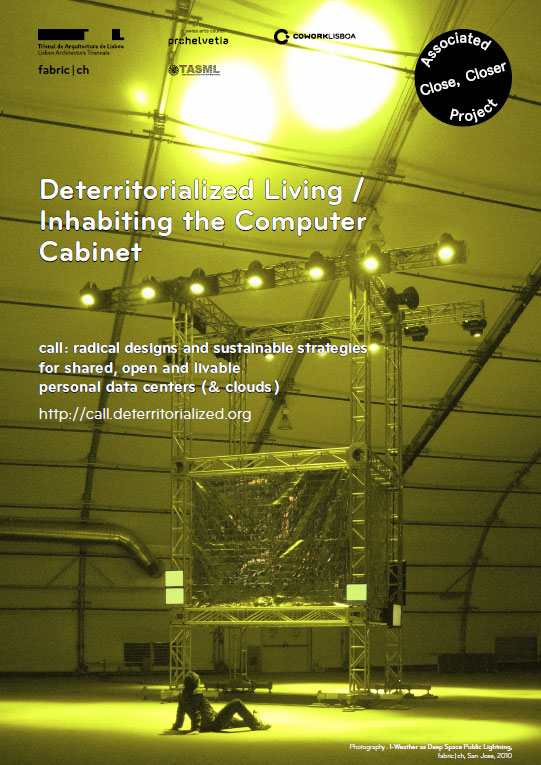
Download the call in English (PDF)
Download the call in Chinese (PDF)
Call : radical designs and sustainable strategies for shared, open and livable personal data centers (& clouds)
In collaboration with fabric | ch, Tsinghua Art & Sciences Research Center Media Laboratory (TASML) is pleased to announce an open call to the Tsinghua community for individuals or interdisciplinary groups of students and faculty in the fields of Architecture, Design, Art and Sciences. Conceived by fabric | ch, the competition is inspired by Deterritorialized Living, a workshop, a project and series of online “tools / atmospherics” developed on the Tsinghua campus during a recent residency.
The purpose of the competition is to explore a radicalized experience of deterritorialisation / detemporalization through intensive use of network, transportation and sometimes biochemical devices as well as to investigate alternative strategies in lieu of corporate approaches to data, data centers and cloud computing. The competition aims to develop speculative and innovative artifacts (code, interfaces, programs, objects, devices, spaces, etc.) for this contemporary situation.
Inhabiting the Computer Cabinet competition (Deterritorialized Living, the Beijing sessions) will be an Associated Project during Close, Closer, the much anticipated Lisbon Architecture Triennale that will take place in late summer and fall of 2013, curated by Beatrice Galilee, Liam Young, Mariana Pestana and Jose Esparza Chong Cuy.
Brief

One of the first general purpose computer, the Eniac I, back in 1946.
Context: Since the public emergence of the Internet and the web in the mid ’90s and the ubiquitous presence of wireless communication, peer to peer exchanges, and social networks of all kinds in recent years, we have witnessed a growing tendency towards horizontally mediated decentralization. These conditions have not only deeply influenced the ways in which people and societies interact (social interactions, exchanges, mobilities, artifacts, economies, etc.), but have also affected how clusters of computers and hardware collaborate or exchange information. To some extent, networks have generated some sort of “geo-engineered” milieu that triggers an experience of delocalization: ambient deterritorialization that is always around, always on.
Recently the “network” concept has started to widen its influence: the energy industry is planning to adopt the horizontal model with its “smart grid” plans, in which everybody should be able to produce their own clean energy and store it or share it with the rest of the community. We can witness something similar in alternative, locally produced food: the idea of distributed food that is produced close to the place where it will be eaten, through the approach of highly decentralized and small scale “gardening” or through certain forms of urban “farming”. Rapid prototyping also helps to spur a similar movement in the product design community.
Yet, on the data side, we are witnessing the exact opposite: we have moved from a fundamentally decentralized model towards a highly “mainframed” (centralized) structure of corporately owned data, services and data centers, although these seemingly “immaterial” information architectures appear to be deceptively decentralized, accessible everywhere, anytime.
Should we then consider personal-urban-“data-farming” instead of corporate data centralization too? Or should we rather try urban-“data-gardening” instead? Could we build a highly decentralized, almost atomized open system of small interconnected data centers? Could we possibly inhabit these data centers, taking advantage of the heat they generate, the high-bandwidth network access they provide, the data they collect? Should we also consider their necessary relocation while taking into account their highly mediated nature?
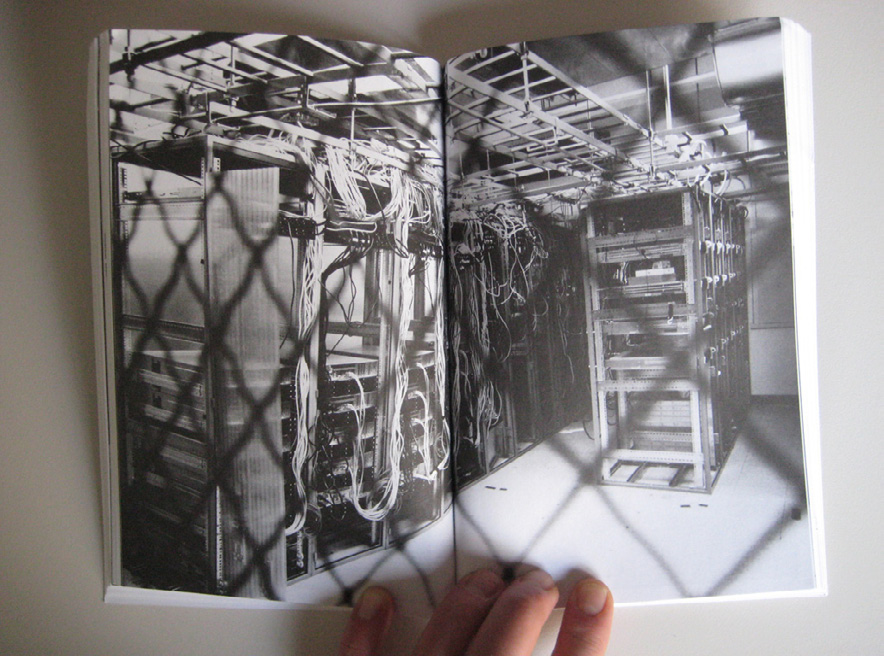
… and a picture of several servers cabinets taken out of Clog: Data Space (2012).
Or should we simply consider the data center figure (and its services) for what it is: the furtive icon of our modernity and of the radically modified relation we maintain to global territory? Should we therefore think about it in even more radical or speculative terms?
Based on the context above, we are calling for proposals under the title of Deterritorialized Living (Beijing sessions) / Inhabiting the Computer Cabinet.
Objective: An abstract space of 9 square meters is proposed for the competition, to be designed into a large computer cabinet that is inhabitable. Its exact shape, height and volume are to be defined by the candidates.
The cabinet can be situated in any natural or artificial place on Earth. It can also be located in an ideal environment (which should be defined in detail). Cooling (natural or artificial) is the only necessary condition: fresh air (and/or other refreshing means) needs to enter the space and to cool down the machines. It is then transformed into hot air charged with positive ions by the processing units that could in turn be used for any other meaningful purposes or symbiotic uses, before eventually being extracted.
The computer cabinet functions as a small data center. A certain number of servers, NAS (networked attached storage), virtual machines, etc. are therefore also installed within this space. The inhabitant(s) have to share the space with the machines in some ways. The status and/or security of the data could also be addressed in some creative ways.
The cabinet is part of a network and can be combined or aggregated with others to form a larger, possibly mobile, mediated and/or networked structure.
Goal: by taking advantage of the physical, informational, computational, chemical, biological, environmental or climatological features of the facility (inside and outside), the project focuses on creating a livable environment within the computer data cabinet (or personal data center). The outcome of the project could be to engage with the overall design or to develop a very specific device, object, software, interface and/or installation within this given framework.
Ressources
http://www.deterritorialized.org is an artificial atmosphere conceived by fabric | ch that is delivered in the form of algorithmically constructed data feeds. It is composed by a set of web services and libraries that were developed in the context of a residency on the Tsinghua University campus in Beijing, between Spring and Summer of 2013 (at TASML). The open data feeds of this "geo-engineered" climate can be addressed and used by any custom designed program or device (the website will be open from the 6th of September).
These open-source, “ambient deterritorialization” data feeds and environments in the form of Deterritorialized Air (N2, O2, CO2, Ar), Deterritorialized Daylight (Lm, IR, UV) and Deterritorialized Time can be freely used in the context of this competition.
Eligibility / Rules
The call is open to all students and young faculty members of Tsinghua University. The application should include candidate’s name and school or department affiliation.
The Award of Distinction of US$ 1000 is open to international submissions.
Works submitted by individuals or teams are all welcome. However we highly encourage interdisciplinary, transdepartmental team participation. All submissions should be written in English.
Submissions shall not be published or made public in other venues until a final decision by the jury is made public.
Submission Deadline
The submission deadline is October 14, 2013, 10pm Beijing time.
Any uncompleted submission by the time of the deadline will be excluded from judgment by the Jury.
Schedule
Competition launch: August 30, 2013
-
Final Submission: 10pm (Beijing time), October 14, 2013
-
Announcement of winning entries and mentions: November 1, 2013
-
Presentation by the winning team in Lisbon at the Lisbon International Architecture Biennial Close, Closer, Portugal: December 14, 2013
Submission Guidelines
Email submission, in one email with one pdf file attached, to call@deterritorialized.org, maximum size limit is 20mb, with the title of the message as the title of your project.
File to be attached to your mail:
One pdf document in A3 horizontal layout (labelled: name-of-my-project.pdf), to be screened (the jury will look at your proposition on screen), containing the following, not exceeding 8 pages:
A - Information
- Title of the project.
- Name / surname, Tsinghua school or department affiliation (or profile for Award of Distinction), email address and date of birth of the representing member for the team (one person only).
- Names / surnames, Tsinghua school or department affiliation (or profile for Award of Distinction), email addresses and dates of birth of all other members of the team.
- Short descriptive biography (not exceeding 150 English words of each individual).
- Links to additional visual materials, including video, website, etc., if needed.
B - Project
- Images and diagrams summary of the project (most important elements, in screen quality).
- Project concept: describe the conceptual reasoning of the project.
- Project description: describe what it does practically.
- Technical description: describe the technical components of the project.
Note:Proposal should be written in English. Project title should be listed in the lower right corner of each page on all documents.
Evaluation guidelines
Transformative potential, speculation, risk taking, and the originality yet feasibility of the proposal will be key factors for the jury.
Quality of presentation and documentation (including technical, scientific description and visual presentation).
Note:
The project shouldn’t be a “fantasy”. Its feasibility should be proven in some ways (demo, mockups, proofs of concept, technical schemes), even though the technologies proposed might still be in their research phase.
Jury members
An international jury will select the winning proposal. Jury members will be disclosed along with the announcement of the winning candidates.
Awards / Prizes
Two prizes will be awarded by the jury, along with two honorary mentions.
1st prize: A trip for the winner or one representative of the winning team to Lisbon (including airfare and hotel) to present the results of their proposal during a talk, along with fabric | ch and TASML. Free viewing of the Triennial Close, Closer.
2nd prize: 3000 RMB.
2 honorary mentions
Award of Distinction
Price: 1000 US Dollars
This award is open to international submissions from students and professionals.
About the organizers
fabric | ch is a Swiss based art and architecture studio that combines experimentation, exhibition and production. It formulates new architectural proposals and produces singular livable spaces that mingle territories, algorithms, “geo-engineered” atmospheres and technologies. Through their works, the architects and scientists of fabric | ch have investigated the field of contemporary spaces, from networked related environment to the interfacing of dimensions and locations such as their recent works about “spatial creolization”.
www.fabric.ch
TASML (Tsinghua University Art and Science Research Center Media) is conceived as a research and production unit that aims to synergize the rich resources available among the University’s diverse research institutions and laboratories to create an incubator for crossbred, interdisciplinary experiments among artists, designers, scientists and technologists. TASML also functions as a center and a hub for worldwide exchange and collaboration both with academic and research institutions and the global media art and design community. Through information sharing and knowledge transfer, TASML can also be seen as a catalyst of innovations for other disciplines in the arts and for the creative industry in general.
tasml.parsons.edu
COWORKLISBOA is a 750 m2 shared office for startups, nano companies and independent or mobile professionals such as designers, architects, illustrators, translators, among others. Getting fat and lazy @ home? Come, it is at LX Factory and Central Station in Lisbon.
www.coworklisboa.pt
Close, Closer, the third Lisbon Architecture Trienale will put forward an alternative reading of contemporary spatial practice from the 12th of September to the 15th of December in Lisbon, Portugal. For three months chief curator Beatrice Galilee and curators Liam Young, Mariana Pestana and José Esparza Chong Cuy will examine the multiple possibilities of architectural output through critical and experimental exhibitions, events, performances and debates across the city.
www.close-closer.com
Friday, December 21. 2012
Via ExtremTech
-----
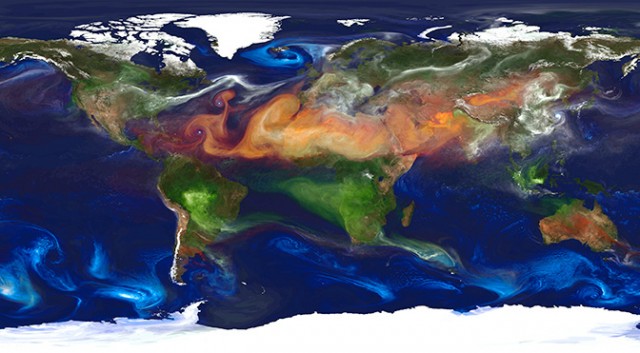
Here’s a mind-blowing view of the Earth that you’ve probably never seen — or even thought of — before. Dubbed “Portrait of Global Aerosols” by NASA, this is the kind of imagery that climate scientists use to analyze the Earth’s atmosphere, the weather, and trends such as global climate change.
Now, first things first: The Earth doesn’t actually look like this from space (alas). Rather, this is an image output by the Goddard Earth Observation System Model, version 5 (GEOS-5). GEOS-5 is an almighty piece of software that runs on a supercomputer at NASA’s Center for Climate Simulation in Maryland.
In the case of this image, GEOS-5 is modeling the presence of aerosols (solid or liquid particles suspended in gas) across the Earth’s atmosphere. Each of the colors represents a different aerosol: Red is dust (swept up from deserts, like the Sahara); Blue is sea salt, swirling inside cyclones; Green is smoke from forest fires; and white is sulfates, which bubble forth from volcanoes — and from burning fossil fuels. The full-size version of the image is particularly mesmerizing, with beautiful swirls of Saharan sand in the Atlantic, and perhaps the tail end of the Gulf Stream circling around Iceland.
It’s hard to be certain, but it seems like the US east coast, central Europe, and east Asia are burning a lot of fossil fuels. Japan, of course, sits on the edge of the Pacific Ring of Fire, so the sulfates there could be from volcanoes. The smoke in Australia is probably from forest fires — but the large volume of smoke from the Amazon rain forest and sub-Saharan Africa is curious. Are these forest fires, or the large-scale burning of wood for heat and power?
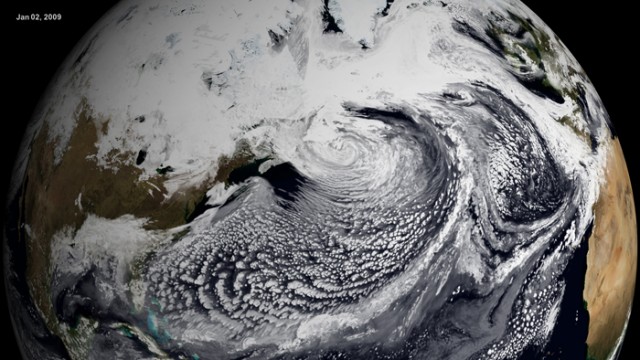
As you can imagine, the amount of raw data required to produce such imagery is immense. Weather modeling is still one of the primary uses of supercomputers. To create the Portrait of Global Aerosols, GEOS-5 will have aggregated the measurements from hundreds of weather stations across Earth, along with data from the four NASA/NOAA GOES weather satellites. So you have some idea of the complexity of the GEOS-5 model, the resolution of this image is 10 kilometers (6 miles) — meaning the Earth has been split into regions (“pixels”) of 10km2, and then the atmospheric conditions are simulated for each region. The surface area of the Earth is 510,072,000km2, which means the total number of regions is around 5 million.
Each of these 5 million pixels might have megabytes or gigabytes of weather data associated with it — and of course, in any given area, the weather in each pixel interacts with those around it. This gives you some idea of how much data needs to be processed and moved around — and it only becomes exponentially more complex as sensors improve (producing more data) and as you increase the depth of your analysis. In the case of climate change, for example, scientists are modeling decades or even centuries of data to try and divine some kind of pattern — a task that taxes even the most powerful supercomputers. If you’ve ever wondered why we keep building faster and faster supercomputers, now you know why.
Now read: What can you actually do with a supercomputer?
Tuesday, December 18. 2012
Via space.com
-----
NASA plans a new weapon in the fight against space insomnia: high-tech light-emitting diodes to replace the fluorescent bulbs in the U.S. section of the International Space Station.
About half of everyone who flies to space relies on sleep medication, at some point, to get some rest. For $11.2 million, NASA hopes to use the science of light to reduce astronauts' dependency on drugs.
According to NASA flight surgeon Smith Johnston, studies in Anchorage, Alaska showed that hospital staff made more medical errors during the darkest times of the year. The finding demonstrates that people have a day-night cycle that must be respected, even when they're doing the demanding work of space exploration.
"When you have normal light coming through the windows of stores, and schools, and hospitals, people do better. They function better," said Johnston, the lead physician for NASA's wellness program. [Video: Do Astronauts Dream of Weightless Sheep?]
Tough sleep in space
Sleep is no trivial matter in space. Astronauts generally get about six hours of shut-eye in orbit despite being allowed 8.5. Demanding schedules and unusual environments are among the factors that cause insomnia.
"The station is noisy, carbon dioxide is high, you don't have a shower, there's a lot of angst because you've got to perform. Imagine if you have a camera on you 24 hours a day," Johnston said.
Over time, sleep deprivation can cause irritation, depression, sickness or mistakes. Any of these problems can be dangerous in the close, confined, pressurized quarters of the space station.
In an effort to address the problem, NASA plans to replace the orbiting laboratory's fluorescent bulbs with an array of LEDs switching between blueish, whitish and reddish light, according to the time of day. The changes can be programmed in by the ground, or the astronauts. The new light bulbs are due to be swapped in by 2016.
Blue light stimulates the human brain best because people evolved to respond to the color of Earth's sky, experts say. When an astronaut's eyes are exposed to blue light, his or her body suppresses melatonin, a sleep-inducing hormone. Blue also promotes the formation of melanopsin, a "protein pigment" that keeps people awake.
In simple terms, the color red reverses the process. Melatonin increases, making the astronaut sleepy, while melanopsin is suppressed.
"You can dial in a natural day-night cycle on the space station" with the new light arrays, which are being developed by Boeing, Johnston said.
It should work well, he added, unless astronauts look out the window at bedtime. They then run the risk of confusing their body clocks by exposing their eyes to natural sunlight reflecting off of Earth.
Sleep training
Technology can go only so far in solving sleep problems, Johnston said. This is why NASA prescribes good "sleep hygiene" for its crews before and during spaceflight.
Medications are used only as a last resort, and are tested extensively on Earth by each crew member. In case of emergency, astronauts must awaken easily even during the deepest stages of sleep.
The astronauts also get practice sleeping under difficult circumstances by virtue of their demanding preflight schedules, which include flights to Russia and Japan for training.
NASA works with the astronauts to minimize jet lag. Techniques that help for each crew member, such as wearing sunglasses on the plane and taking medications at a certain time, can then be used in orbit.
Groups on Earth will benefit from the research, too, especially shift workers or travellers fighting jet lag, Johnston said.
"Hopefully, we'll have spinoffs that other doctors can use, and the military can use for their flight surgeons."
Note:
Of course, it makes me think (a lot!) to the 3 projects we did back in 2010 (I-Weather as Deep Space Public Lighting) and with Philippe Rahm architects in 2009 (I-Weather v.2009) and 2001 (I-Weather).
This to say, you can still download the I-Weather App for free on the app store an regulate your sleep during Christmas (which is also some sort of sleep deprivation period)!
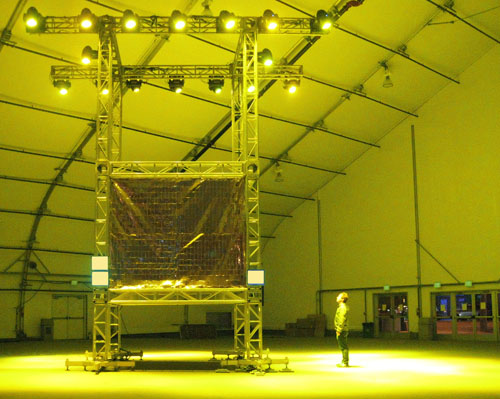
I-Weather as Deep Space Public Lighting, 2010 01SJ Biennial, San Jose (CA), by fabric | ch.
.jpg)
I-Weather, networked based application and deterritorilized luminous climate, 2009 version, by Philippe Rahm architects and fabric | ch.
Tuesday, June 26. 2012
-----
de Nicola

IMAGE: Gut flora redesign, using a yogurt vehicle, is already a commonplace activity at breakfast tables around the world.
For many, the consumption of probiotic supplements is already a daily routine — a regular, intentional, and frequently yogurt-based effort to re-design our intestinal flora. This makes sense: the five hundred (or so) different species of bacteria living inside our guts have an important influence on everything from our ability to digest certain foods to our emotional well-being and behaviour.
Doses of “friendly” bacteria have already been shown to cure chronic digestive illnesses, and, according to Professor John Cryan of the Alimentary Pharmabiotic Centre at University College, Cork, it’s highly likely that they will soon be used to treat “stress-related psychiatric disorders such as anxiety and depression.” These beneficial microbes are typically consumed orally, either dried and encapsulated in supplement form or cultured in a dairy base, although in extreme situations they can also be introduced directly to the colon using the somewhat horrifying-sounding technique of fecal transplant.

IMAGE: Probiotic bacteria.
Last month, however, scientists at the University of Toronto announced the results of a study that examined both babies’ gut bacteria and the bacteria present in dust samples from their homes. To their surprise, they found a significant overlap, suggesting, as Jessica Hamzelou writes in New Scientist, that babies “may be sharing their gut bacteria with the environment and vice versa.”
Extrapolating from this, public health researcher Pilar Francino goes on to speculate that “people living in the same dusty house may also share health and behavioural characteristics.”
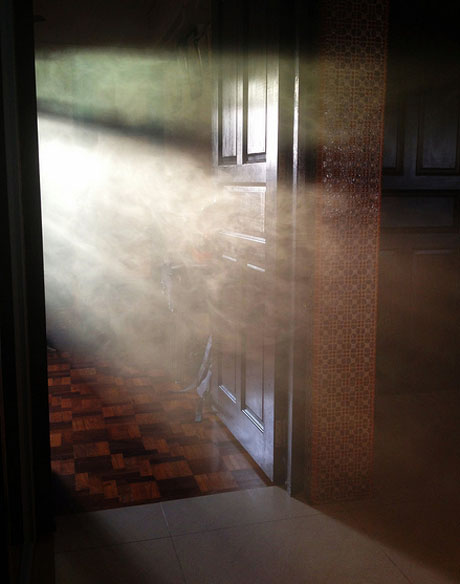
IMAGE: A dusty house, via.
In other words, just as the colour of your walls has been shown to affect your heart rate and blood pressure, your home’s bacterial biome may be making you obese and anxious — or, of course, healthy and happy.
Forget yogurt or fecal transplants — it seems to be only a matter of time before we are able to intentionally inoculate our homes with custom blends of bacteria in order to redesign our gut flora. Designer dust will take its place alongside formaldehyde-free furniture polish and low VOC paint for the responsible homeowner.
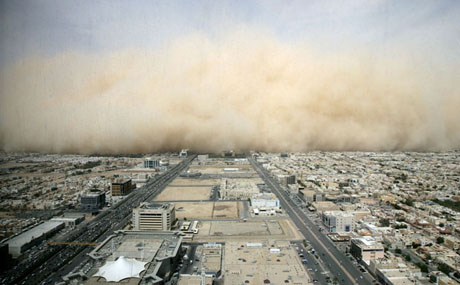
IMAGE: A dust cloud envelopes a city, via.
Perhaps, given the rising cost of obesity-related diseases combined with the increasing occurrence of allergies, environmental bacteria supplementation will come to be seen as a public health issue, with sanitation crews spraying down pavements and gutters with a fine layer of dried lactobacilli each week.
Meanwhile, somewhere, someday, the Bazalgette of urban probiotics will install a city-wide enteric enhancement program, combining a biotic sensor network and precision bifidobacteria crop-dusting drones in order to transform the city’s streets, transit network, and shared spaces into a giant, shared digestive supplement.
Thursday, April 26. 2012
In the "tele-present" environments serie and after the water, here comes the wind, by David Bowen:
See also his previous work, "Tele-present water" that has been published a lot already.
PS. Thanks Sinan Mansuroglu for the link.
Personal comment:
It is a very direct translation of the source, very readable and therefore quite efficient (but also possibly too direct, like a roboticized reproduction). In this case, we are confronted to a kinetic sculpture, which makes it works, especially in the case of the water. It is, literaly, a kinetic sculpture in the abstract realism tradition.
We would be in our case of course more interested in the creation of full livable environments (Perpetual (Tropical) SUNSHINE and Arctic Opening or RealRoom(s) are some examples of what we are trying on our side), possibly working more in the direction of a transposition and combination process (without going into a synestetic approach though!)
Tuesday, April 24. 2012
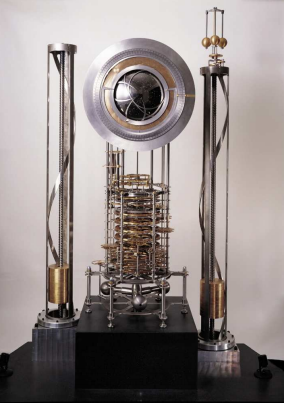
Ten thousand years is about the age of civilisation. Archaeologists have a few relics that have spanned this period, mostly stone tools and works of art. But most evidence of the earliest civilisations has long crumbled into dust.
So the plan to build a mechanical clock that will keep time for the next ten thousand years is hugely ambitious. And yet that is exactly the goal of the Long Now Foundation, an organisation set up to promote long term thinking and responsibility.
These guys are currently building a prototype of their clock inside a mountain in Texas near the border with New Mexico. And today, Danny Hillis at the foundation and a few pals, outline the way in which it will keep time.
Keeping time over such a period generates numerous challenges. First is ensuring the mechanical integrity of the machinery, which they achieve with long-lasting materials such as titanium, ceramics, quartz and sapphire.
Just as important is the environment: a series of tunnels carved into a mountainside in the high desert. Inside the mountain, the conditions are dry and the temperature constant.
Outside, however, the temperature varies between dessert extremes of hot and freezing. Hillis and co plan to exploit this temperature difference to power the clock using metal rods that change in length as the temperature varies. Human visitors will also be able to wind it.
As for time, the heart of the clock is a titanium pendulum with a 10 second cycles. Pendulum Time advances one unit once every 30 cycles, in other words every five minutes.
The rest of the clock is a digital computer using Pendulum Time as an input and generating analogue outputs in the form of various displays of time.
The mechanism first calculates Uncorrected Solar Time using a straightforward equation of time, which has been precomputed for the next ten thousand years to within the accuracy of the Earth's variable rotation.
Next, the clock calculates Solar Time using a correction provided by a solar sychroniser: a vertical chamber that heats up when the sun is directly overhead and shines into it. This can add or take away a tick if the clock is out of sync. "The correction is positive if the Sun is detected before the just-before-noon tick, and negative if it is detected after the just after-noon tick," say Hillis and co.
An obvious problem occurs if the Sun is obscured for long periods of time, perhaps because of dust from a volcanic eruption. In that case, the clock will keep uncorrected solar time until the Sun becomes visible again. Then it can correct the time in 5 minutes steps each sunny day.
It is this mechanism that corrects for any changes in the Earth's rotation, caused by climate change, shifts in the Earth's crust and so on. An accumulation of ice at the poles will cause the rotation to speed up, for example.
But provided the clock does not drifted by more than 12 hours, it should return to the right time. "This allows the clock to successfully recover after more than a century of overcast skies," say Hillis and co.
The clocks uses Corrected Solar Time to generate a Displayed Solar Time that visitors will see. It also calculates Orrery Time, a display of the position and phase of the Moon, the tropical year, the sidereal day, orbits of the visible planets, and the precession of the Earth's axis.
The plan is to use the lessons from building this prototype to create another clock in a mountain in Nevada. After that, the creators hope that other groups around the world will make their own millennium clocks, thereby spreading the pattern of long term thinking.
A profoundly impressive project.
Personal comment:
Obviously we are interested in "dimensions" and the way to architecture or interact with them. In this case, it is particularly interesting to underline the relationship between the construction of the clock (its materials, architecture) and the environment (the tunnels) that could/should last unchanged for 10'000 years.
Monday, April 02. 2012
-----
de Marion Wagner

A l’heure actuelle la demande en énergie croît plus vite que l’offre. Selon l’Agence internationale de l’énergie, à l’horizon 2030 les besoins de la planète seront difficiles à satisfaire, tous types d’énergies confondus. Il faudra beaucoup de créativité pour satisfaire la demande.
Vincent Schachter, directeur de la recherche et du développement pour les énergies nouvelles à Total commence son exposé sur la biologie de synthèse. “C’est important de préciser dans quel cadre nous travaillons”. Ses chercheurs redessinent le vivant. Ils s’échinent à mettre au point des organismes microscopiques, des bactéries, capables de produire de l’énergie.
En combinant ingénierie, chimie, informatique et biologie moléculaire, les scientifiques recréent la vie.
Ambition démiurgique
Aucune avancée scientifique n’a incarné tant de promesses : détourner des bactéries en usines biologiques capables de produire des thérapeutiques contre le cancer, des biocarburants ou des molécules capables de dégrader des substances toxiques.
Dans la salle Lamartine de l’Assemblée nationale ce 15 février, le parterre de spécialistes invités par l’Office parlementaire d’évaluation des choix scientifique et techniques (OPECST) est silencieux. L’audition publique intitulée Les enjeux de la biologie de synthèse s’attaque à cette discipline jeune, enjeu déjà stratégique. Geneviève Fioraso, députée de l’Isère, qui l’a organisée, confesse : “J’ai des collègues parlementaires à l’Office qui sont biologistes. Ils me disent qu’ils sont parfois dépassés par ce qui est présenté. Ce sont des questions très complexes d’un point de vue scientifique”.
L’Office, dont la mission est “d’informer le Parlement des conséquences des choix de caractère scientifique et technologique afin, notamment, d’éclairer ses décisions” est composé de parlementaires, députés et sénateurs. Dix-huit élus de chaque assemblée qui représentent proportionnellement l’équilibre politique du Parlement. Assistés d’un conseil scientifique ad hoc ils sont saisis des sujets scientifiques contemporains : la sûreté nucléaire en France, les effets sur la santé des perturbateurs endocriniens, les leçons à tirer de l’éruption du volcan Eyjafjöll…
Marc Delcourt, le PDG de la start-up Global Bioenergies, basée à Evry, prend la parole :
La biologie de synthèse, c’est créer des objets biologiques. Nous nous attachons à transformer le métabolisme de bactéries pour leur faire produire à partir de sucres une molécule jusqu’à maintenant uniquement issue du pétrole, et dont les applications industrielles sont énormes.
Rencontré quelques jours plus tard, Philippe Marlière, le cofondateur de l’entreprise, “s’excuse”. Il donne, lui, une définition “assez philosophique” de la biologie de synthèse : ” Pour moi c’est la discipline qui vise à faire des espèces biologiques, ou tout objet biologique, que la nature n’aurait pas pu faire. Ce n’est pas ‘qu’elle n’a pas fait’, c’est ‘qu’elle n’aurait pas pu faire. Il faut que ce soit notre gamberge qui change ce qui se passe dans le vivant”.

Ce bio-chimiste, formé à l’École Normale Supérieure, assume sans fard une ambition de démiurge, il s’agit de créer la vie de manière synthétique pour supplanter la nature. Il ajoute :
Je ne suis pas naturaliste, je ne fais pas partie des gens qui pensent que la nature est harmonieuse et bonne. Au contraire, la biologie de synthèse pose la nature comme imparfaite et propose de l’améliorer .
Aussi provoquant que cela puisse paraître c’est l’objectif affiché et en partie atteint par la centaine de chercheurs qui s’adonne à la discipline depuis 10 ans en France. Il reprend : “Aussi vaste que soit la diversité des gènes à la surface de la terre, les industriels se sont déjà persuadés que la biodiversité naturelle ne suffira pas à procurer l’ensemble des procédés dont ils auront besoin pour produire de manière plus efficace des médicaments ou des biocarburants. Il va falloir que nous nous retroussions les manches et que nous nous occupions de créer de la bio-diversité radicalement nouvelle, nous-mêmes.”
Biologiste-ingénieur
L’évolution sur terre depuis 3 milliard et demi d’années telle que décrite par Darwin est strictement contingente. La sélection naturelle, écrit le prix Nobel de médecine François Jacob dans Le jeu des possibles “opère à la manière d’un bricoleur qui ne sait pas encore ce qu’il va produire, mais récupère tout ce qui lui tombe sous la main, les objets les plus hétéroclites, bouts de ficelle, morceaux de bois, vieux cartons pouvant éventuellement lui fournir des matériaux […] D’une vieille roue de voiture il fait un ventilateur ; d’une table cassée un parasol. Ce genre d’opération ne diffère guère de ce qu’accomplit l’évolution quand elle produit une aile à partir d’une patte, ou un morceau d’oreille avec un fragment de mâchoire”.
Le hasard de l’évolution naturelle, combiné avec la nécessité de l’adaptation a sculpté un monde “qui n’est qu’un parmi de nombreux possibles. Sa structure actuelle résulte de l’histoire de la terre. Il aurait très bien pu être différent. Il aurait même pu ne pas exister du tout”. Philippe Marlière ajoute, laconique : “A posteriori on a toujours l’impression que les choses n’auraient pas pu être autrement, mais c’est faux, le monde aurait très bien pu exister sans Beethoven”.
Cliquer ici pour voir la vidéo.
Comprendre que l’évolution n’a ni but, ni projet. Et la science est sur le point de pouvoir mettre un terme au bricolage inopérant de l’évolution. Le biologiste, ici, est aussi ingénieur. A partir d’un cahier des charges il définit la structure d’un organisme pour lui faire produire la molécule dont il a besoin. Si la biologie de synthèse en est à ses balbutiements, elle est aussi une révolution culturelle.
Il s’agit désormais de créer de nouvelles espèces dont l’existence même est tournée vers les besoins de l’humanité. “La limite à ne pas toucher pour moi c’est la nature humaine. Je suis un opposant acharné au transhumanisme“, met tout de suite en garde le généticien.
A, T, G, C
Depuis que Francis Crick, James Watson et Rosalind Franklin ont identifié l’existence de l’ADN, l’acide désoxyribonucléique, en 1953, une succession de découvertes ont permis de modifier cet l’alphabet du vivant.
On sait désormais lire, répliquer, mais surtout créer un génome et ses gènes, soit en remplaçant certaines de ses parties, soit en le synthétisant entièrement d’après un modèle informatique. Les gènes, quatre bases azotées, A, T, G et C qui se succèdent le long de chacun des deux brins d’ADN pour former la fameuse double hélice, illustre représentation du vivant. Quatre molécules chimiques qui codent la vie : A, pour adénine, T pour thymine, G pour guanine, et C pour cytosine. Leur agencement détermine l’activité du gène, la ou les protéines pour lesquelles il code, qu’il crée. Les protéines, ensuite, déterminent l’action des cellules au sein des organismes vivants : produire des cheveux blonds, des globules blancs, ou des bio-carburants.
On peut à l’heure actuelle, en quelques clics, acheter sur Internet une base azotée pour 30 cents. Un gène de taille moyenne, chez la bactérie, coûte entre 300 et 500 €, il est livré aux laboratoires dans de petits tubes en plastique translucide. Là il est intégré à un génome qui va générer de nouvelles protéines, en adéquation avec les besoins de l’industrie et de l’environnement.
L’être humain est devenu ingénieur du vivant, il peut transformer de simples êtres unicellulaires, levures ou bactéries en de petites usines qu’il contrôle. C’est le bio-entrepreneur américain Craig Venter qui sort la discipline des laboratoires en annonçant en juin 2010 avoir crée Mycoplasma mycoides, une bactérie totalement artificielle “fabriquée à partir de quatre bouteilles de produits chimiques dans un synthétiseur chimique, d’après des informations stockées dans un ordinateur”.

Si la création a été saluée par ses pairs et les médias, certains s’attachent toutefois à souligner que sa Mycoplasma mycoides n’a pas été crée ex nihilo, puisque le génome modifié a été inséré dans l’enveloppe d’une bactérie naturelle. Mais la manipulation est une grande première.
Tour de Babel génétique
Philippe Marlière a posé devant lui un petit cahier, format A5, où après avoir laissé dériver son regard il prend quelques notes. “Il y a longtemps qu’on essaye de changer le vivant en profondeur. Moi c’est l’aspect chimique du truc qui m’intéresse : où faut-il aller piocher dans la table de Mandeleiev pour faire des organismes vivants ? Jusqu’où sont-ils déformables ? Jusqu’à quel point peut-on les lancer dans des mondes parallèles sur terre ?”. Il jette un coup d’œil à son Schweppes :
Prenez l’exemple de l’eau lourde. C’est une molécule d’eau qui se comporte pratiquement comme de l’eau, et on peut forcer des organismes vivants à y vivre et évoluer. Or il n’y a d’eau lourde nulle part dans l’univers, il n’y a que les humains qui savent la concentrer. On peut créer un microcosme complètement artificiel et être sûr que l’évolution qui a lieu là-dedans n’a pas eu lieu dans l’univers. C’est l’évolution dans des conditions qui n’auraient pas pu se dérouler sur terre, c’est intéressant. La biologie de synthèse est une forme radicale d’alter-mondialisme, elle consiste à dire que d’autres vies sont vraiment possibles, en les changeant de fond en comble.
Ce n’est pas une provocation feinte, ce n’est même pas une provocation. L’homme a à cœur d’être bien compris. Il s’agit de venir à bout de l’évolution darwinienne, pathétiquement coincée à un stade qui n’assure plus les besoins en énergie des 10 milliards d’humains à venir. Il faut pour ça réécrire la vie, son code. Innover dans l’alphabet de quatre lettres, A, C, G et T. Créer une nouvelle biodiversité. Condition sine qua non : ces mondes, le nôtre, le naturel, et le nouveau, l’artificiel, devraient cohabiter sans pouvoir jamais échanger d’informations. Il appelle ça la tour de Babel génétique, où les croisements entre espèces seraient impossibles.
“Les écologistes exagèrent souvent, mais ils mettent en garde contre les risques de dissémination génétique et ils ont raison. Les croisements entre espèces vont très loin. J’ai lu récemment que le chat et le serval sont inter-féconds”. Il estime de la main la hauteur du serval, un félin tacheté, proche du guépard, qui vit en Afrique. Un mètre de haut environ.
Par ailleurs il fallait être superstitieux pour imaginer que le pollen des OGM n’allait pas se disséminer. Le pollen sert à la dissémination génétique ! D’où notre projet, il s’agit de faire apparaître des lignées vivantes pour lesquelles la probabilité de transmettre de l’information génétique est nulle.
Le concept tient en une phrase :
“The farther, the safer : plus la vie artificielle est éloignée de celle que nous connaissons, plus les risques d’échanges génétiques entre espèces diminuent. C’est là qu’il y a le plus de brevets et d’hégémonie technologique à prendre.”
Il s’agit de modifier notre alphabet de 4 lettres, A, C, G et T, pour créer un nouvel ADN, le XNA, clé de la “xénobiologie”:
X pour Xeno, étranger, et biologie. Le sens de cet alphabet ne serait pas lisible par les organismes vivants, c’est ça le monde qu’on veut faire. C’est comme lancer un Spoutnik, c’est difficile. Mais comme disait Kennedy, ‘On ne va pas sur la lune parce que c’est facile, on y va parce que c’est difficile.’
Cliquer ici pour voir la vidéo.
|


