Monday, March 13. 2023
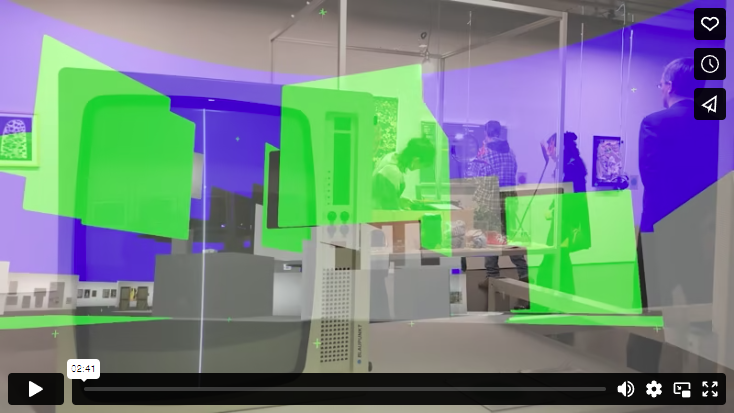
Atomized (re-)Staging short video documentation | #fabricch #digital #hybrid #exhibition
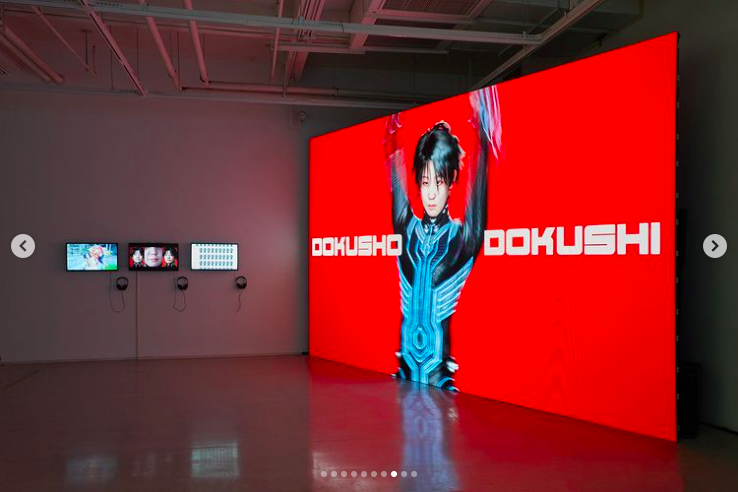
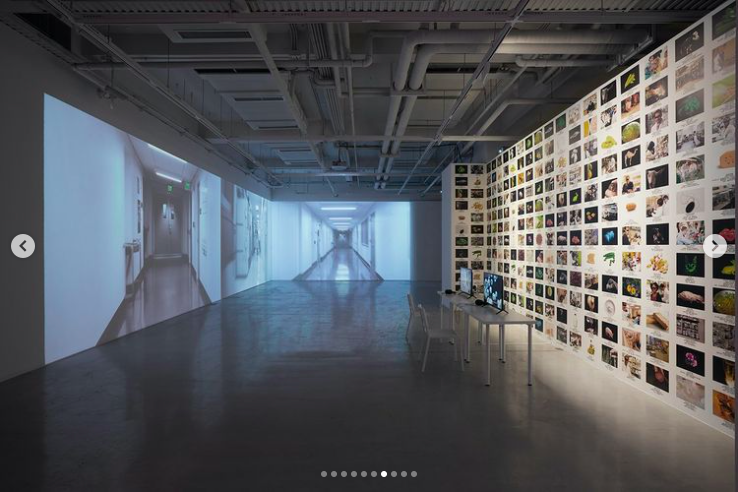
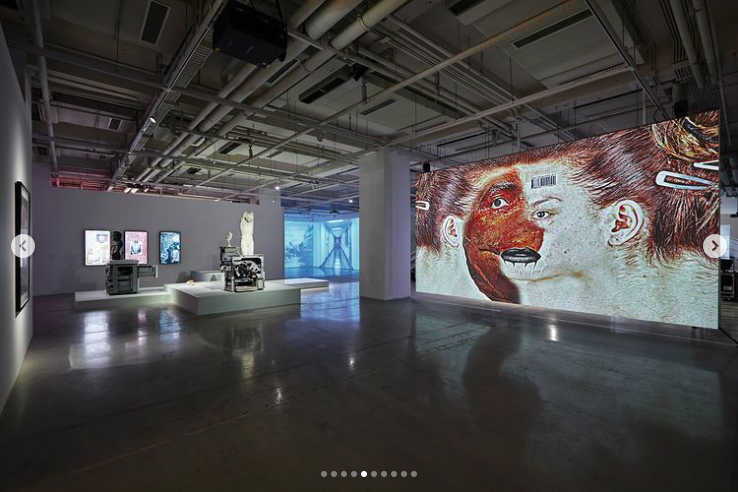
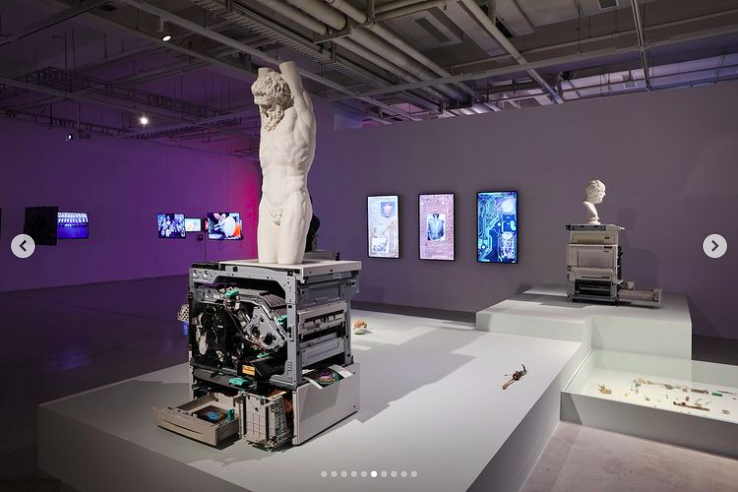
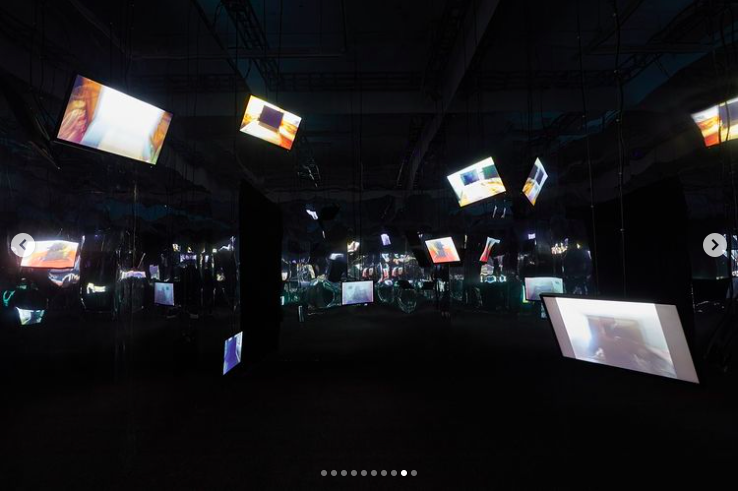
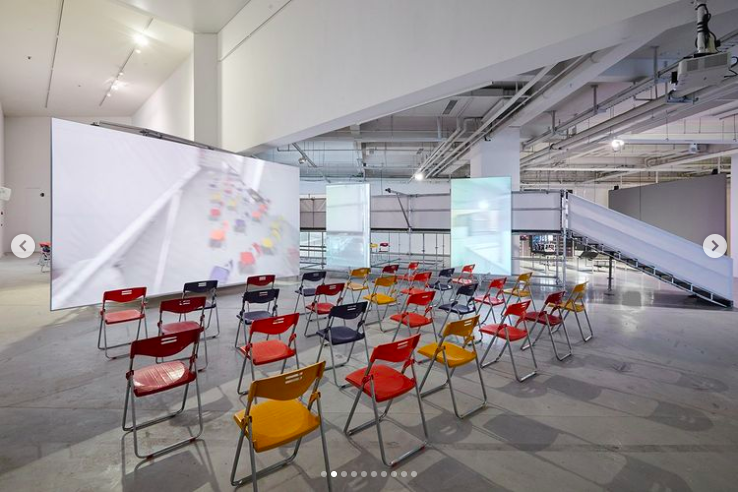
Note: a brief video documentation about one of fabric | ch's latest project – Atomized (Re)Staging – that was exhibited at ZKM during Matter. Non-Matter. Anti-Matter.
The exhibition was curated by Lívía Nolasco-Roszás and Felix Koberstein and took place ibn the context of the European research project Beyond Matter.
-----
Friday, March 10. 2023
Atomized (re-)Staging at ZKM, Instagram @zkmkarlsruhe (2023) | #fabricch #digital #exhibition #algorithmic #intelligence
Tuesday, January 17. 2023
Pro Helvetia – Visual Arts – Beneath the Skin, Between the Machines (2022) | #exhibition #bestof2022 #review
Note: fabric | ch is thrilled to be part of Pro Helvetia's Shanghai best of 2022! Thanks for this new post and for the support to the exhibition at the HOW Art Museum, as well as it's performances and online lectures program during the pandemic!
We were glad to see that the architectural installation fabric | ch realized in this context remained useful also for remote interaction, exchange of ideas and collaboration.
...
And it's also a way – and still the time – to wish everyone a good start in 2023! With, we hope, many successes, exciting projects and creative statements responding to the challenges of our time.
Via Pro Helvetia (Visual Arts)
-----
Our Best Picks of 2022
For art practitioners or audiences alike, it has not been an easy year. The path of global encounter seemed distant for a while, but has never vanished. Somehow we know, maybe in the most surprising manner, that we will meet each other again halfway. It could be one of these reassuring moments that convinced us of hope when the world is turned upside down: the flipping of bookpages, the smiles from digital rooms, a concert without performers, a recital without playwrights. We are so eager to present what has excited, motivated, or touched us in the past year. Scroll down and discover a diverse selection of projects highlighted under the three overarching themes -- support, connect, and inspire.
Wish you a brilliant start and a Happy New Year 2023!
Pro Helvetia Shanghai


Pro Helvetia Shanghai
Swiss Arts Council
Room 509, Building 1
No.1107, Yuyuan Road, Changning District
Shanghai 200050, China
shanghai@prohelvetia.cn
-----
Beneath the Skin, Between the Machines

Exhibition overview
---

---
“Man is only man at the surface. Remove the skin, dissect, and immediately you come to machinery.” When Paul Valéry wrote this down, he might not foresee that human beings – a biological organism – would indeed be incorporated into machinery at such a profound level in a highly informationized and computerized time and space. In a sense, it is just as what Marx predicted: a conscious connection of machine[1]. Today, machine is no longer confined to any material form; instead, it presents itself in the forms of data, coding and algorithm – virtually everything that is “operable”, “calculable” and “thinkable”. Ever since the idea of cyborg emerges, the man-machine relation has always been intertwined with our imagination, vision and fear of the past, present and future.
In a sense, machine represents a projection of human beings. We human beings transfer ideas of slavery and freedom to other beings, namely a machine that could replace human beings as technical entities or tools. Opposite (and similar, in a sense,) to the “embodiment” of machine, organic beings such as human beings are hurrying to move towards “disembodiment”. Everything pertinent to our body and behavior can be captured and calculated as data. In the meantime, the social system that human beings have created never stops absorbing new technologies. During the process of trial and error, the difference and fortuity accompanying the “new” are taken in and internalized by the system. “Every accident, every impulse, every error is productive (of the social system),”[2] and hence is predictable and calculable. Within such a system, differences tend to be obfuscated and erased, but meanwhile due to highly professional complexities embedded in different disciplines/fields, genuine interdisciplinary communication is becoming increasingly difficult, if not impossible.
As a result, technologies today are highly centralized, homogenized, sophisticated and commonized. They penetrate deeply into our skin, but beyond knowing, sensing and thinking. On the one hand, the exhibition probes into the reconfiguration of man by technologies through what’s “beneath the skin”; and on the other, encourages people to rethink the position and situation we’re in under this context through what’s “between the machines”. As an art institute located at Shanghai Zhangjiang Hi-Tech Industrial Development Zone, one of the most important hi-tech parks in China, HOW Art Museum intends to carve out an open rather than enclosed field through the exhibition, inviting the public to immerse themselves and ponder upon the questions such as “How people touch machines?”, “What the machines think of us?” and “Where to position art and its practice in the face of the overwhelming presence of technology and the intricate technological reality?” Departing from these issues, the exhibition presents a selection of recent works of Revital Cohen & Tuur Van Balen, Simon Denny, Harun Farocki, Nicolás Lamas, Lynn Hershman Leeson, Lu Yang, Lam Pok Yin, David OReilly, Pakui Hardware, Jon Rafman, Hito Steyerl, Shi Zheng and Geumhyung Jeong. In the meantime, it intends to set up a “panel installation”, specially created by fabric | ch for this exhibition, trying to offer a space and occasion for decentralized observation and participation in the above discussions. Conversations and actions are to be activated as well as captured, observed and archived at the same time.
[1] Karl Marx, “Fragment on Machines”, Foundations of a Critique of Political Economy
[2] Niklas Luhmann, Social Systems
---
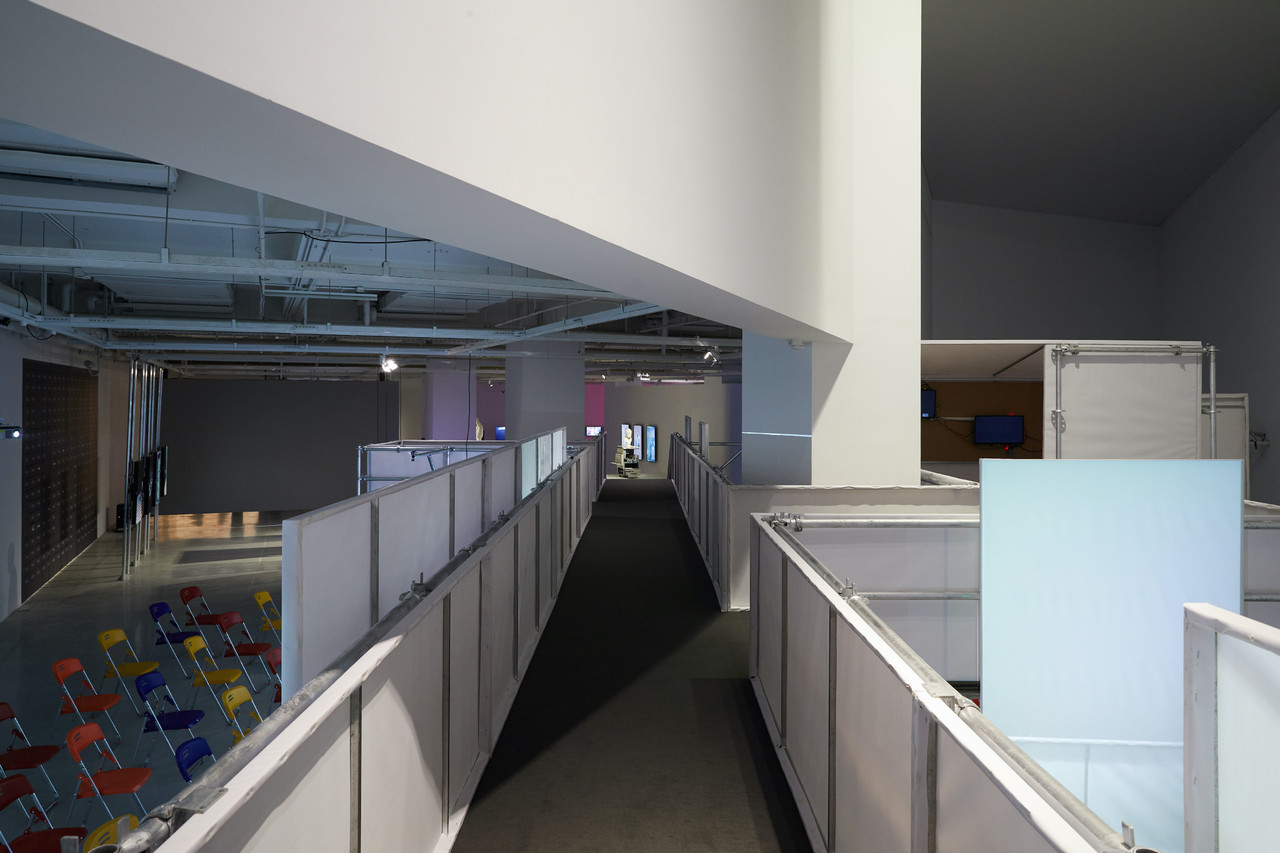
fabric | ch, Platform of Future-Past, 2022, Installation view at HOW Art Museum.
Work by fabric | ch
HOW Art Museum has invited Lausanne-based artist group fabric | ch to set up a “panel installation” based on their former project “Public Platform of Future Past” and adapted to the museum space, fostering insightful communication among practitioners from different fields and the audiences.
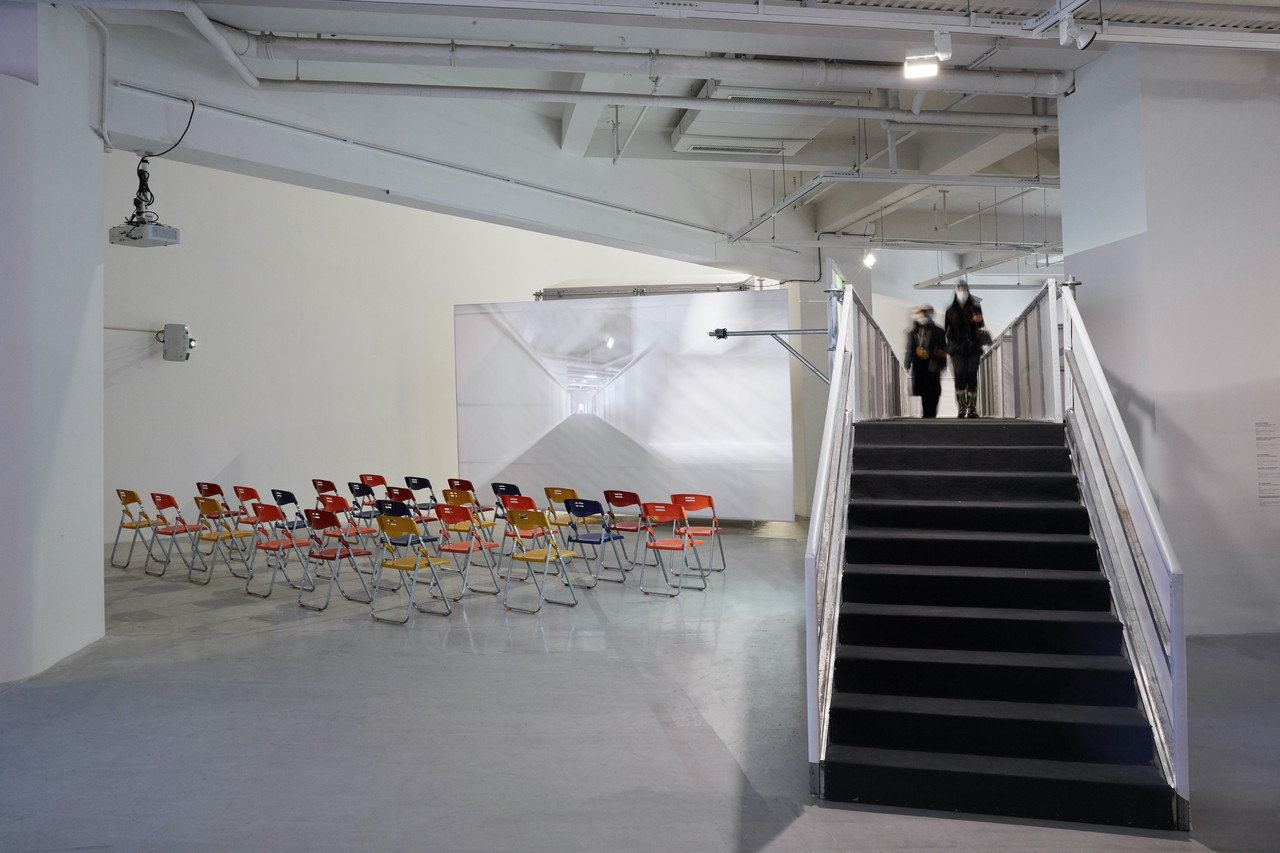
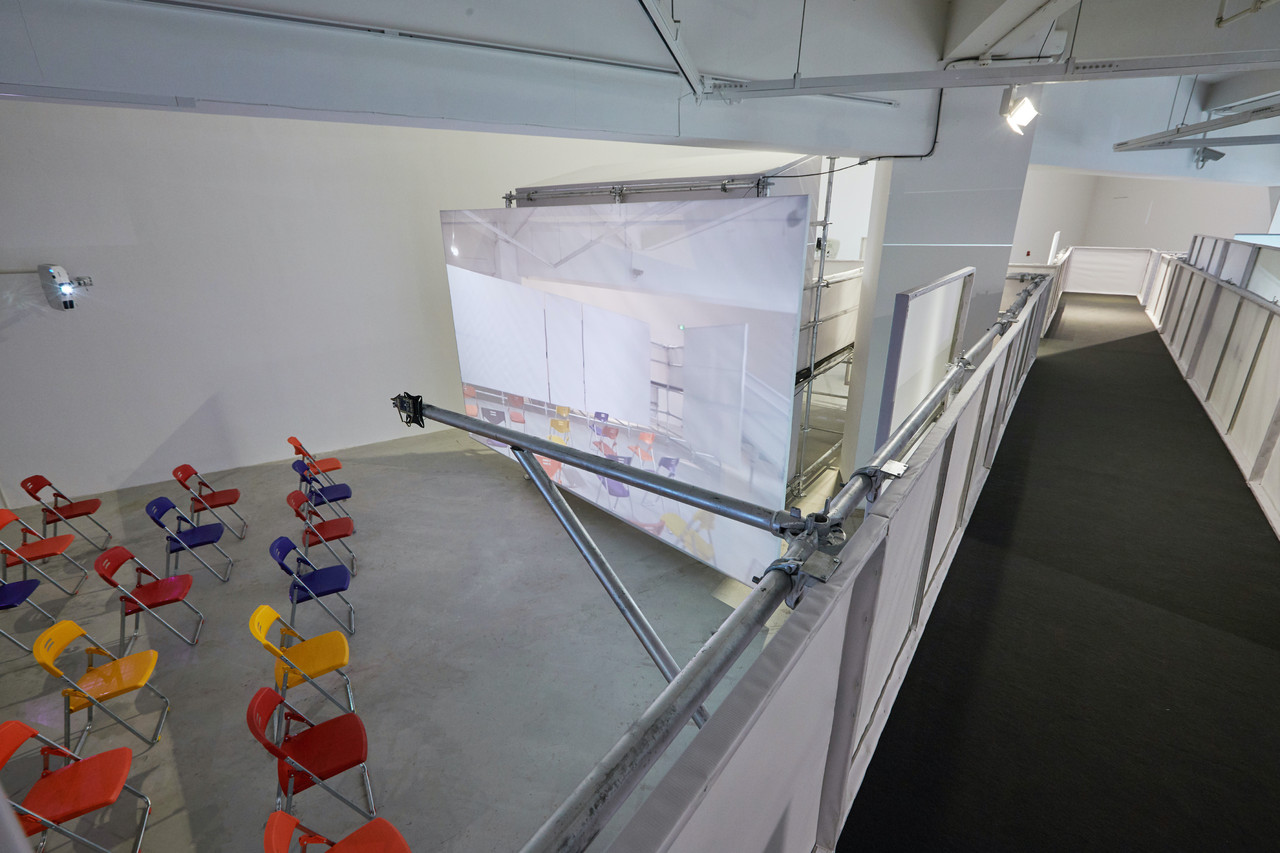
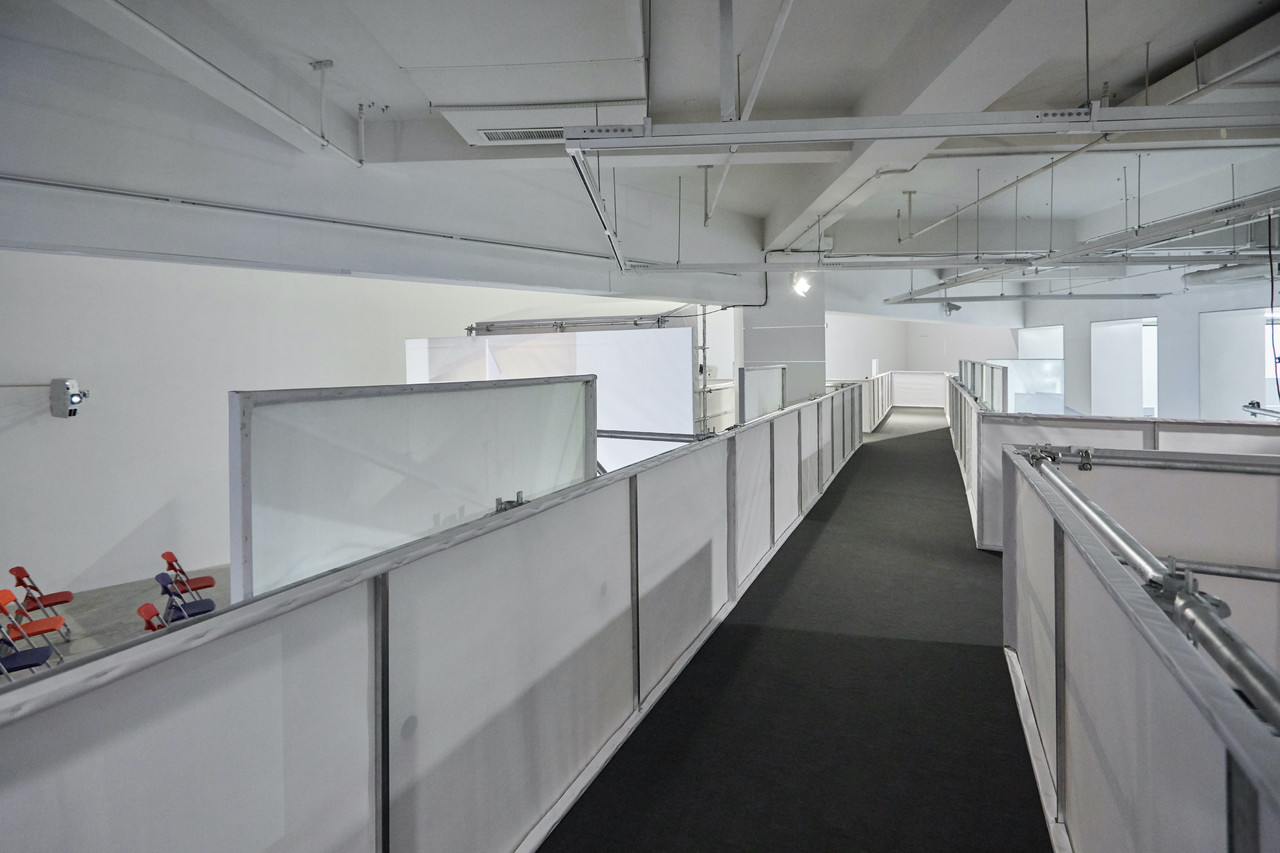
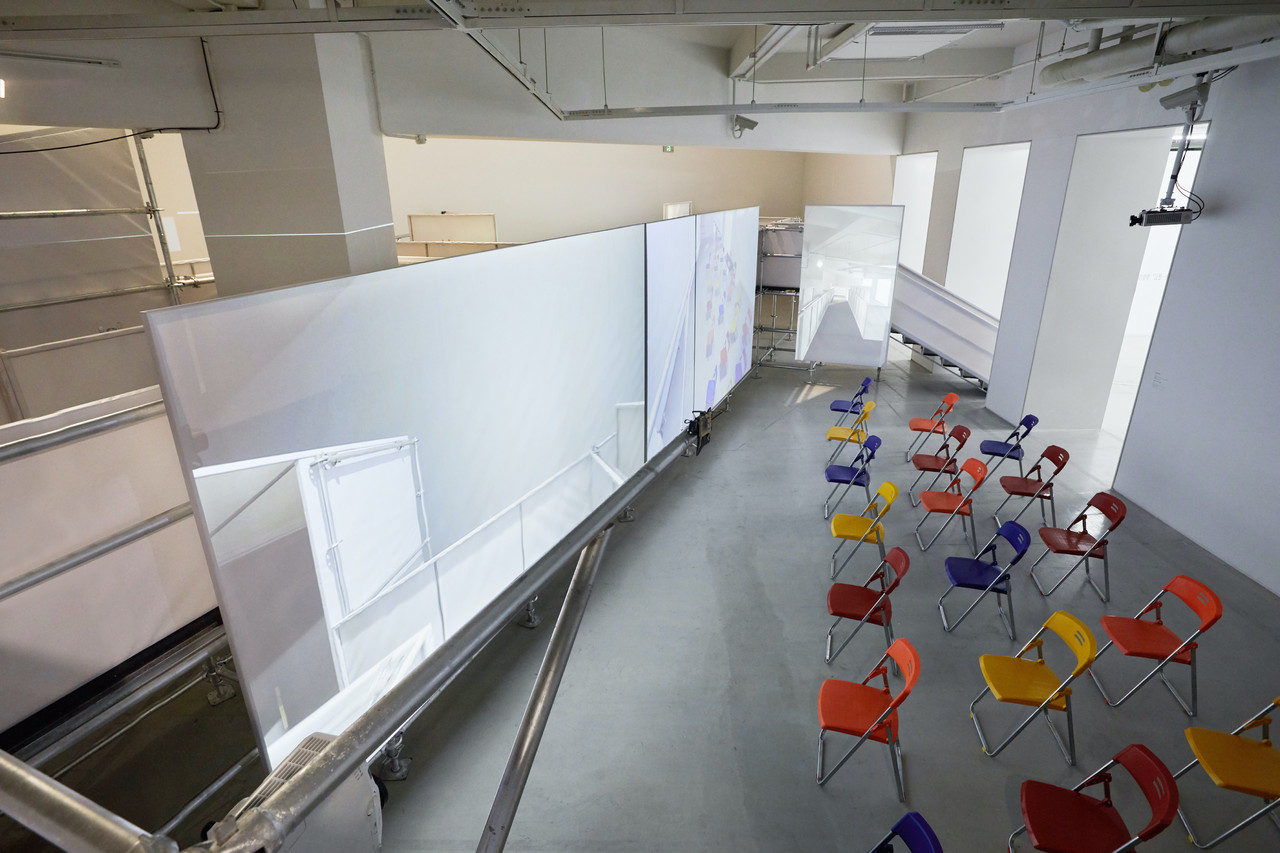
“Platform of Future-Past” is a temporary environmental device that consists in a twenty meters long walkway, or rather an observation deck, almost archaeological: a platform that overlooks an exhibition space and that, paradoxically, directly links its entrance to its exit. It thus offers the possibility of crossing this space without really entering it and of becoming its observer, as from archaeological observation decks. The platform opens- up contrasting atmospheres and offers affordances or potential uses on the ground.
The peculiarity of the work consists thus in the fact that it generates a dual perception and a potential temporal disruption, which leads to the title of the work, Platform of Future-Past: if the present time of the exhibition space and its visitors is, in fact, the “archeology” to be observed from the platform, and hence a potential “past,” then the present time of the walkway could be understood as a possible “future” viewed from the ground…
“Platform of Future-Past” is equipped in three zones with environmental monitoring devices. The sensors record as much data as possible over time, generated by the continuously changing conditions, presences and uses in the exhibition space. The data is then stored on Platform Future-Past’s servers and replayed in a loop on its computers. It is a “recorded moment”, “frozen” on the data servers, that could potentially replay itself forever or is waiting for someone to reactivate it. A “data center” on the deck, with its set of interfaces and visualizations screens, lets the visitors-observers follow the ongoing process of recording.
The work could be seen as an architectural proposal built on the idea of massive data production from our environment. Every second, our world produces massive amounts of data, stored “forever” in remote data centers, like old gas bubbles trapped in millennial ice.
As such, the project is attempting to introduce doubt about its true nature: would it be possible, in fact, that what is observed from the platform is already a present recorded from the past? A phantom situation? A present regenerated from the data recorded during a scientific experiment that was left abandoned? Or perhaps replayed by the machine itself ? Could it already, in fact, be running on a loop for years?
---
Schedule
Duration: January 15-April 24, 2022
Artists: Revital Cohen & Tuur Van Balen, Simon Denny, fabric | ch, Harun Farocki, Geumhyung Jeong, Nicolás Lamas, Lynn Hershman Leeson, Lu Yang, Lam Pok Yin, David OReilly, Pakui Hardware, Jon Rafman, Hito Steyerl, Shi Zheng
Curator: Fu Liaoliao
Organizer: HOW Art Museum, Shanghai
Lead Sponsor: APENFT Foundation
Swiss participation is supported by Pro Helvetia Shanghai, Swiss Arts Council.
---
[Banner image: fabric | ch, Platform of Future-Past, 2022, Scaffolding, projection screens, sensors, data storage, data flows, plywood panels, textile partitions, Dimensions variable.]
Event I
Beneath the Skin, Between the Machines — Series Panel
Investigating Sensoriums: Beyond Life/Machine Dichotomy

Schedule
Organizers: HOW Art Museum, Pro Helvetia Shanghai, Swiss Arts Council
Date: March 19, 2022
Time : 15:00 -16:30 (CST) / 8:00 – 9:30 (CET)
Host: Iris Long
Guests: Zian Chen, Geocinema (Solveig Qu Suess, Asia Bazdyrieva), Marc R. Dusseiller
Language: Chinese, English (with Chinese translation)
Event on Zoom(500 audience limit)
Link: https://zoom.us/j/92512967837
---
This round of discussion derived from the participating speakers’ responses toward to the title of the exhibition, Beneath the Skin, Between The Machines.
What lies beneath the skin of the earth and between the machines may well be signals among sensors. Geocinema’s study on the One Belt One Road initiative and exploration of a “planetary” notion of cinema relate directly to the above concern. Marc R. Dusseiller as a transdisciplinary scholar draws our attention to the possible pathways that skin/machines may generate for understanding to go beyond life/machine dichotomy. Zian Chen’s recent research attempts to bring the mediatized explorations back to our real living conditions. He will resort to real news events as cases to show why these mediatized explorations are embodied experience.
HOW Art Museum in collaboration with Pro Helvetia Shanghai, Swiss Arts Council, invite Zian Chen (writer and curator), Geocinema (art collective) and Marc R. Dusseiller (transdisciplinary scholar and artist) to have a panel discussion, probing into the topic of Beneath the Skin, Between The Machines from the perspectives of their own practice and experience. The panel will be moderated by curator and writer Iris Long.
* Due to pandemic restrictions, the panel will take place online. Video recording of the panel will be played on Platform of Future-Past (2022), an environmental installation conceived by fabric | ch, studio for architecture, interaction and research, for the exhibition.
---
About the Host
Iris Long
About the Guests
Zian Chen, Geocinema, Marc R. Dusseiller
---
Event II

Schedule
Organizers: HOW Art Museum, Pro Helvetia Shanghai, Swiss Arts Council, Conversazione (CVSZ)
Date: April 16, 2022
Time : 14:00-15:30(CST)/ 7:00 – 8:30 (CET)
Host: Cai Yixuan
Guests:Chloé Delarue, fabric | ch, Pedro Wirz, Chun Shao
Language: Chinese, English (with Chinese translation)
Event on Zoom(500 audience limit)
Link: https://us06web.zoom.us/j/85822263121
---
In the hotbed to breed new forms of life, the notion of “life” and digital intimacy are under constant construction and development.
Unfolding the histories of nature and civilization, what kind of interactions could be perceived from the materials, which we constantly used in past narratives, and the environment? How have these interactive relationships, perceivable yet invisible, been evolving and entwined?
This Saturday from 14:00 to 15:30, HOW Art Museum in collaboration with Pro Helvetia Shanghai, Swiss Arts Council and Conversazione, research-based art and design collective based in China, invite Chloé Delarue, whose ongoing body of work centers on the notion of TAFAA – Towards A Fully Automated Appearance; fabric | ch, studio for architecture and research who present an environmental installation at HOW Art Museum where discussions and events could take place; Pedro Wirz whose practice seeks to merge the supernatural with scientific realities; and Shao Chun whose new media artistic practice is dedicated to combing traditional handicrafts and electronic programming to have a panel discussion.
The event intends to probe into the topics covered in Beneath the Skin, Between The Machines and participants will share with audience their insights to materials and media from the perspectives of their own practices. The panel will be moderated by curator Cai Yixuan.
---
About the Host
Cai Yixuan
About the Guests
Chloé Delarue, fabric | ch, Pedro Wirz, Chun Shao
---
Event III
Beneath the Skin, Between the Machines — Online Performance
Holding it together*: myself and the other by Jessica Huber

Schedule
Artist: Jessica Huber, in collaboration with the performers Géraldine Chollet & Robert Steijn, video by Michelle Ettlin
Date: May 31, 2022, 21:00-June 4, 24:00, 2022
Organizer: HOW Art Museum
Performance Support: Pro Helvetia Shanghai, Swiss Arts Council
Technical Support: Centre for Experimental Film (CEF)
Online Screening: Link
---
*Due to COVID-related prevention measures, this projection of the performance will take place online via CEF.
Performance projection will be played when the museum can reopen on Platform of Future-Past (2022), an environmental installation conceived by fabric | ch, studio for architecture, interaction and research, for the exhibition.
HOW Art Museum (Shanghai) will also be temporarily closed during this period.
---
About the artist

Jessica Huber works as an artist in the field of the performing arts and is also together with Karin Arnold a founding member of mercimax, a performance collective based in Zürich.
After finishing her dance studies in London, she danced for various dance companies and most of her early pieces have been dance pieces too. Though her recent work and the forms and formats she chooses, have become more diverse during the past few years. Recently she has been collaborating with the British artist and activist James Leadbitter aka the vacuum cleaner on the hope & fear project.
Jessica works with curiosity and has a special interest in the texture of relationships and in how we function as individuals and as communities in society. She regularly gives workshops to professionals and non-professionals (different social groups) and teaches as a guest tutor at the Hyperwerk in Basel (Institut for studies for Post Industrial Design – or as they call it “the place where we think about how we want to live together in the future”) and is one of two artists who are part of the newly founded dramaturgy pool of Tanzhaus Zürich. She deeply enjoys diversity and is fascinated by the many possible aesthetics of exchange and sharing.
---
About the performance

Picture in the dark: Fletcher/Huber, picture daytime: Ettlin/Huber *pictures from “holding it together”: Nelly Rodriguez
Holding it together*: myself and the other is first of all an encounter between the two performers Géraldine Chollet and Robert Steijn – and the underlying questions of what binds us together and how we create intimacy, playfulness and trust by sharing rituals and treatments with each other.
Two very different and differently old bodies nestle together, doing silent rituals of gentle intimacy. They explain, apparently quite privately, how they met at a party and worked with each other – one with, one without a plan – and what this resulted in. The Dutch performer with a penchant for Shamanism and the dancer from Lausanne offer each other a song, a dance and neither shy away from deep feelings…
“Holding it together” is a series of collaborations, performances and researches Jessica Huber created in collaboration with different artists. The first idea for ‘Holding it together’ sparked during her studio residency in Berlin in 2013. This led to a collection of ideas, approaches to movement and formats under the thematic umbrella: ‘Holding it together’. Four thematic chapters or acts stem from this period: – The Thing; The Mass; Myself; Myself & the other(s).
“Holding it together” is not only a reference to the series’ overarching theme of cooperation and the question of how we perceive and create our world, but also an announcement of the working method: At the core of this series were reflections about the aesthetics and praxis of exchange and sharing, about rituals, as well as the longing for space and time for encounter.
Wednesday, November 30. 2022
Past exhibitions as Digital Experiences @ZKM, fabric | ch | #digital #exhibition #experimentation
Note:
The exhibition related to the project and European research Beyond Matter - Past Exhibitions as Digital Experiences will open next week at ZKM, with the digital versions (or should I rather say "versioning"?) of two past and renowned exhibitions: Iconoclash, at ZKM in 2002 (with Bruno Latour among the multiple curators) and Les Immateriaux, at Beaubourg in 1985 (in this case with Jean-François Lyotard, not so long after the release of his Postmodern Condition). An unusual combination from two different times and perspectives.
The title of the exhibition will be Matter. Non-Matter. Anti-Matter, with an amazing contemporary and historic lineup of works and artists, as well as documentation material from both past shows.
Working with digitized variants of iconic artworks from these past exhibitions (digitization work under the supervision of Matthias Heckel), fabric | ch has been invited by Livia Nolasco-Roszas, ZKM curator and head of the research, to present its own digital take in the form of a combination on these two historic shows, and by using the digital models produced by their research team and made available.

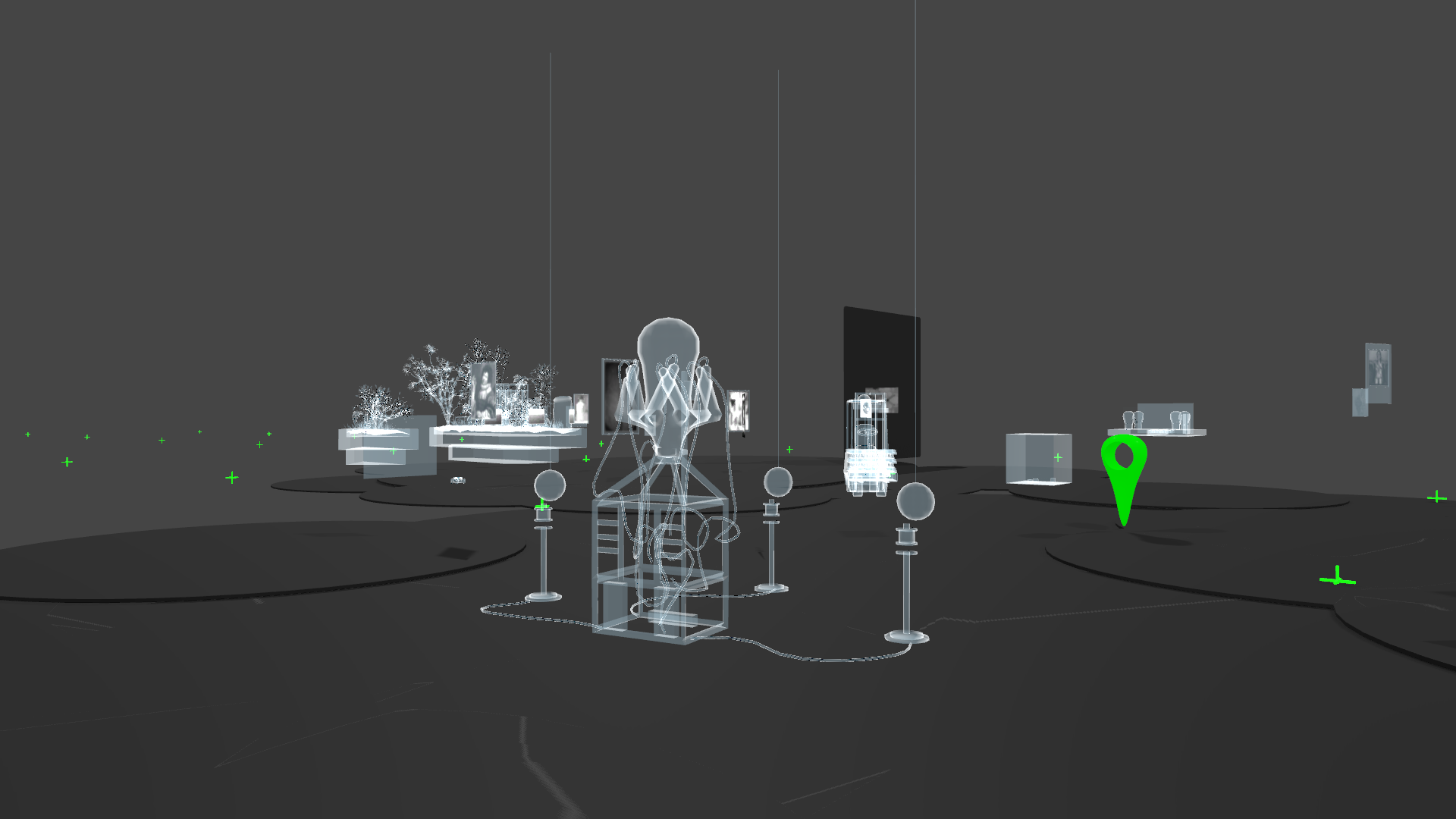
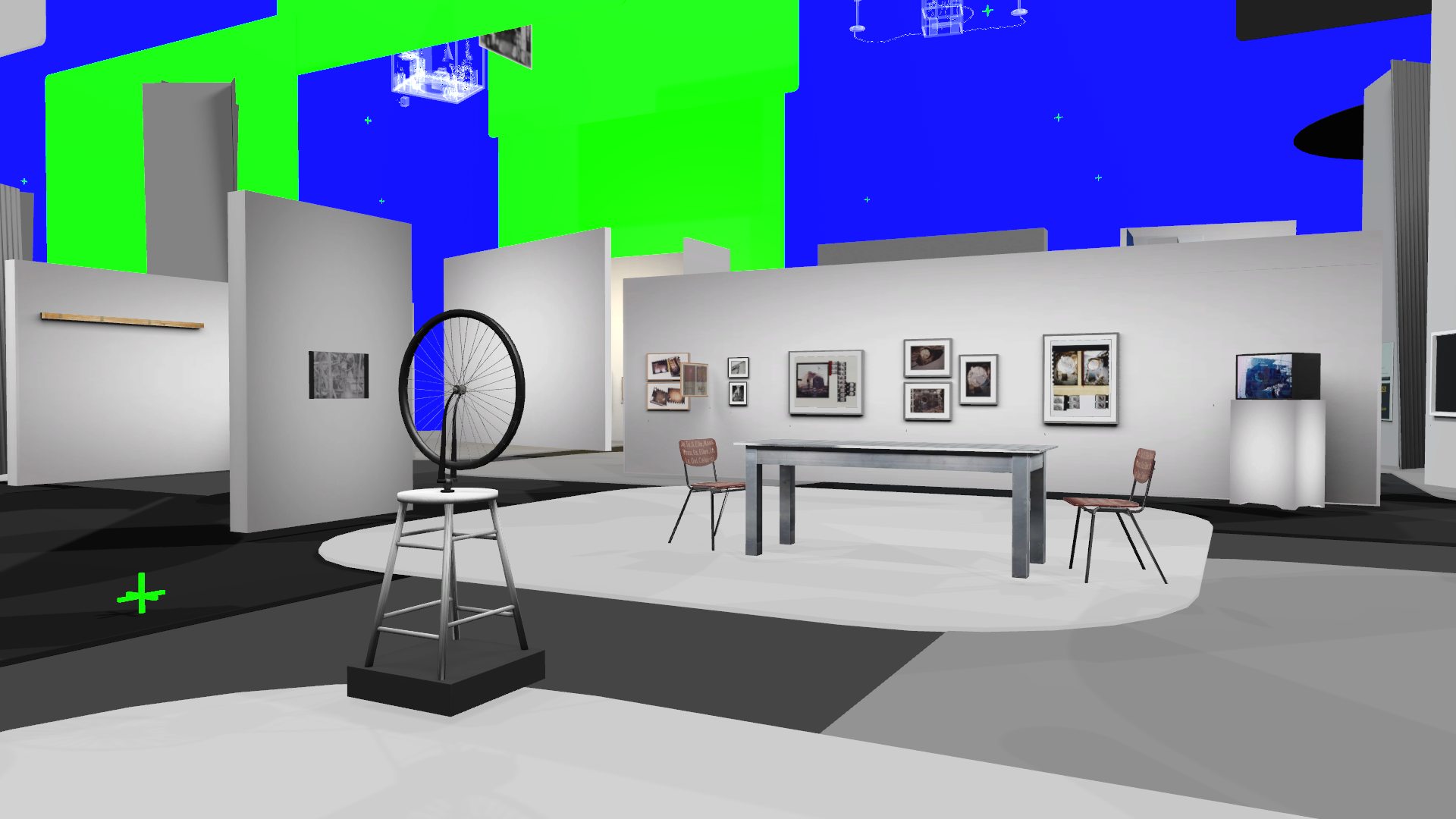
The result, a new fabric | ch project entitled Atomized (re-)Staging, will be presented at the ZKM in Karlsruhe from this Saturday on (03.12.2022 - 23.04.2023).
Via ZKM
-----

Opening: Matter. Non-Matter. Anti-Matter.
© ZKM | Center for Art and Media Karlsruhe, Visual: AKU Collective / Mirjam Reili
Past exhibitions as Digital Experiences
Fri, December 02, 2022 7 pm CET, Opening
---
Free entry
---
When past exhibitions come to life digitally, the past becomes a virtual experience. What this novel experience can look like in concrete terms is shown by the exhibition »Matter. Non-Matter. Anti-Matter«.
As part of the project »Beyond Matter. Cultural Heritage on the Verge of Virtual Reality«, the ZKM | Karlsruhe and the Centre Pompidou, Paris, use the case studies »Les Immatériaux« (Centre Pompidou, 1985) and »Iconoclash« (ZKM | Karlsruhe, 2002) to investigate the possibility of reviving exhibitions through experiential methods of digital and spatial modeling.
The digital model as an interactive presentation of exhibition concepts is a novel approach to exploring exhibition history, curatorial methods, and representation and mediation. The goal is not to create »digital twins«, that is, virtual copies of past assemblages of artifacts and their surrounding architecture, but to provide an independent sensory experience.
On view will be digital models of past exhibitions, artworks and artifacts from those exhibitions, and accompanying contemporary commentary integrated via augmented reality. The exhibition will be accompanied by a conference on virtualizing exhibition histories.
The exhibition will be accompanied by numerous events, such as specialist workshops, webinars, online and offline guided tours, and a conference.
---
Program
7 – 7:30 p.m. Media Theater
Short lectures by
Sybille Krämer, Professor (emer.) at the Free University of Berlin
Siegfried Zielinski, media theorist with a focus on archaeology and variantology of arts and media, curator, author
Moderation: Lívia Nolasco-Rózsás, curator
7:30 – 8:15 p.m. Media Theater
Welcome
Olga Sismanidi, Representative Creative Europe Program of the European Commission (EACEA)
Arne Braun, State Secretary in the Ministry of Science, Research and the Arts of Baden-Württemberg
Frank Mentrup, Lord Mayor of the City of Karlsruhe
Peter Weibel, Director of the ZKM | Karlsruhe
Xavier Rey, Director of the Centre Pompidou, Paris
8:15 – 8:30 p.m. Improvisation on the piano
Hymn Controversy by Bardo Henning
8:30 p.m.
Curator guided tour of the exhibition
---
The exhibition will be open from 8 to 10 p.m.
The mint Café is also looking forward to your visit.
---
Matter. Non-Matter. Anti-Matter.
Past Exhibitions as Digital Experiences.
Sat, December 03, 2022 – Sun, April 23, 2023
The EU project »Beyond Matter: Cultural Heritage on the Verge of Virtual Reality« researches ways to reexperience past exhibitions using digital and spatial modeling methods. The exhibition »Matter. Non-Matter. Anti-Matter.« presents the current state of the research project at ZKM | Karlsruhe.
At the core of the event is the digital revival of the iconic exhibitions »Les Immatériaux« of the Centre Pompidou Paris in 1985 and »Iconoclash: Beyond the Image Wars in Science, Religion, and Art« of the ZKM | Karlsruhe in 2002.
Based on the case studies of »Les Immatériaux« (Centre Pompidou, 1985) and »Iconoclash: Beyond the Image Wars in Science, Religion, and Art« (ZKM, 2002), ZKM | Karlsruhe and the Centre Pompidou Paris investigate possibilities of reviving exhibitions through experiential methods of digital and spatial modeling. Central to this is also the question of the particular materiality of the digital.
At the heart of the Paris exhibition »Les Immatériaux« in the mid-1980s was the question of what impact new technologies and materials could have on artistic practice. When philosopher Jean-François Lyotard joined as cocurator, the project's focus eventually shifted to exploring the changes in the postmodern world that were driven by a flood of new technologies.
The exhibition »Iconoclash« at ZKM | Karlsruhe focused on the theme of representation and its multiple forms of expression, as well as the social turbulence it generates. As emphasized by curators Bruno Latour and Peter Weibel, the exhibition was not intended to be iconoclastic in its approach, but rather to present a synopsis of scholarly exhibits, documents, and artworks about iconoclasms – a thought experiment that took the form of an exhibition – a so-called »thought exhibition.«
»Matter. Non-Matter. Anti-Matter.« now presents in the 21st century the digital models of the two projects on the Immaterial Display, hardware that has been specially developed for exploring virtual exhibitions. On view are artworks and artifacts from the past exhibitions, as well as contemporary reflections and artworks created or expanded for this exhibition. These include works by Jeremy Bailey, damjanski, fabric|ch, Geraldine Juárez, Carolyn Kirschner, and Anne Le Troter that echo the 3D models of the two landmark exhibitions. They bear witness to the current digitization trend in the production, collection, and presentation of art.
Case studies and examples of the application of digital curatorial reconstruction techniques that were created as part of the Beyond Matter project complement the presentation.
The exhibition »Matter. Non-Matter. Anti-Matter.« is accompanied by an extensive program of events: A webinar series aimed at museum professionals and cultural practitioners will present examples of work in digital or hybrid museums; two workshops, coorganized with Andreas Broeckmann from Leuphana University Lüneburg, will focus on interdisciplinary curating and methods for researching historical exhibitions; workshops on »Performance-Oriented Design Methods for Audience Studies and Exhibition Evaluation« (PORe) will be held by Lily Díaz-Kommonen and Cvijeta Miljak from Aalto University.
After the exhibition ends at the ZKM, a new edition of »Matter. Non-Matter. Anti-Matter.« will be on view at the Centre Pompidou in Paris from May to July 2023.
>>>
Artists
Josef Albers, Giovanni Anselmo, Arman, Art & Language, Jeremy Bailey, Fiona Banner, DiMoDa featuring Banz & Bowinkel, Christiane Paul, Tamiko Thiel, Ricardo Miranda Zúñiga, Samuel Bianchini, Bio Design Lab (HfG Karlsruhe), Jean-Louis Boissier & Liliane Terrier, John Cage, Jacques-Élie Chabert & Camille Philibert, damjanski, Annet Dekker & Marialaura Ghidini & Gaia Tedone, Marcel Duchamp, fabric | ch, Eric J. Heller, Prof. Dr. Kai-Uwe Hemken (Art Studies Kunsthochschule Kassel / University of Kassel), Joasia Krysa, Leonardo Impett, Eva Cetinić, MetaObjects, Sui, Michel Jaffrennou, Geraldine Juárez, Martin Kippenberger, Carolyn Kirschner, Maria Klonaris & Katerina Thomadaki, Joseph Kosuth, Denis Laborde, Mark Lewis & Laura Mulvey, Kasimir Malevich, Pietro Manzoni, Gordon Matta-Clark, Peo Olsson, Katarina Sjögren, Jonas Williamsson, Roman Opalka, Nam June Paik, Readymades belong to everyone®, Jeffrey Shaw, Annegret Soltau, Daniel Soutif & Paule Zajderman, Klaus Staeck, Anne Le Troter, Manfred Wolff-Plottegg, Erwin Wurm
-
Curator
Livia Nolasco-RózsásCuratorial team
Felix Koberstein (ZKM)
Moritz Konrad (ZKM)
Marcella Lista (Centre Pompidou, Paris)
Philippe Bettinelli (Centre Pompidou, Paris)
Julie Champion (Centre Pompidou, Paris)Beyond Matter project team at ZKM
Marianne Schädler (managing editor)
Aurora Bertolli (communication)Exhibition team
Matthias Gommel (Scenography)
Janine Burger (Participation)
Thomas Schwab (Technical project management)Graphic design
AKU.coMuseum and Exhibition Technology
Martin Mangold - Organization / Institution
- Initiated by the ZKM | Center for Art and Media Karlsruhe and the Centre Pompidou, Paris, in collaboration with the Aalto University, Espoo, the Tallinn Art Hall, and the Tirana Art Lab.
>>>
Further locations and dates:
| Mar 14, 2022 – Mar 29, 2022 | Väre, Aalto University, Espoo |
| Apr 20, 2022 – Apr 25, 2022 | The Cube / Helsinki Central Library Oodi |
| Apr 25, 2022 – May 5, 2022 | Väre, Aalto University, Espoo |
| May 16, 2022 – May 22, 2022 | Design Museum Helsinki |
| June 25, 2022 – August 28, 2022 | Tirana Art Lab, Albanien |
| Dec 3, 2022 – Apr 23, 2023 | ZKM |
| Summer 2023 | Centre Pompidou, Paris |
---
Project

Cooperation partners



Supported by



Atomized (re-)Staging, new work by fabric | ch on @beyondmatter and @zkm | #exhibition #digital #autonomous
Friday, October 28. 2022
Art x Science Dialogues: Curation In The Context of Artificial Intelligence - fabric | ch & Aiiiii Art Center Shanghai | #AI #exhibition #architecture
Note:
fabric | ch had the pleasure to present our recent works at the invitation of Swissnex China, during an online panel along with Ms. Xi Li, curator and director of the Aiiiii Art Center in Shanghai.
This was in particular the occasion to introduce Platform of Future-Past, a new installation and environmental device realized for the exhibition at How Art Center (Shanghai)
The panel was moderated by Cissy Sun, Head of Art-Science, Swissnex in China.
Via Swissnex China
-----

Art x Science Dialogues: Curation In The Context of Artificial Intelligence
Join the upcoming Art x Science Dialogue, exploring the topic of curation and artificial intelligence with Mr. Patrick Keller, Architect and Co-founder of fabric | ch and Ms. Xi Li, Curator and Director of Aiiiii Art Center.
---
When
Where
While the question of whether AI will take over the art world has been raised repeatedly, there seems to be a consensus in the art world that AI is a creative tool and that we should make better use of it. And it is the same with curation. Using algorithms in content curation and spatial design, implementing AI systems in museums, curating on generative artworks and etc. are the new issues facing today’s curators.
In the upcoming edition of Art x Science Dialogue, we’ll invite Mr. Patrick Keller, Architect and Co-founder of fabric | ch, and Ms. Xi Li, Curator and Director of Aiiiii Art Center, to join the conversation on the topic of curation and artificial intelligence.
Patrick Keller will present the works from their Collective – fabric | ch, featuring Atomized (curatorial) Functioning. It is an architectural project based on automated algorithmic principles, to which a machine learning layer can be added as required. It is a software piece that endlessly creates and saves new spatial configurations for a given situation and converges towards a “solution”, in real-time 3d and according to dynamic data and constraints. While Xi Li will present her research on AI art curation and her perspectives and practices in curating the exhibitions at Aiiiii Art Center. It is a brand new artificial intelligence art institution based in Shanghai, aiming to offer insight into the many challenges, practices, and creative modes of artificial intelligence-based art.

Atomized (curatorial) Functioning, by fabric | ch
---
PROGRAM
16:00 – 16:05 Opening Remarks
Cissy Sun, Head of Art-Science, Swissnex in China
16:05 – 16:25 Presentation
Patrick Keller, Architect, Co-founder, fabric | ch
16:25 – 16:45 Presentation
Xi Li, Curator, Director, Aiiiii Art Center
16:45 – 17:00 Discussion and Q&A
SPEAKERS
---
fabric | ch – studio for architecture, interaction & research
Combining experimentation, exhibition, and production, fabric | ch formulates new architectural proposals and produces singular livable spaces that bind localized and distributed landscapes, algorithmic behaviors, atmospheres, and technologies.
Since the foundation of the studio, the architects and scientists of fabric | ch have investigated the field of contemporary space in its interaction with technologies. From network-related environments that blend physical and digital properties to algorithmic recombination of locations, temporalities, and dimensions based on the objective sensing of their environmental data, it is the nature of our relationship to the environment and to contemporary space that is rephrased.
The work of fabric | ch deals with issues related to the mediation of our relationship to place and distance, to automated climatic, informational, and energetic exchanges, to mobility and post-globalization, all inscribed in a perspective of creolization, spatial interbreeding, new materialism, and sustainability.
fabric | ch is currently composed of Christian Babski, Stéphane Carion, Christophe Guignard and Patrick Keller (cofounders of the collective), Keumok Kim and Michaël Chablais.
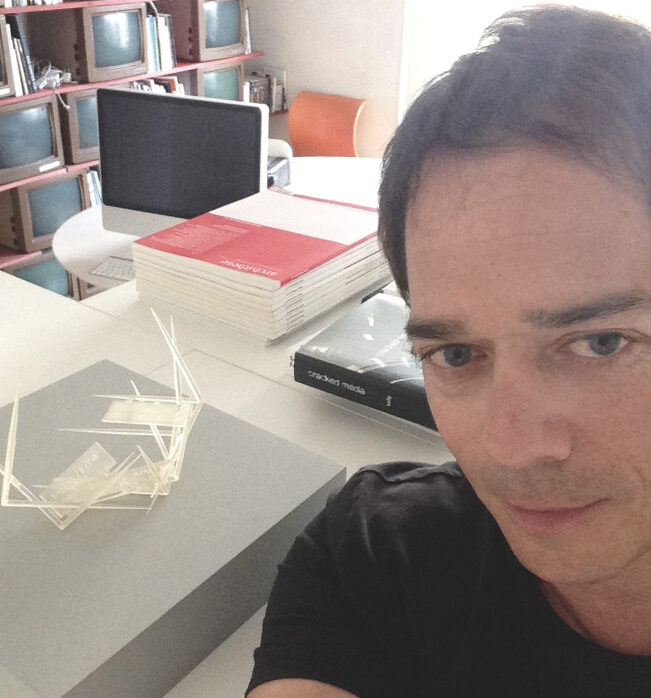
Patrick Keller is an architect and founding member of the collective fabric | ch, composed of architects, artists, and engineers, based in Lausanne, Switzerland.
In this context, he has contributed to the creation, development, and exhibition of numerous experimental works dealing with the intersection of architecture, networks, algorithms, and data, along with livable environments.
---
Aiiiii Art Center
Aiiiii Art Center (Est. 2021) is an artificial intelligence art institution based in Shanghai. The organization seeks to support, promote, as well as incubate both international and domestic artists and projects related to intelligent algorithms. Aiiiii Art Center is committed to becoming a pioneer of artificial intelligence through the discovery of exciting possibilities afforded by the intersections of creativity and technology.
Aiiiii Art Center aims to offer insight into the many challenges, practices, and creative modes of artificial intelligence-based art. Such aims will be achieved through academic conferences and published research efforts conducted either independently or in collaboration with domestic and international institutions and organizations. This organization will also actively promote and showcase the exploratory uses of artificial intelligence-based art in practice.
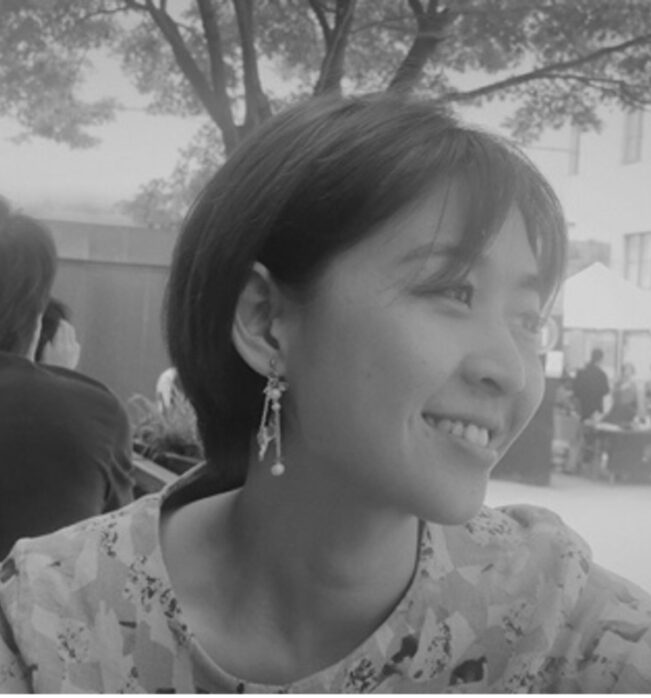
Xi Li, curator, director of Aiiiii Art Center. Graduated from Central Saint Martins MA in Narrative Environments and Central Academy of Fine Arts with a BA in Art Management.
Programs: Book of Sand: The Inaugural Exhibition of Aiiiii Art Center (2021); aai International Conference on AI Art (2021, 2022); Ritual of Signs and Metamorphosis (2018); Olafur Eliasson: The Unspeakable Openness of Things (2017);Captive of Love: Danwen Xing (2017); Over Time: The Poetic Image of the Urbanscape (2016).
---
ART X SCIENCE DIALOGUES
Art x Science Dialogues is a new webinar series initiated by Swissnex in China in 2020. The webinar series not only presents artistic projects where scientists and research engineers are deeply involved but also looks into new interdisciplinary initiatives and trends. Through the dialogues between artists and scientists, we try to stimulate the exchange of ideas between the two different worlds and explore opportunities for collaboration.
Wednesday, January 26. 2022
Platform of Future-Past (2022) at HOW Art Museum in Shanghai | #data #monitering #installation
Note:
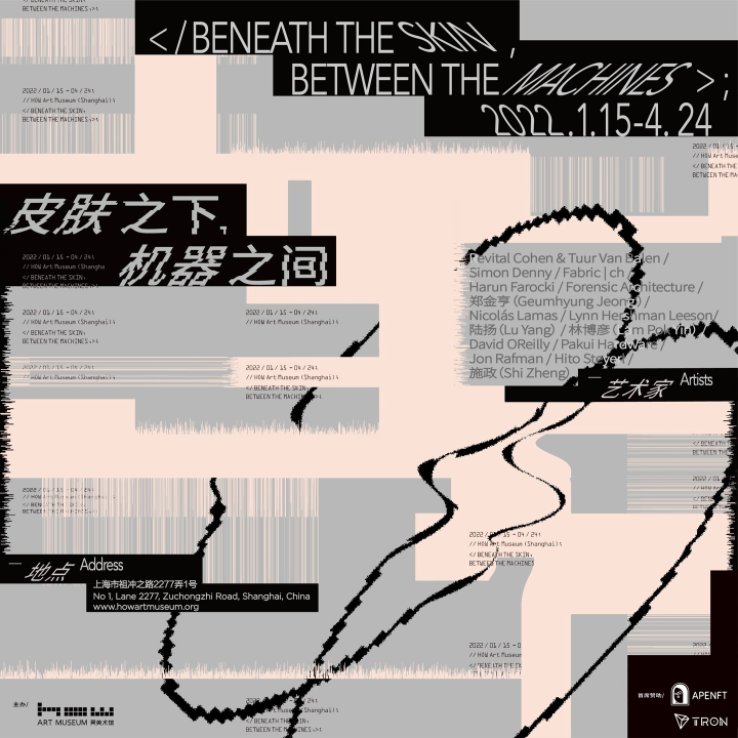
The exhibition Beneath the Skin, Between the Machines just opened at HOW Art Museum (Hao Art Gallery) and fabric | ch was keen to be invited to create a large installation for the show, also intented to be used during a symposium that will be entirely part of the exhibition (panels and talks as part of the installation therefore). The exhibition will be open between January 15 - April 24 2022 in Shanghai.
Along with a selection of chinese and international artists, curator Liaoliao Fu asked us to develop a proposal based on a former architectural device, Public Platform of Future-Past, which in itself was inspired by an older installation of ours... Heterochrony.
This new work, entitled Platform of Future-Past, deals with the temporal oddity that can be produced and induced by the recording, accumulation and storage of monitoring data, which contributes to leaving partial traces of "reality", functioning as spectres of the past.
We are proud to present this work along artists such as Hito Steyerl, Geumhyung Jeong, Lu Yang, Jon Rafman, Forensic Architecture, Lynn Hershman Leeson and Harun Farocki.
...
Last but not least and somehow a "sign of the times", this is the first exhibition in which we are participating and whose main financial backers are a blockchain and crypto-finance company, as well as a NFT platform. Both based in China.
More information about the symposium will be published.
Via Pro Helvetia
-----

-----
Curatorial Statement
By Fu Liaoliao and the curatorial team
"Man is only man at the surface. Remove the skin, dissect, and immediately you come to machinery.” When Paul Valéry wrote this down, he might not foresee that human beings – a biological organism – would indeed be incorporated into machinery at such a profound level in a highly informationized and computerized time and space. In a sense, it is just as what Marx predicted: a conscious connection of machine[1]. Today, machine is no longer confined to any material form; instead, it presents itself in the forms of data, coding and algorithm – virtually everything that is “operable”, “calculable” and “thinkable”. Ever since the idea of cyborg emerges, the man-machine relation has always been intertwined with our imagination, vision and fear of the past, present and future.
In a sense, machine represents a projection of human beings. We human beings transfer ideas of slavery and freedom to other beings, namely a machine that could replace human beings as technical entities or tools. Opposite (and similar, in a sense,) to the “embodiment” of machine, organic beings such as human beings are hurrying to move towards “disembodiment”. Everything pertinent to our body and behavior can be captured and calculated as data. In the meantime, the social system that human beings have created never stops absorbing new technologies. During the process of trial and error, the difference and fortuity accompanying the “new” are taken in and internalized by the system. “Every accident, every impulse, every error is productive (of the social system),”[2] and hence is predictable and calculable. Within such a system, differences tend to be obfuscated and erased, but meanwhile due to highly professional complexities embedded in different disciplines/fields, genuine interdisciplinary communication is becoming increasingly difficult, if not impossible.
As a result, technologies today are highly centralized, homogenized, sophisticated and commonized. They penetrate deeply into our skin, but beyond knowing, sensing and thinking. On the one hand, the exhibition probes into the reconfiguration of man by technologies through what’s “beneath the skin”; and on the other, encourages people to rethink the position and situation we’re in under this context through what’s “between the machines”. As an art institute located at Shanghai Zhangjiang Hi-Tech Industrial Development Zone, one of the most important hi-tech parks in China, HOW Art Museum intends to carve out an open rather than enclosed field through the exhibition, inviting the public to immerse themselves and ponder upon the questions such as “How people touch machines?”, “What the machines think of us?” and “Where to position art and its practice in the face of the overwhelming presence of technology and the intricate technological reality?”
Departing from these issues, the exhibition presents a selection of recent works of Revital Cohen & Tuur Van Balen, Simon Denny, Harun Farocki, Nicolás Lamas, Lynn Hershman Leeson, Lu Yang, Lam Pok Yin, David OReilly, Pakui Hardware, Jon Rafman, Hito Steyerl, Shi Zheng and Geumhyung Jeong. In the meantime, it intends to set up a “panel installation”, specially created by fabric | ch for this exhibition, trying to offer a space and occasion for decentralized observation and participation in the above discussions. Conversations and actions are to be activated as well as captured, observed and archived at the same time.
[1] Karl Marx, “Fragment on Machines”, Foundations of a Critique of Political Economy
[2] Niklas Luhmann, Social Systems
-----
Schedule
Duration: January 15-April 24, 2022
Artists: Revital Cohen & Tuur Van Balen, Simon Denny, fabric | ch, Harun Farocki, Geumhyung Jeong, Nicolás Lamas, Lynn Hershman Leeson, Lu Yang, Lam Pok Yin, David OReilly, Pakui Hardware, Jon Rafman, Hito Steyerl, Shi Zheng
Curator: Fu Liaoliao
Organizer: HOW Art Museum, Shanghai
Lead Sponsor: APENFT Foundation
Swiss participation is supported by Pro Helvetia Shanghai, Swiss Arts Council.
(Swiss speakers and performers appearing in the educational events will be updated soon.)
-----
Work by fabric | ch
HOW Art Museum has invited Lausanne-based artist group fabric | ch to set up a “panel installation” based on their former project “Public Platform of Future Past” and adapted to the museum space, fostering insightful communication among practitioners from different fields and the audiences.
“Platform of Future-Past” is a temporary environmental device that consists in a twenty meters long walkway, or rather an observation deck, almost archaeological: a platform that overlooks an exhibition space and that, paradoxically, directly links its entrance to its exit. It thus offers the possibility of crossing this space without really entering it and of becoming its observer, as from archaeological observation decks. The platform opens- up contrasting atmospheres and offers affordances or potential uses on the ground.
The peculiarity of the work consists thus in the fact that it generates a dual perception and a potential temporal disruption, which leads to the title of the work, Platform of Future-Past: if the present time of the exhibition space and its visitors is, in fact, the “archeology” to be observed from the platform, and hence a potential “past,” then the present time of the walkway could be understood as a possible “future” viewed from the ground…
“Platform of Future-Past” is equipped in three zones with environmental monitoring devices. The sensors record as much data as possible over time, generated by the continuously changing conditions, presences and uses in the exhibition space. The data is then stored on Platform Future-Past’s servers and replayed in a loop on its computers. It is a “recorded moment”, “frozen” on the data servers, that could potentially replay itself forever or is waiting for someone to reactivate it. A “data center” on the deck, with its set of interfaces and visualizations screens, lets the visitors-observers follow the ongoing process of recording.
The work could be seen as an architectural proposal built on the idea of massive data production from our environment. Every second, our world produces massive amounts of data, stored “forever” in remote data centers, like old gas bubbles trapped in millennial ice.
As such, the project is attempting to introduce doubt about its true nature: would it be possible, in fact, that what is observed from the platform is already a present recorded from the past? A phantom situation? A present regenerated from the data recorded during a scientific experiment that was left abandoned? Or perhaps replayed by the machine itself ? Could it already, in fact, be running on a loop for years?
Platform of Future-Past, Scaffolding, projection screens, sensors, data storage, data flows, plywood panels, textile partitions
-----
Platform of Future-Past (2022)


-----
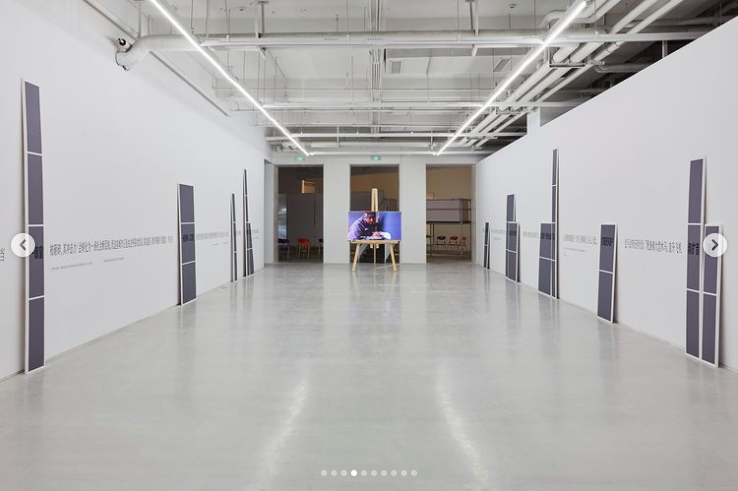
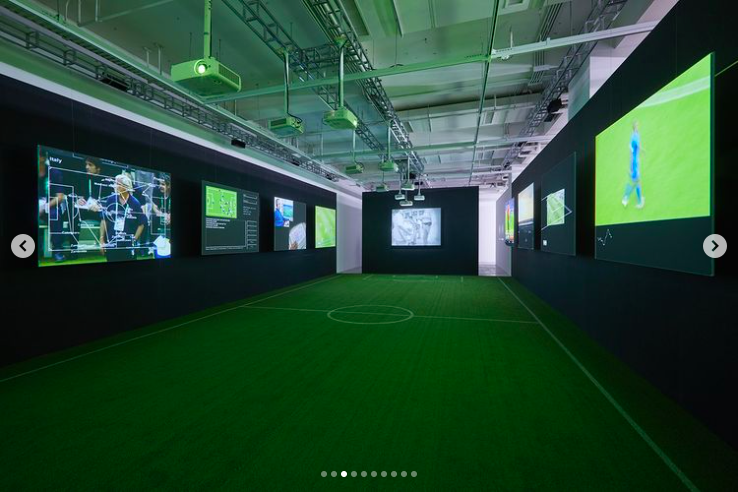
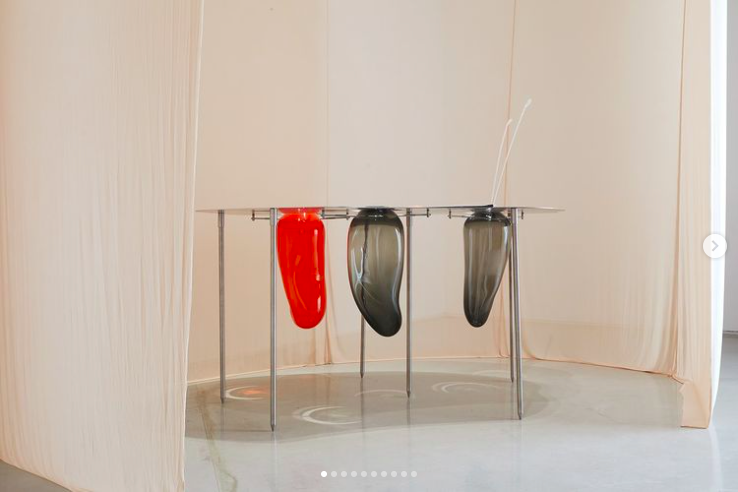
Beneath the Skin, Between the Machines (exhibition, 01.22 - 04.22)
-----
Platform of Future-Past was realized with the support of Pro Helvetia.
Friday, December 03. 2021
Atomized (*) Functioning by fabric | ch, digital Paik exhibition with Nam June Paik Art Center and ECAL | #paik #augmented #automated #exhibition
Note: We had the chance at fabric | ch to initiate a new research / project last Spring, in collaboration with the Nam June Paik Art Center (warning: long loading time!) in South Korea and ECAL / University of Art and Design Lausanne (HES-SO).
In this context, we're having the opportunity to work with some of the amazing material of the museum's collection and archive. It contains some of Paik's major works (single & multi-channel video in particular), that have been difficult to see since the passing of the artist, and most of its archives.
The museum indeed has the largest collection Paik's video, as well as some important installations and a large primary and secondary material about the production of the artworks themselves. The research undertaken is looking to give access to this material in new ways and forms, out of the physical museum and through digital means. For this task, we're planning to further dig into the archives and look at works that were realized, or not, during the Fluxus period ("Symphony for 20 Rooms", "Exhibition of Music, Electronic Television").
The aim of this research is to work on automated curating and digital display (likely AR) of exhibitions at anybody's place (home, appartment, office, warehouse, "garage", etc.), resonating with the concept of "Viewing Rooms" and therefore the title of this first phase of the research: (Re-)Viewing Paik. We are seeking forms of personal exhibitions, for specific spatial configurations and in which the artworks organize their presence themselves, according to an objective understanding of the space.
To achieve these research objectives, we'll work with fabric | ch's software and ongoing project that allows us to automate the creation of environments, based on sensors inputs: Atomized (*) Functioning (pdf), which is based on customizable/scriptable algorithmic and AI procedures. In the specific case of (Re-)Viewing Paik, it is used for curation and exhibition design purposes, therefore Atomized (curatorial) Functioning (pdf). Like we already did for this exhibition at HeK, in 2019.
-----
By fabric | ch
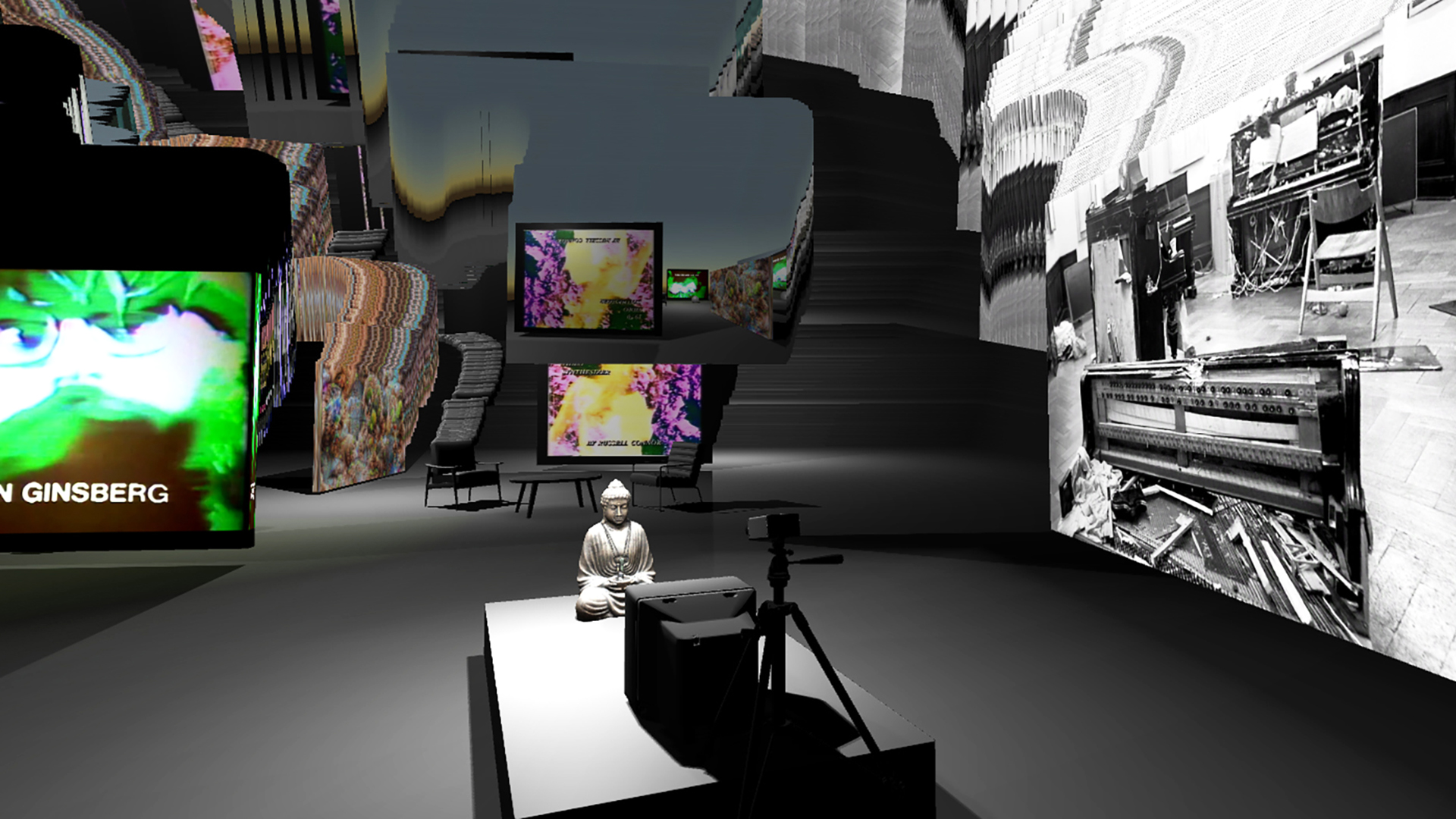
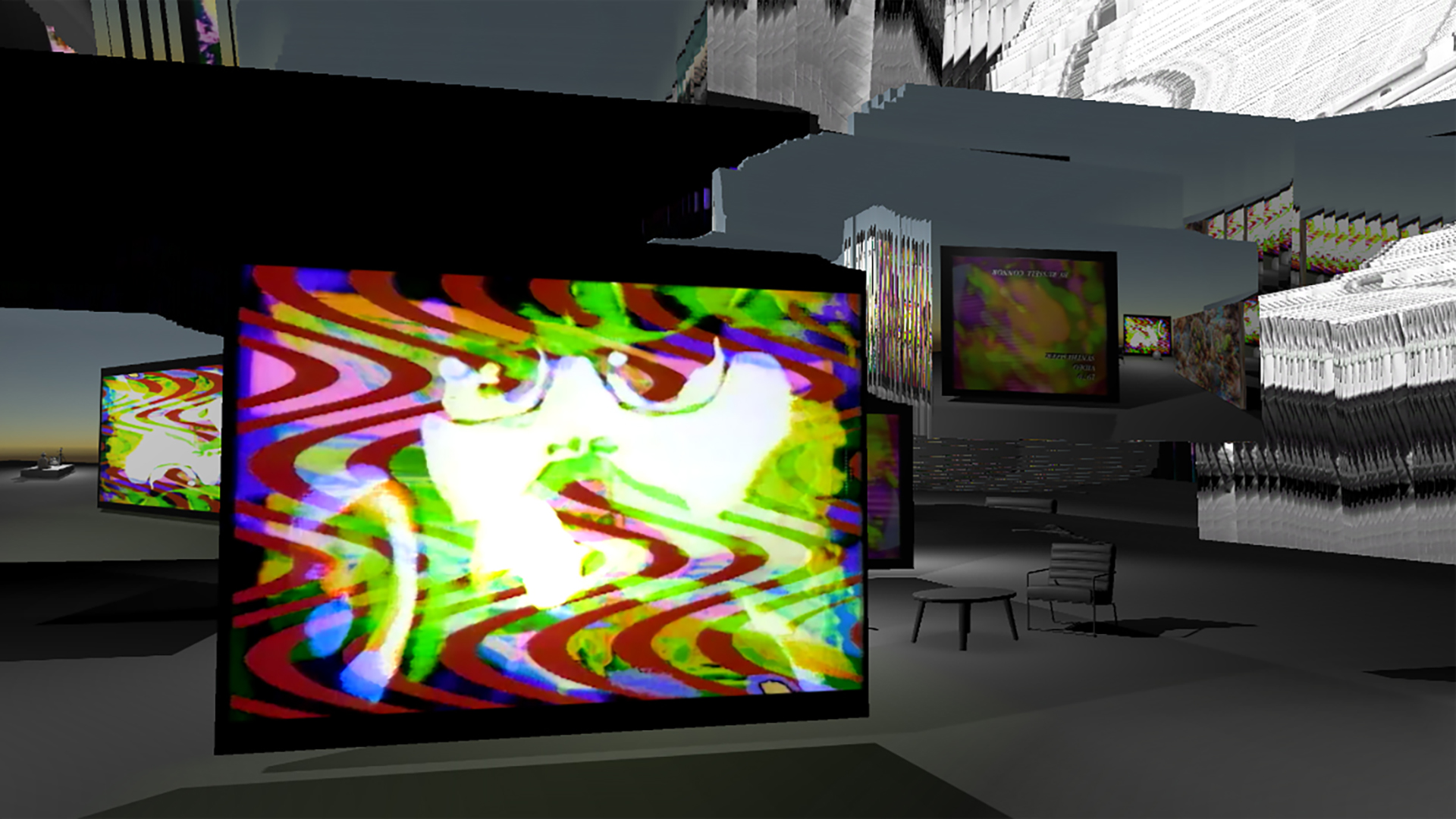
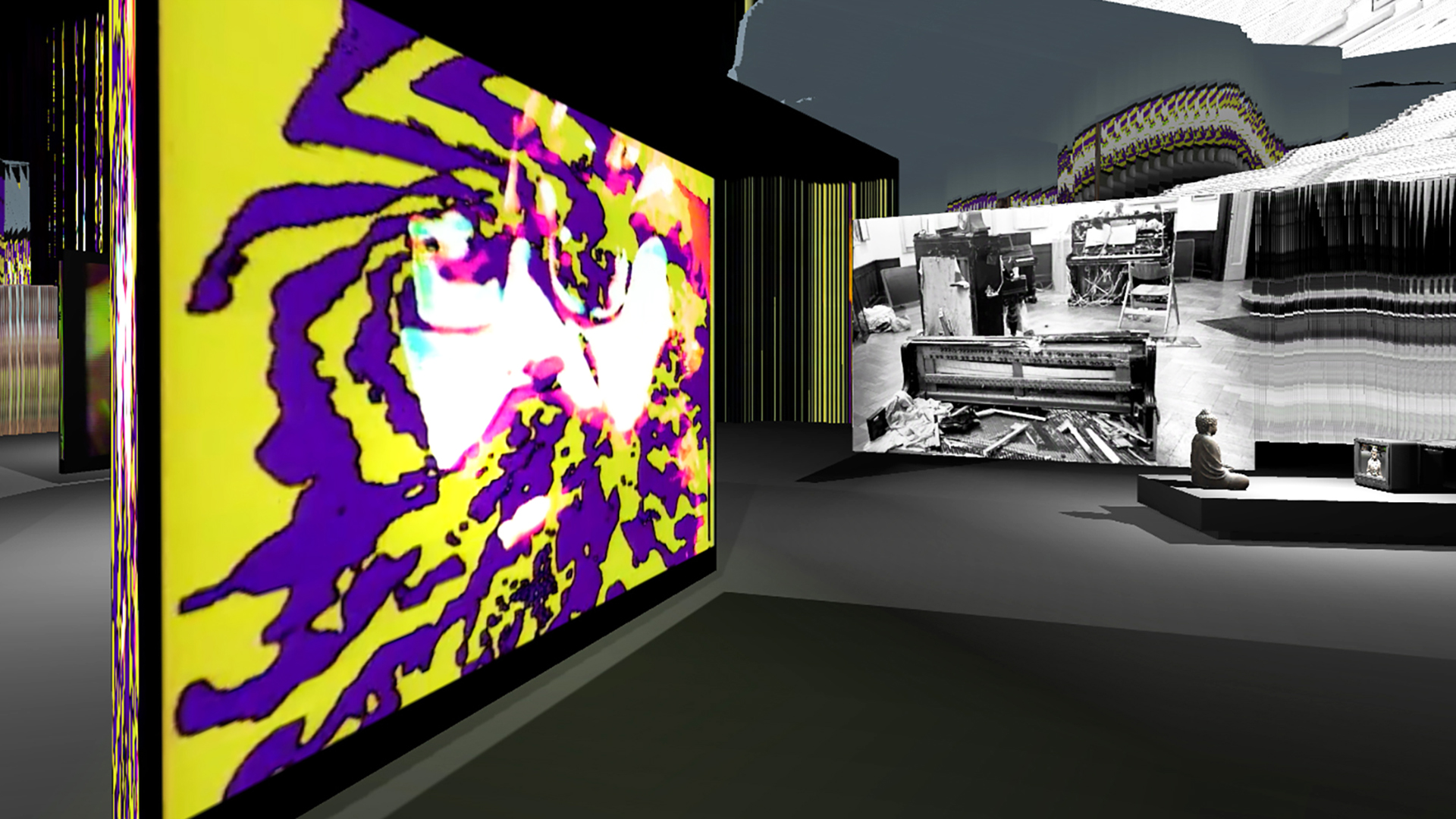
Below are early tests with a digital transposition/reconstruction of TV Buddha (literally), the zen media buddha in between a glitched and mirrored digital environment containing other artworks (video and photographies of the famous 1963 exhibition: Exposition of Music - Electronic Television).
This early phase of the work will see us work with the pieces selected by Nam June Paik Art Center curator and archivst Sans Ae Park. These pieces were selected mainly to test different artwork types and durations into their new display setup.
...

Tuesday, October 05. 2021
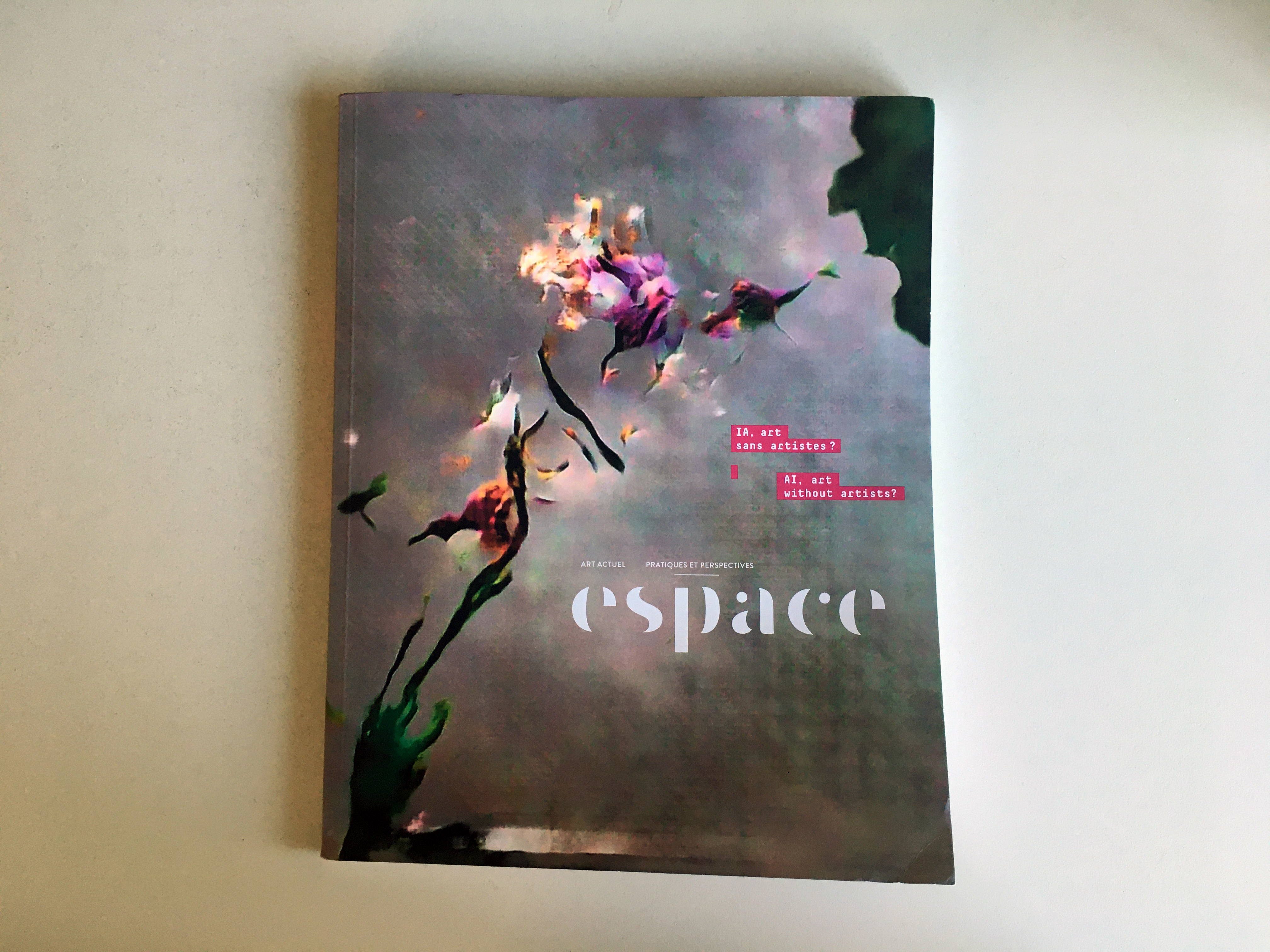
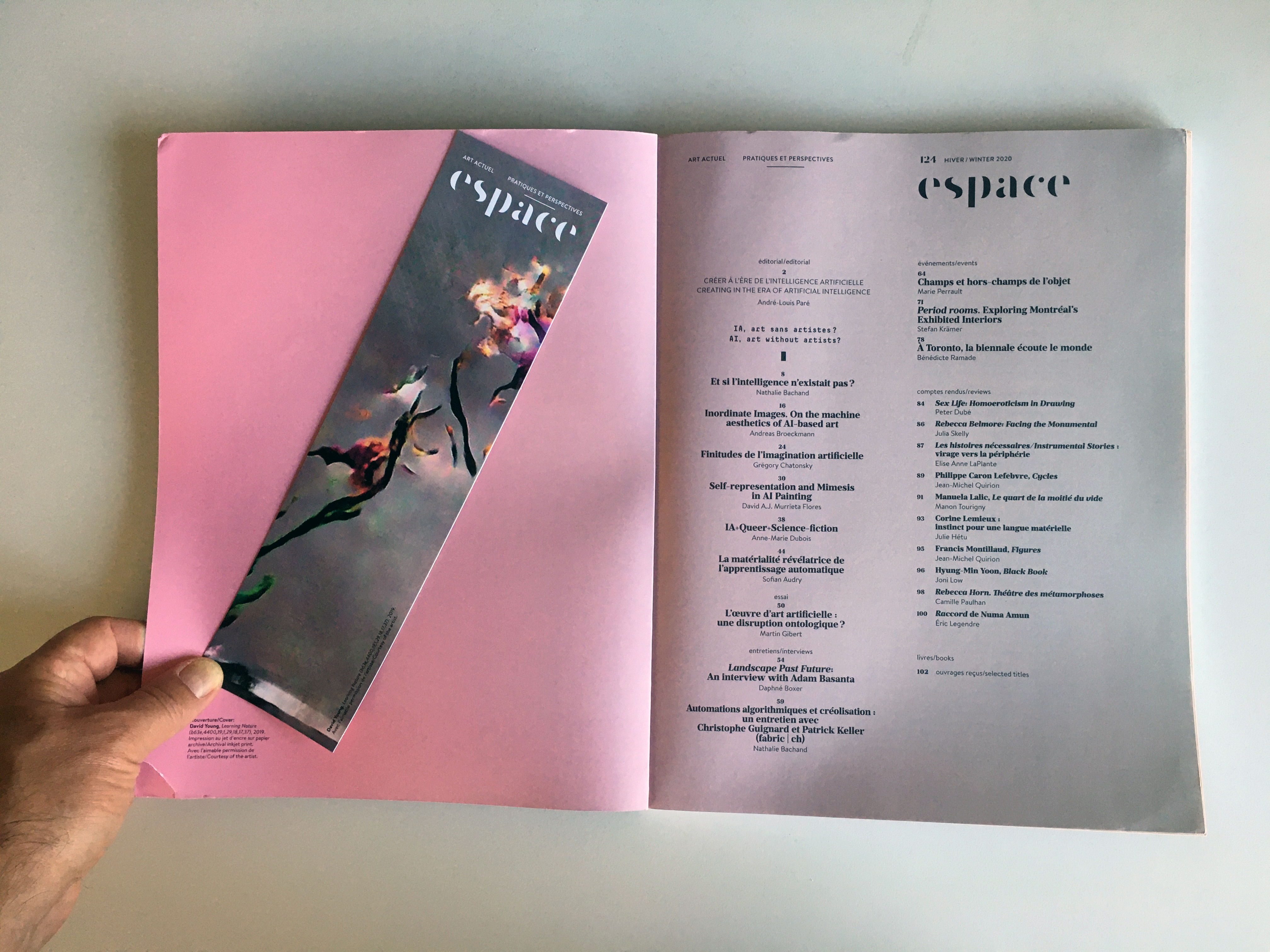
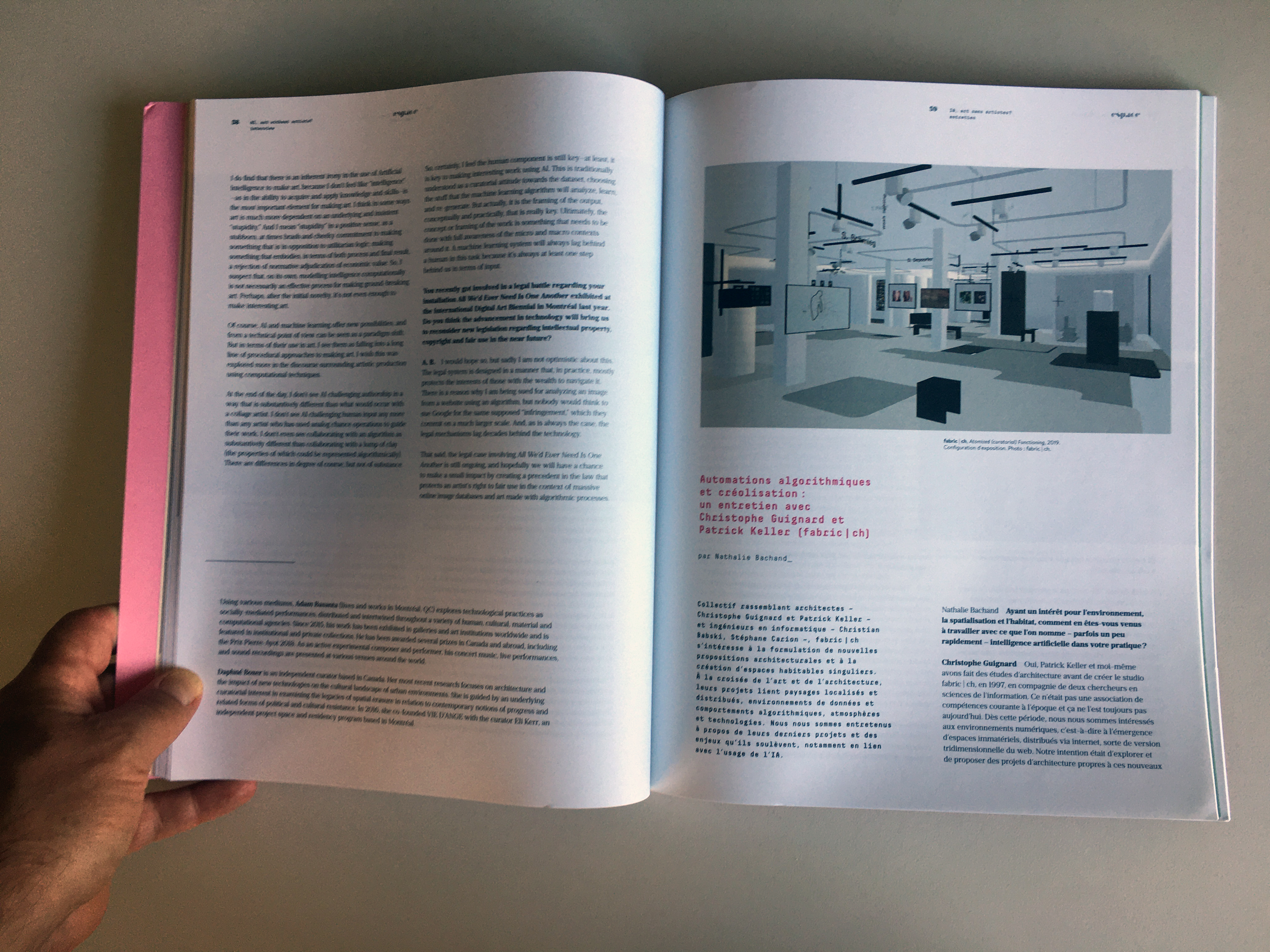
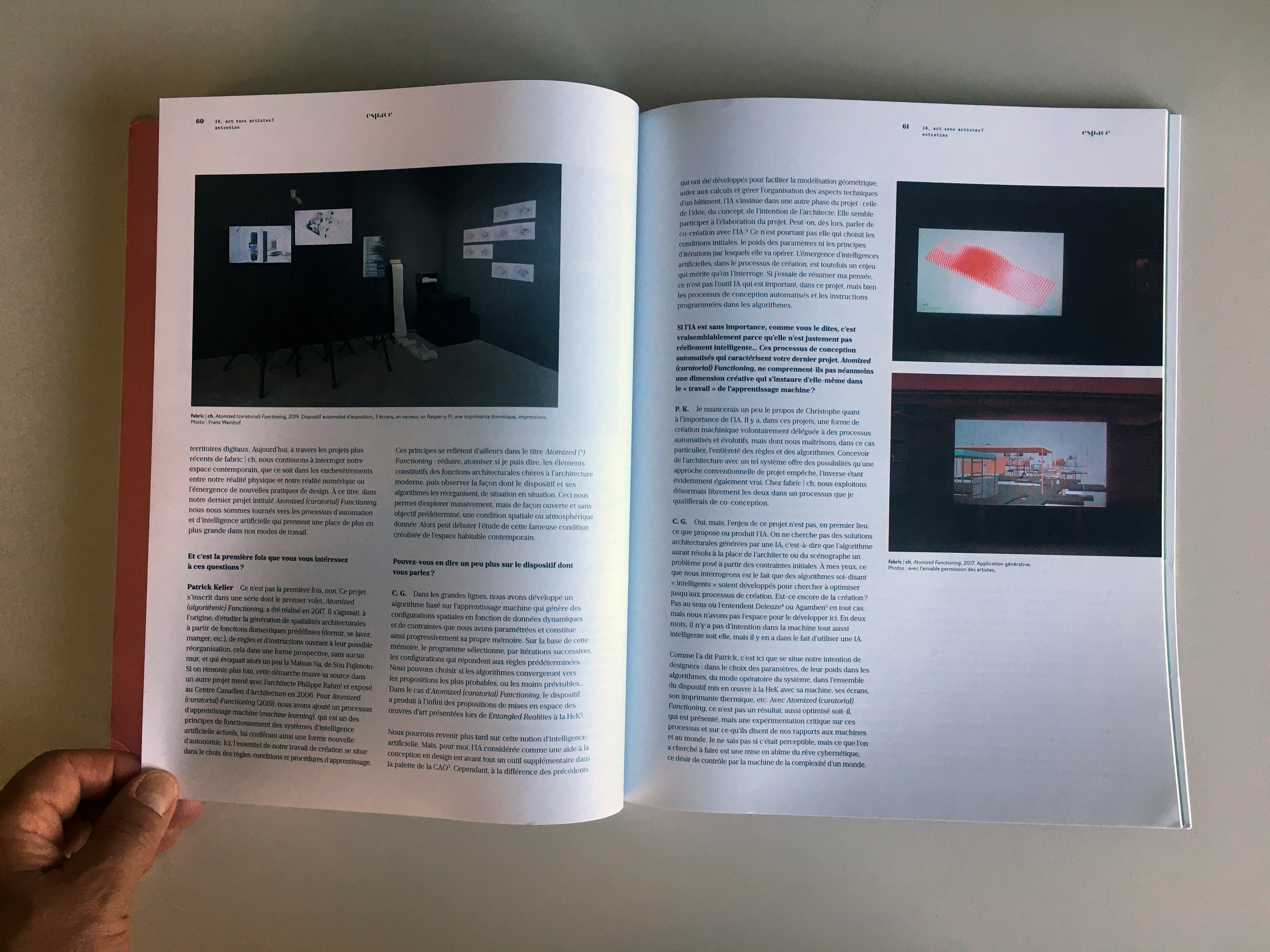
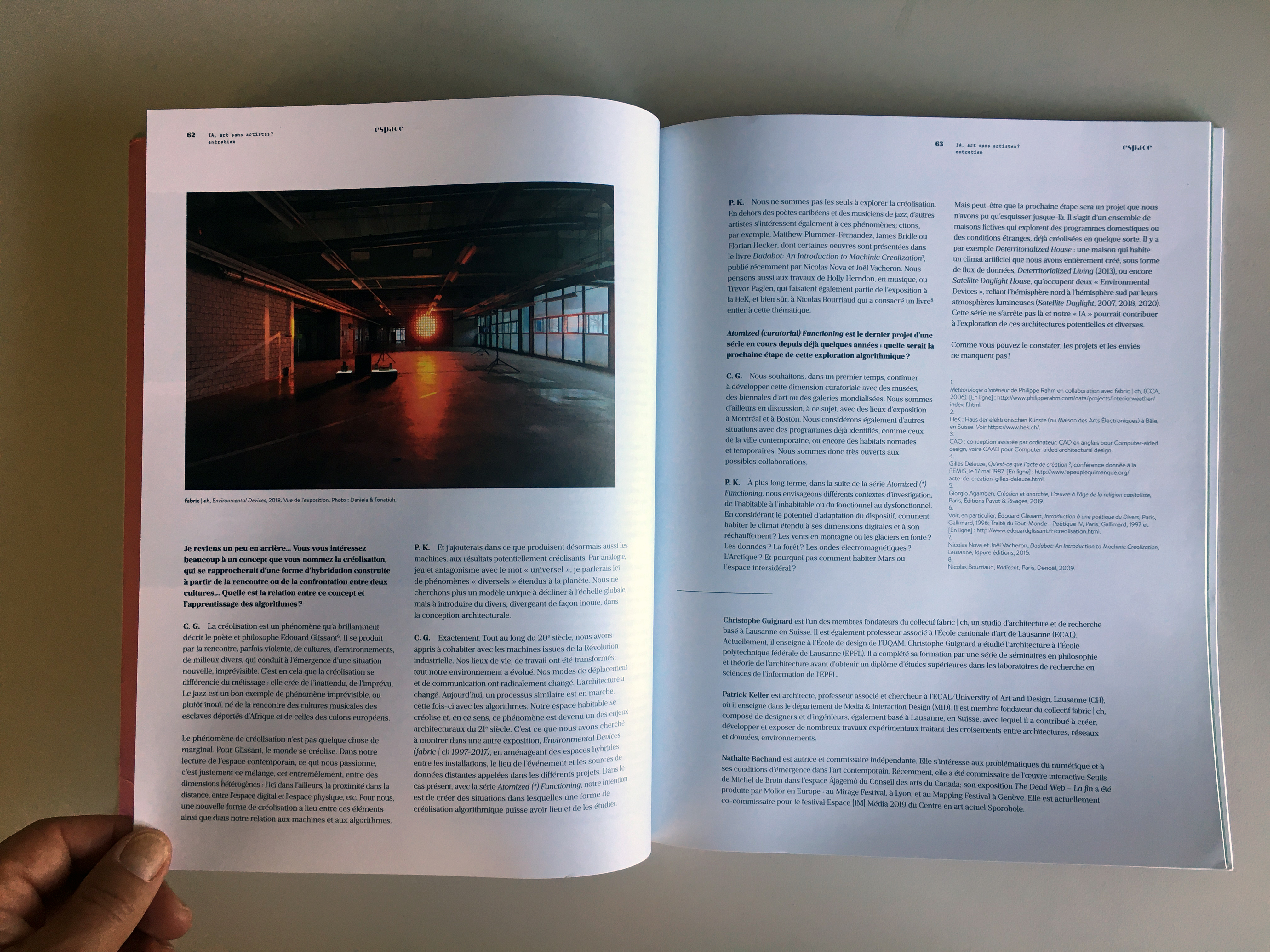
"Automation algorithmiques et créolisations", revue Espace (Montréal, 2020) | #publications #AI #algorithms #automated
Note: an interview about the implications of AI in art and the work of fabric | ch in particular, between Nathalie Bachand (writer & independant curator), Christophe Guignard and myself (both fabric | ch). The exchange happened in the context of a publication in the art magazine Espace, it was fruitful and we had the opportunity to develop on recent projects, like the "Atomized" serie of architectural works that will continue to evolve, as well as our monographic exhibition at Kunshalle Éphémère, entitled Environmental Devices (1997 - 2017).
-----
By fabric | ch
Tuesday, September 21. 2021
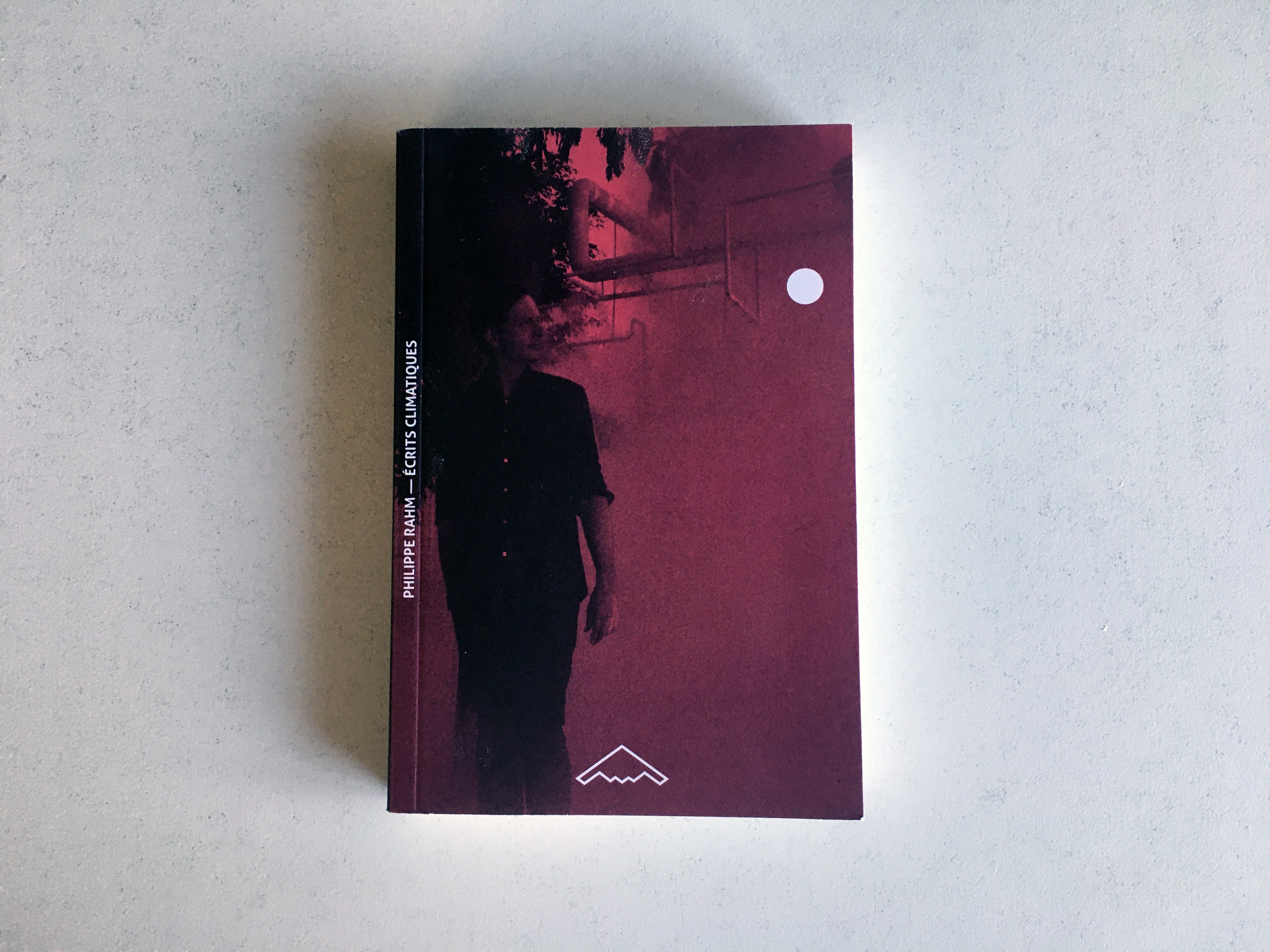
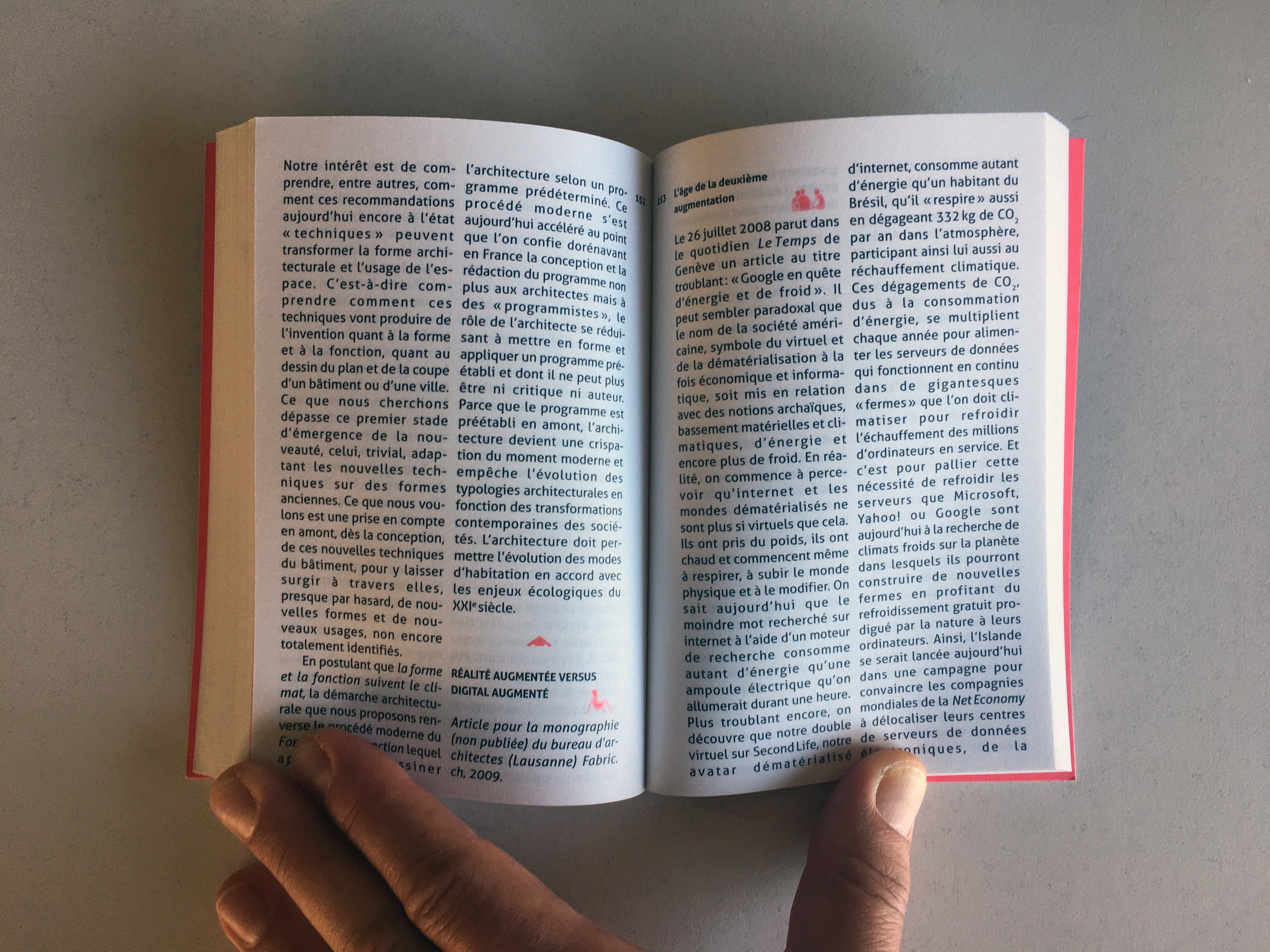
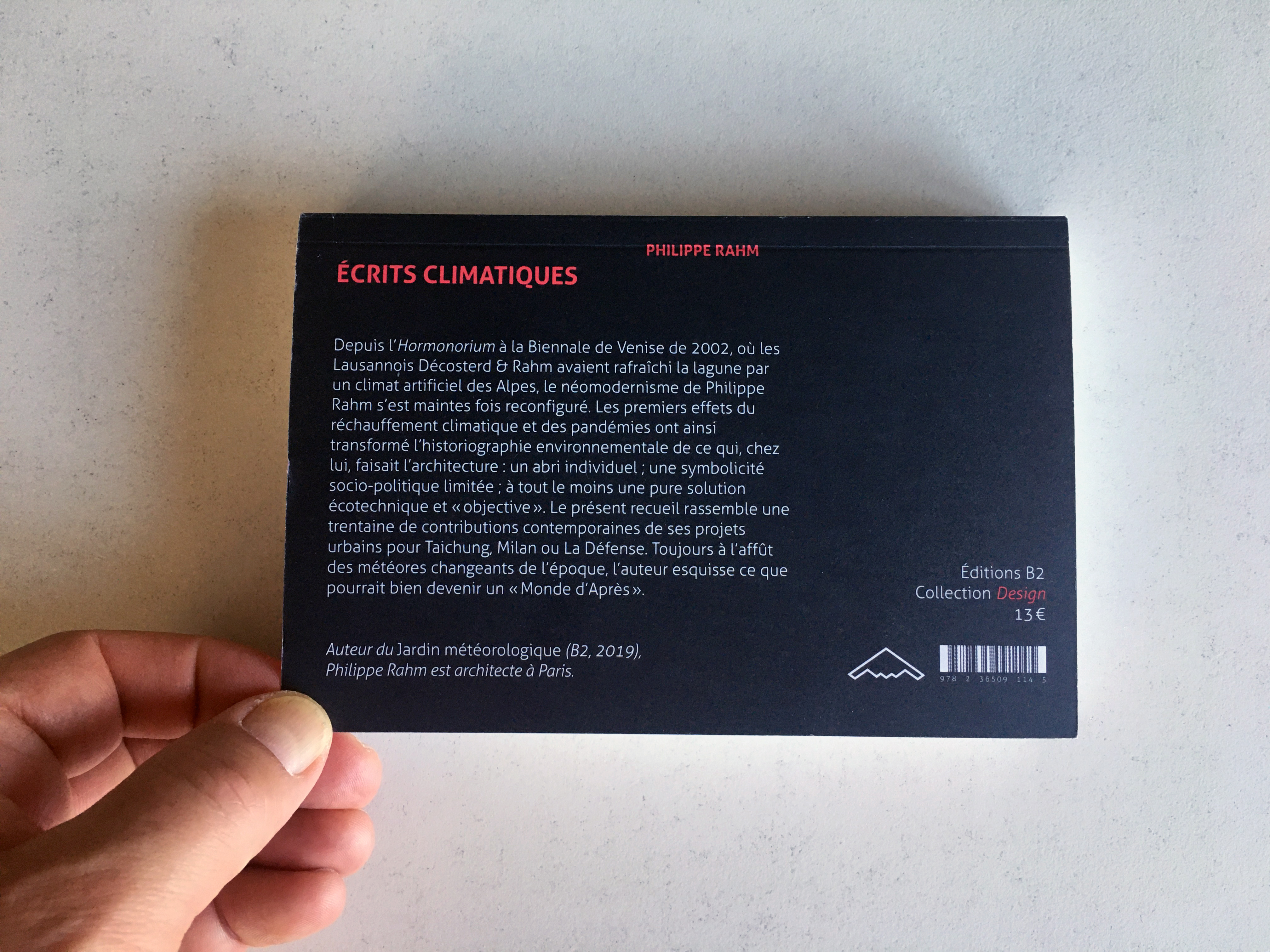
"Essais climatiques" by P. Rahm, Ed. B2 (Paris, 2020) | #2ndaugmentation #essay #AR #VR
Note: it is with great pleasure and interest that I read recently one of Philippe Rahm's last publication, "Essais climatiques" (published in French, by Editions B2), which consists in fact in a collection of articles published in the past 10+ years in various magazines, journals and exhibition catalogs. It is certainly less developed than the even more recent book, "L'histoire naturelle de l'architecture" (ed. Pavillon de l'Arsenal, 2020), but nonetheless an excellent and brief introduction to his thinking and work.
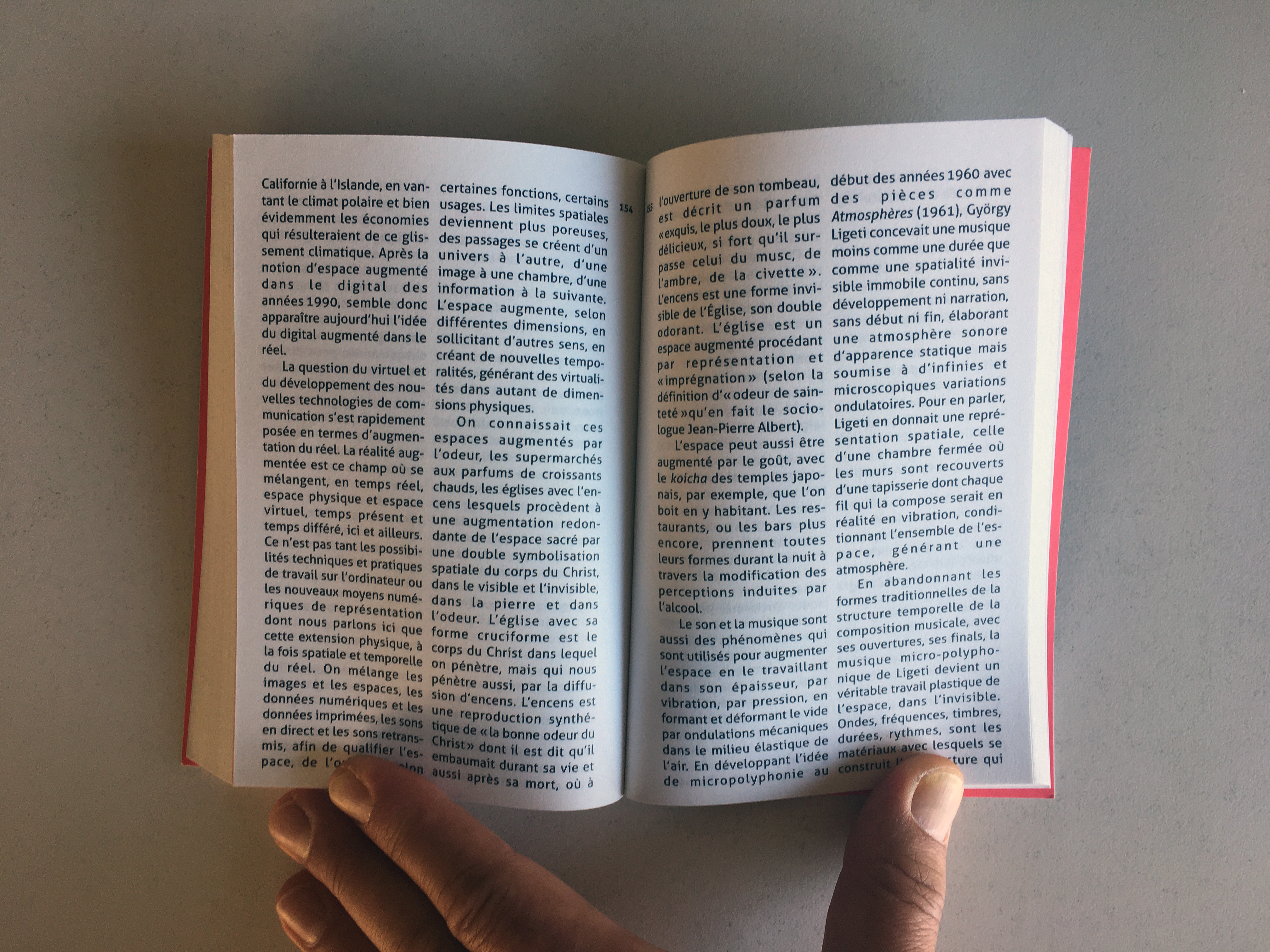
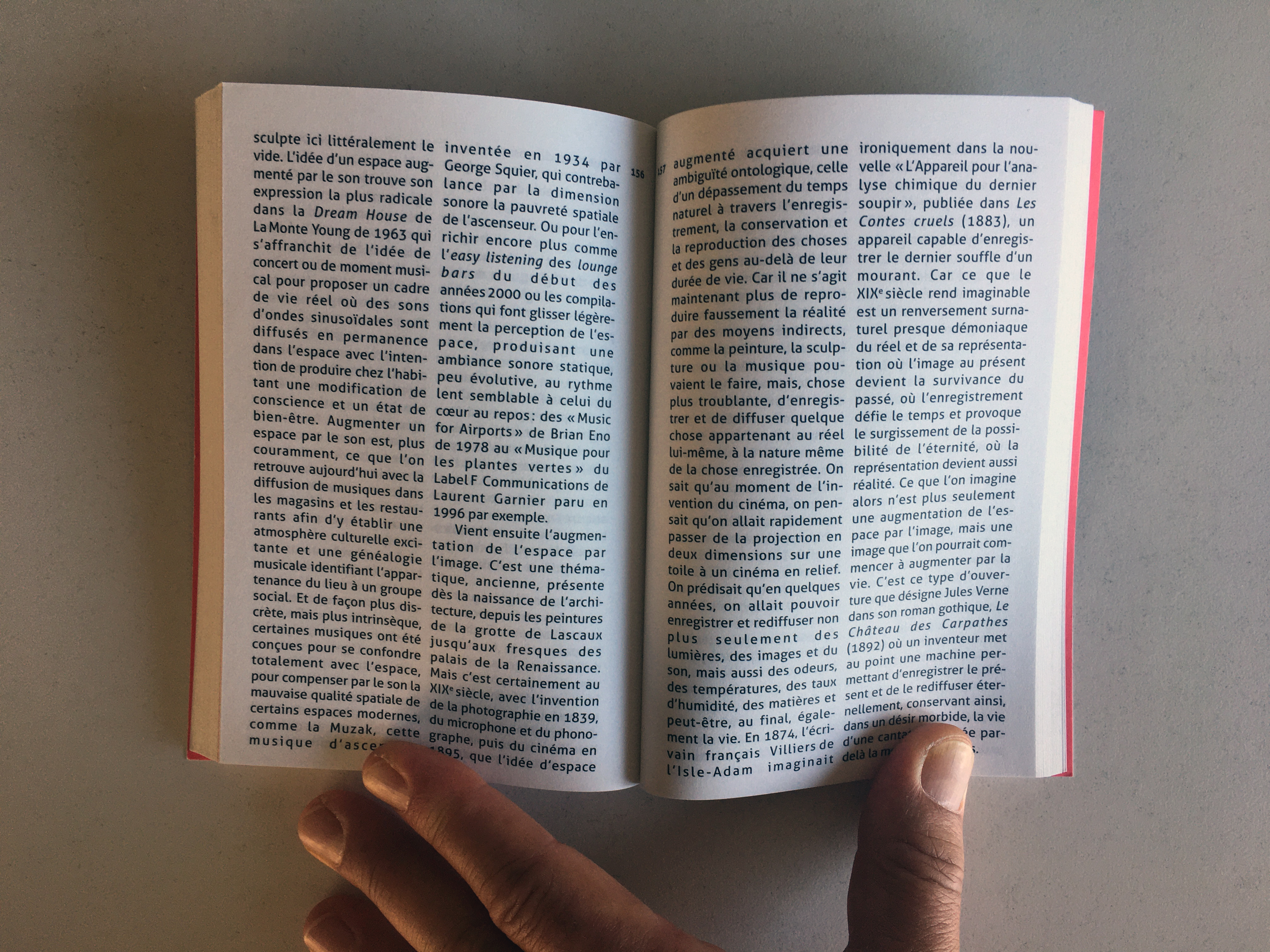
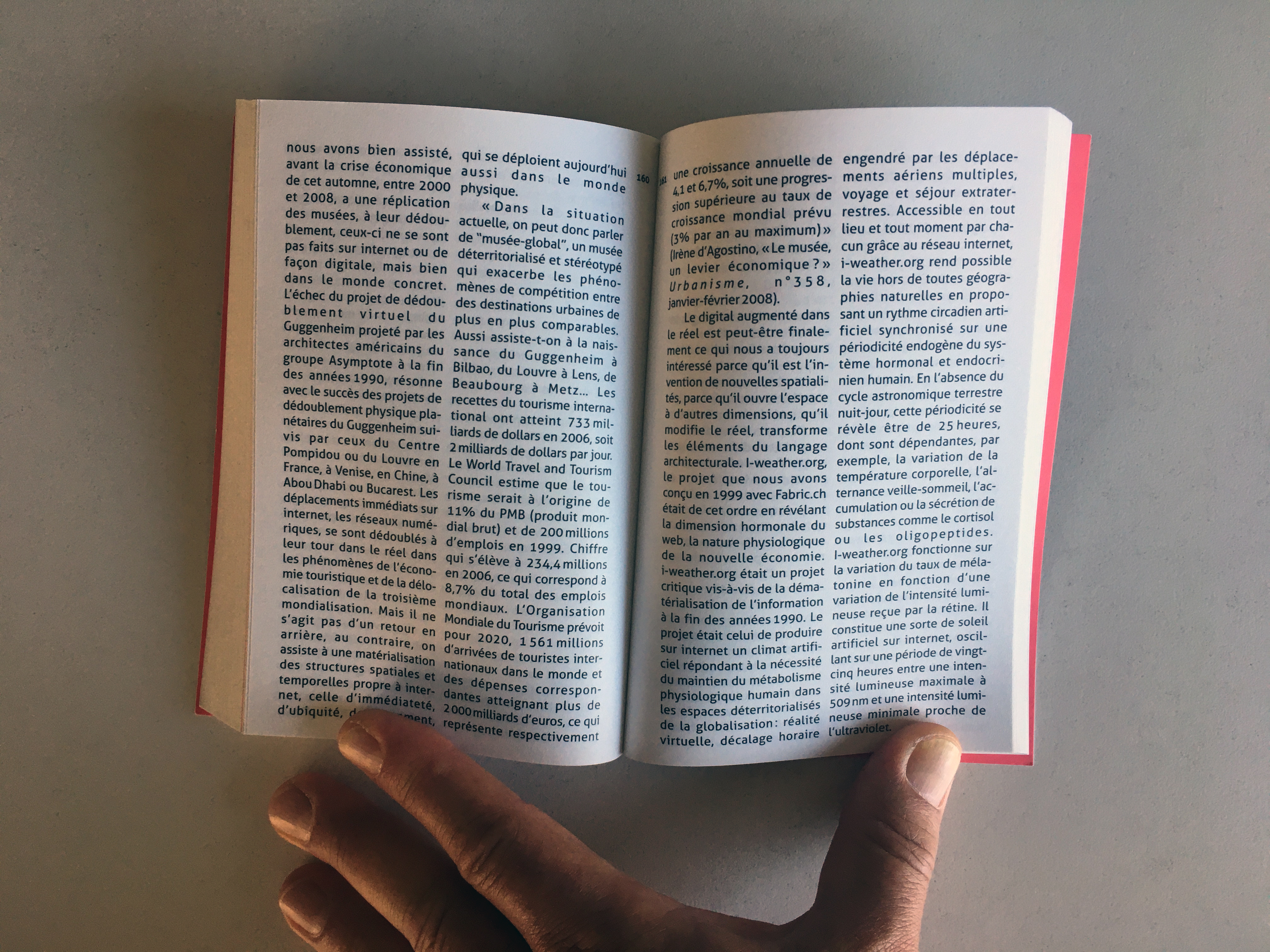
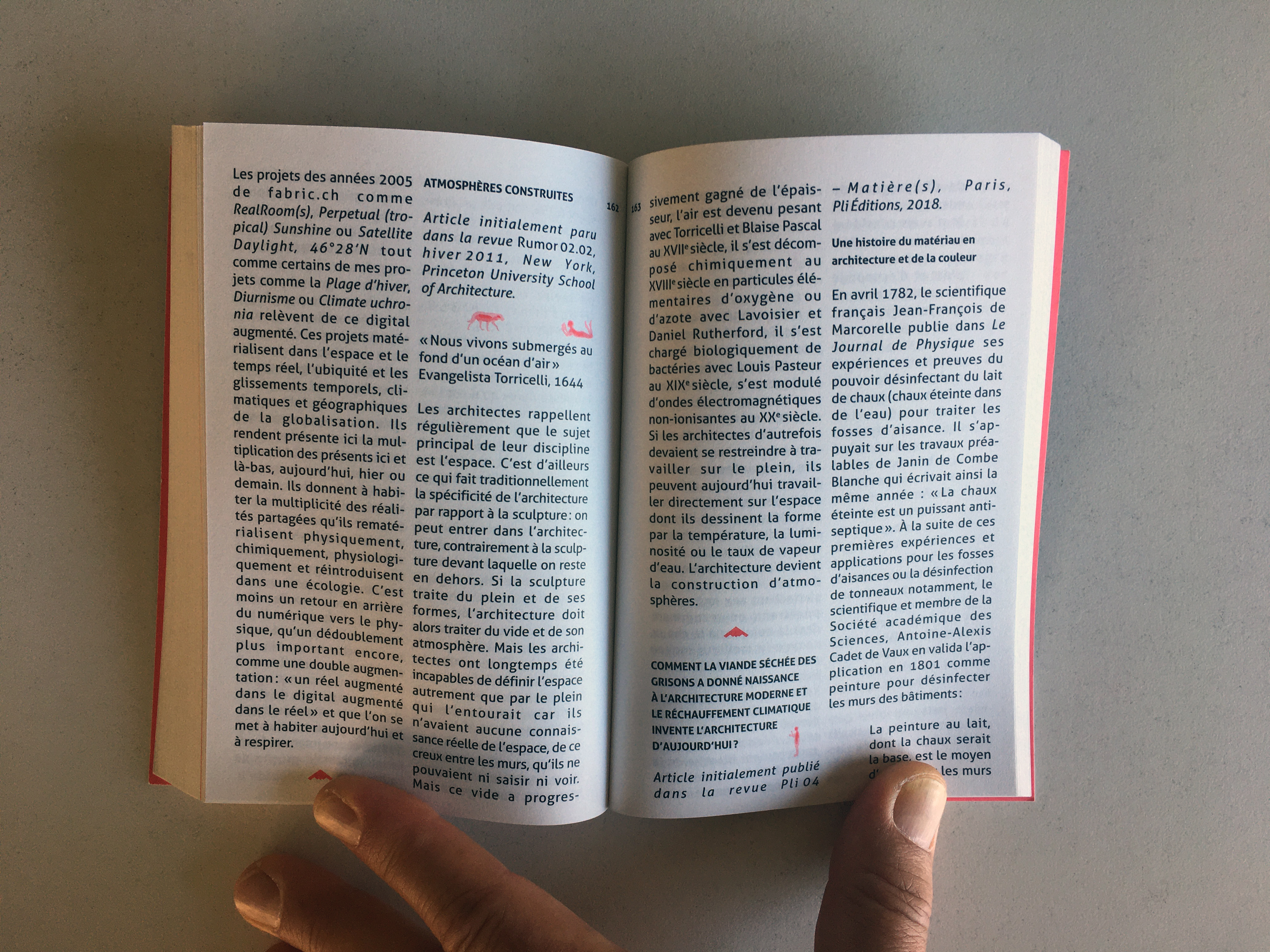
Philippe Rahm's call for the "return" of an "objective architecture", climatic and free of narrative issues, is of great interest. Especially at a time when we need to reduce our CO2 emissions and will need to reach energy objectives of slenderness. The historical reading of the postmodern era (in architecture), in relation to oil, vaccines and antibiotics is also really valuable in this context, when we are all looking to move forward this time in cultural history.
I also had the good surprise, and joy, to see the text "L'âge de la deuxième augmentation" finally published! It was written by Philippe back in 2009 probably, about the works of fabric | ch at the time, when we were preparing a publication that finally never came out... Though this text will also be part of a monographic publication that is expected to be finalized and self-published in 2022.
Via fabric | ch
-----

fabric | rblg
This blog is the survey website of fabric | ch - studio for architecture, interaction and research.
We curate and reblog articles, researches, writings, exhibitions and projects that we notice and find interesting during our everyday practice and readings.
Most articles concern the intertwined fields of architecture, territory, art, interaction design, thinking and science. From time to time, we also publish documentation about our own work and research, immersed among these related resources and inspirations.
This website is used by fabric | ch as archive, references and resources. It is shared with all those interested in the same topics as we are, in the hope that they will also find valuable references and content in it.
Quicksearch
Categories
Calendar

|
April '24 | |||||
| Mon | Tue | Wed | Thu | Fri | Sat | Sun |
| 1 | 2 | 3 | 4 | 5 | 6 | 7 |
| 8 | 9 | 10 | 11 | 12 | 13 | 14 |
| 15 | 16 | 17 | 18 | 19 | 20 | 21 |
| 22 | 23 | 24 | 25 | 26 | 27 | 28 |
| 29 | 30 | |||||
