Tuesday, December 08. 2009
Put on Your Google Goggles and Visually Search the World
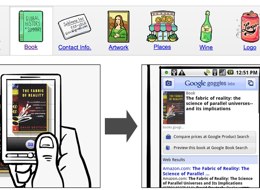 Google’s breaking news left and right today. Of course the big news is that real-time search is live, but the release of Google Goggles can’t be overlooked. The brand-new addition to Google Labs is an experimental application for Android devices that supports visual search.
How does it work? Just open the app, snap a photo and voilà: Google will process the image and return search results. The photo search functionality eliminates the need to type or say anything on your mobile device, and it adds context to your real-world surroundings.
While the technology is pretty remarkable, Google admits that it is still in its infancy. So while some image searches work brilliantly — think photos of books, business cards, artwork, places, logos and landmarks — don’t be too disappointed if your image searches for food, animals, plants and cars are less than stellar.
Still, the application should prove useful, and we hope to see versions of it made available for other smartphone users as well. For now, though, iPhone users can turn to a number of different augmented reality applications for camera-enabled search functionality.
Watch the video below for a demonstration of Google Goggles.
-----
Via Mashable
Related Links:
Personal comment:
More about Google today: yet another example of Google starting to mix real and virtual worlds and mediatization to space a bit further. What they call Google Goggles.
Related Links:
fabric | rblg
This blog is the survey website of fabric | ch - studio for architecture, interaction and research.
We curate and reblog articles, researches, writings, exhibitions and projects that we notice and find interesting during our everyday practice and readings.
Most articles concern the intertwined fields of architecture, territory, art, interaction design, thinking and science. From time to time, we also publish documentation about our own work and research, immersed among these related resources and inspirations.
This website is used by fabric | ch as archive, references and resources. It is shared with all those interested in the same topics as we are, in the hope that they will also find valuable references and content in it.
Quicksearch
Categories
Calendar

|
April '24 | |||||
| Mon | Tue | Wed | Thu | Fri | Sat | Sun |
| 1 | 2 | 3 | 4 | 5 | 6 | 7 |
| 8 | 9 | 10 | 11 | 12 | 13 | 14 |
| 15 | 16 | 17 | 18 | 19 | 20 | 21 |
| 22 | 23 | 24 | 25 | 26 | 27 | 28 |
| 29 | 30 | |||||
